

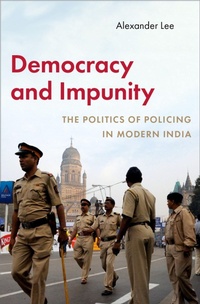
Democracy and Impunity
The Politics of Policing in Modern India
Published on 24. June 2025
Book
Paperback/Softback
200 pages
978-0-19-779962-8 (ISBN)
Description
India faces a crisis of criminal impunity. Crimes against the poor and marginalized go unprosecuted, while crimes committed by the rich and influential are ignored in return for bribes or favors. Those who have enough money to pay the police, or enough power to influence them, can quite literally get away with murder.
In Democracy and Impunity, Alexander Lee examines the politics of law enforcement in India and why the police perform so poorly across multiple dimensions--a level of performance that is exceptional even for similar developing democracies. Lee shows that high levels of impunity in India are the result of two interdependent policy choices--the Indian police are severely under-resourced and have very low autonomy in relation to senior members of the political elite.
While Lee focuses on India, his account sheds light on how nations can find themselves in the "policy trap" of low police resources and low police autonomy, and why they find it so hard to get out of this equilibrium. He also explains why some politicians find it in their interests to have a weak and tightly controlled police force, why many police officers work with these politicians, and discusses specific reforms that could alleviate the impunity crisis.
In Democracy and Impunity, Alexander Lee examines the politics of law enforcement in India and why the police perform so poorly across multiple dimensions--a level of performance that is exceptional even for similar developing democracies. Lee shows that high levels of impunity in India are the result of two interdependent policy choices--the Indian police are severely under-resourced and have very low autonomy in relation to senior members of the political elite.
While Lee focuses on India, his account sheds light on how nations can find themselves in the "policy trap" of low police resources and low police autonomy, and why they find it so hard to get out of this equilibrium. He also explains why some politicians find it in their interests to have a weak and tightly controlled police force, why many police officers work with these politicians, and discusses specific reforms that could alleviate the impunity crisis.
More details
Series
Language
English
Place of publication
New York
United States
Target group
Professional and scholarly
Product notice
Paperback (trade)
Unsewn / adhesive bound
Dimensions
Height: 234 mm
Width: 150 mm
Thickness: 15 mm
Weight
295 gr
ISBN-13
978-0-19-779962-8 (9780197799628)
Copyright in bibliographic data and cover images is held by Nielsen Book Services Limited or by the publishers or by their respective licensors: all rights reserved.
Schweitzer Classification
Other editions
Additional editions
Book
05/2025
Oxford University Press Inc
€79.23
Shipment within 15-20 days
E-Book
04/2025
OUP eBook
€22.99
Available for download
E-Book
04/2025
OUP eBook
€22.99
Available for download
Person
Alexander Lee is an Associate Professor of Political Science at the University of Rochester. His research focuses on the politics of South Asia, the process of economic and political development, and the role of historical forces and events in shaping modern politics. He is the author or co-author of four books, including From Hierarchy to Ethnicity and The Cartel System of States.
Content
1. Introduction
2. Institutional Background
3. The Police's Constraints: Low Resources, Low Autonomy
4. The Politics of Impunity
5. The Political Origins of Low Autonomy and Low Resources
6. The Political Origins of High Resources and Low Autonomy
7. Is the Indian Police Reformable?
2. Institutional Background
3. The Police's Constraints: Low Resources, Low Autonomy
4. The Politics of Impunity
5. The Political Origins of Low Autonomy and Low Resources
6. The Political Origins of High Resources and Low Autonomy
7. Is the Indian Police Reformable?