

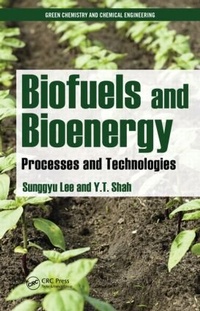
Biofuels and Bioenergy
Processes and Technologies
1st Edition
Published on 30. August 2012
Book
Hardback
341 pages
978-1-4200-8955-4 (ISBN)
Description
The newest addition to the Green Chemistry and Chemical Engineering series from CRC Press, Biofuels and Bioenergy: Processes and Technologies provides a succinct but in-depth introduction to methods of development and use of biofuels and bioenergy. The book illustrates their great appeal as tools for solving the economic and environmental challenges associated with achieving energy sustainability and independence through the use of clean, renewable alternative energy. Taking a process engineering approach rooted in the fuel and petrochemical fields, this book masterfully integrates coverage of current conventional processes and emerging techniques.
Topics covered include:
Characterization and analysis of biofuels
Process economics
Chemistry of process conversion
Process engineering and design and associated environmental technologies
Energy balances and efficiencies
Reactor designs and process configurations
Energy materials and process equipment
Integration with other conventional fossil fuel processes
Byproduct utilization
Governmental regulations and policies and global trends
After an overview of the subject, the book discusses crop oils, biodiesel, and algae fuels. It examines ethanol from corn and from lignocelluloses and then explores fast pyrolysis and gasification of biomass. Discussing the future of biofuel production, it also describes the conversion of waste to biofuels, bioproducts, and bioenergy and concludes with a discussion of mixed feedstock. Written for readers with college-level backgrounds in chemistry, biology, physics, and engineering, this reference explores the science and technology involved in developing biofuels and bioenergy. It addresses the application of these and other disciplines, covering key issues of special interest to fuel process engineers, fuel scientists, and energy technologists, among others.
Topics covered include:
Characterization and analysis of biofuels
Process economics
Chemistry of process conversion
Process engineering and design and associated environmental technologies
Energy balances and efficiencies
Reactor designs and process configurations
Energy materials and process equipment
Integration with other conventional fossil fuel processes
Byproduct utilization
Governmental regulations and policies and global trends
After an overview of the subject, the book discusses crop oils, biodiesel, and algae fuels. It examines ethanol from corn and from lignocelluloses and then explores fast pyrolysis and gasification of biomass. Discussing the future of biofuel production, it also describes the conversion of waste to biofuels, bioproducts, and bioenergy and concludes with a discussion of mixed feedstock. Written for readers with college-level backgrounds in chemistry, biology, physics, and engineering, this reference explores the science and technology involved in developing biofuels and bioenergy. It addresses the application of these and other disciplines, covering key issues of special interest to fuel process engineers, fuel scientists, and energy technologists, among others.
Reviews / Votes
"This book fulfills a long needed review of bio-mass conversion to supply the needs of the energy and fuels sector of our society. The current state of the conversion of bio-mass to energy and fuels is covered in a comprehensive way. Requirements for future process developments to ensure economic viability are clearly stated."-David G. Retzioff, Department of Chemical Engineering, University of Missouri, Columbia, USA
"... a valuable addition to the bioenergy literature. It outlines the essentials in biofuels and bioenergy processing with authority and clarity. It is an excellent read!"
-Khaled A.M. Gasem, School of Chemical Engineering, Oklahoma State University, Stillwater, USA
"The book provides current summary of scientific and technical information, especially for researchers working in the field of biofuels. It acknowledges the significance of biomass usage as the oldest fuel in varied parts of the world and to be the most sustainable form of energy with minimal ecological impact and global climate change.
The book provides insight for a development of interest in the area of integrated energy business through sustainable growth. Elevated global fossil fuel demand, increase in crude prices, and depleting supply of petroleum and natural gas in the near future have raised concerns over serious environmental issues, like global warming and climate change due to the emission of greenhouse gases. There arises a need for knowledge excellence for leveraging competitive advantages in R&D and technology sector. Hence, the book elucidates the need to explore the potential alternative sources of clean and sustainable energy resources to satisfy the global energy needs. The book in view of the bioethanol industry covers the detailed substantial information regarding different inter-disciplinary areas along with techno-economic feasibility analysis."
--Sanjeev S Katti & Jyoti Verma, ONGC Energy Center
More details
Series
Language
English
Place of publication
Bosa Roca
United States
Publishing group
Taylor & Francis Inc
Target group
Professional and scholarly
Professional
Illustrations
43 s/w Tabellen, 66 s/w Abbildungen
43 Tables, black and white; 66 Illustrations, black and white
Dimensions
Height: 234 mm
Width: 156 mm
Weight
800 gr
ISBN-13
978-1-4200-8955-4 (9781420089554)
Copyright in bibliographic data and cover images is held by Nielsen Book Services Limited or by the publishers or by their respective licensors: all rights reserved.
Schweitzer Classification
Other editions
Additional editions
E-Book
08/2012
1st Edition
CRC Press
€264.99
Available for download
E-Book
08/2012
1st Edition
CRC Press
€264.99
Available for download
Persons
Sunggyu Lee is Russ Ohio Research Scholar in Coal Syngas Utilization and Professor of Chemical and Biomolecular Engineering at Ohio University, where he is also the Director of the Sustainable Energy and Advanced Materials (SEAM) Laboratory. Dr. Lee holds 32 U.S. patents and has authored over 450 journal articles and conference papers. He has authored and edited 15 books in the fields of chemical, energy, and materials processing. His research specialty areas include alternative fuels, syngas conversion, supercritical fluid technology, chemical process engineering and reactor design, and polymer synthesis and processing.
Dr. Y.T. Shah received his bachelor degree in Chemical Engineering at University of Michigan and Master and Sc.D degrees in Chemical Engineering at M.I.T. During more than 40 years of academic career, he has served as department head of Chemical Engineering, Dean of Engineering and Provost in more than five different institutions. Currently he is a professor of engineering at Norfolk State University, Virginia, USA. Dr. Shah's research interests are in chemical reaction and reactor engineering, particularly as applied to energy and environmental topics. He is an author of three books, about 50 refereed chapters or review articles, and more than 200 refereed journal publications. He has been a consultant to numerous industrial and governmental organizations, particularly in the area of synthetic fuels.
Dr. Y.T. Shah received his bachelor degree in Chemical Engineering at University of Michigan and Master and Sc.D degrees in Chemical Engineering at M.I.T. During more than 40 years of academic career, he has served as department head of Chemical Engineering, Dean of Engineering and Provost in more than five different institutions. Currently he is a professor of engineering at Norfolk State University, Virginia, USA. Dr. Shah's research interests are in chemical reaction and reactor engineering, particularly as applied to energy and environmental topics. He is an author of three books, about 50 refereed chapters or review articles, and more than 200 refereed journal publications. He has been a consultant to numerous industrial and governmental organizations, particularly in the area of synthetic fuels.
Content
Introduction to Biofuels and Bioenergy. Crop Oils, Biodiesel, and Algae Fuels. Ethanol from Corn. Ethanol from Lignocellulose. Fast Pyrolysis and Gasification of Biomass. Conversion of Waste to Biofuels, Bioproducts, and Bioenergy. Mixed Feedstock.