

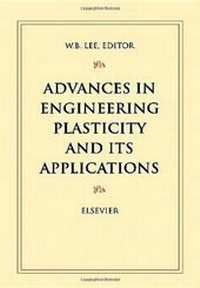
Advances in Engineering Plasticity and Its Applications
Proceedings of the Asia-Pacific Symposium (Aepa '92), Hong Kong, 15-17 December 1992
Published on 10. May 1993
Book
Hardback
1136 pages
978-0-444-89991-0 (ISBN)
Description
Classical plasticity is a well established domain of mechanics and engineering, providing the basis for many engineering structural design, manufacturing processes and natural phenomena. New important characteristics are emerging in the interdisciplinary approach of micro-, meso- and macro-mechanics, and through analysis, experiments and computation. The interaction of mechanics and materials scientists is introducing tremendous changes in the two disciplines, so that the possibility of materials being processed on the microscale to achieve the desired macroscopic properties is rapidly approaching. A comprehensive overview on the latest developments in both macroplasticity and microplasticity theories, their interactions and applications in various engineering disciplines such as solid mechanics, structural analysis and geo-mechanics, materials science and technology, and metal forming and machining, is given in this volume. Case studies written by international experts focus on aspects such as the applications of plasticity in interdisciplinary and non-conventional areas.
The 150 papers provide a current reference on the latest advances for both research workers and engineers in the various fields of plasticity.
The 150 papers provide a current reference on the latest advances for both research workers and engineers in the various fields of plasticity.
More details
Language
English
Place of publication
Oxford
United Kingdom
Publishing group
Elsevier Science & Technology
Target group
College/higher education
Professional and scholarly
Illustrations
index
ISBN-13
978-0-444-89991-0 (9780444899910)
Copyright in bibliographic data and cover images is held by Nielsen Book Services Limited or by the publishers or by their respective licensors: all rights reserved.
Schweitzer Classification
Other editions
Additional editions
E-Book
12/2012
Elsevier
€70.95
Available for download
Person
Content
Part 1 Keynote Papers. Modelling the deformation of polycrystals - explaining the length changes that take place during torsion testing (J.J. Jonas). Deformation mechanisms in impact energy absorbing components and materials (S.R. Reid). Concrete plasticity - macro and micro approaches (W.F. Chen). Contribution to the finite element modelling of three dimensional rolling (J.-L. Chenot et al). The incorporation of an anisotropic yield locus derived from the crystallographic texture in FE modelling of forming (P. van Houtte et al.). Methodology and applications of mesoplasticity in manufacturing sciences (W.B. Lee, W. Yang). Part 2 Constitutive modelling. A consideration on yield criterion for sintered porous metals (J.J. Park). Two surface model for soils with induced anisotropy (N. Yasufuku et al). Part 3 Damage and fracture. A damage model of fatigue analysis for Al alloy 2024-T3 (Y. Wei et al). Experimental and computational models of the deformation of ceramic composites by micro-cracking (J.D. McCafferty, J. W. Hancock). Part 4 Dynamic and visco-plasticity. A technique to probe dynamic strain ageing (C.P. Ling et al). Visco-plastic behaviour of SUS-304 stainless steel at ultra-high temperature (D.Y. Ju et al). Part 5 Crystal plasticity. Anisotropic creep behaviour of textured Ti and Zr alloys (S. Nangalia, K.L. Murty). Mechanical anisotropy and crystallographic texture in TiAlMn alloy sheet (J.C. Britt et al). Part 6 Numerical methods. A benchmark for elastoplastic finite elements (H.S. Yu). Part 7 Structural analysis and geomechanics. Effect of strain-hardening on the behaviour of axially crushed cylindrical tubes (T. Y. Reddy, E. Zhang). Thermoelastoplastic and residual stresses in thick-walled cylindrical pressure vessels of strain hardening material (A. Loghman, M.A. Wahab). Part 8 Forming and machining. An analysis for axisymmetric extrusion including redundant work and strain-hardening (J. Chakrabarty). Generalization of the Marciniak-Kuczynski defect model for predicting forming limit diagrams (P. Van Houtte, L.S. Toth).