

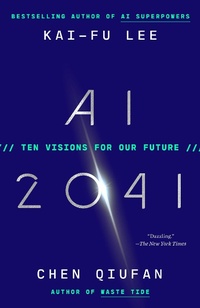
AI 2041
Ten Visions for Our Future
Published on 5. March 2024
Book
Paperback/Softback
496 pages
978-0-593-23831-8 (ISBN)
Description
How will AI change our world within twenty years? A pioneering technologist and acclaimed writer team up for a “dazzling” (The New York Times) look at the future that “brims with intriguing insights” (Financial Times). This edition includes a new foreword by Kai-Fu Lee.
A BEST BOOK OF THE YEAR: The Wall Street Journal, The Washington Post, Financial Times
Long before the advent of ChatGPT, Kai-Fu Lee and Chen Qiufan understood the enormous potential of artificial intelligence to transform our daily lives. But even as the world wakes up to the power of AI, many of us still fail to grasp the big picture. Chatbots and large language models are only the beginning.
In this “inspired collaboration” (The Wall Street Journal), Lee and Chen join forces to imagine our world in 2041 and how it will be shaped by AI. In ten gripping, globe-spanning short stories and accompanying commentary, their book introduces readers to an array of eye-opening settings and characters grappling with the new abundance and potential harms of AI technologies like deep learning, mixed reality, robotics, artificial general intelligence, and autonomous weapons.
A BEST BOOK OF THE YEAR: The Wall Street Journal, The Washington Post, Financial Times
Long before the advent of ChatGPT, Kai-Fu Lee and Chen Qiufan understood the enormous potential of artificial intelligence to transform our daily lives. But even as the world wakes up to the power of AI, many of us still fail to grasp the big picture. Chatbots and large language models are only the beginning.
In this “inspired collaboration” (The Wall Street Journal), Lee and Chen join forces to imagine our world in 2041 and how it will be shaped by AI. In ten gripping, globe-spanning short stories and accompanying commentary, their book introduces readers to an array of eye-opening settings and characters grappling with the new abundance and potential harms of AI technologies like deep learning, mixed reality, robotics, artificial general intelligence, and autonomous weapons.
More details
Language
English
Place of publication
United States
Product notice
Paperback (trade)
Dimensions
Height: 196 mm
Width: 130 mm
Thickness: 30 mm
Weight
362 gr
ISBN-13
978-0-593-23831-8 (9780593238318)
Copyright in bibliographic data and cover images is held by Nielsen Book Services Limited or by the publishers or by their respective licensors: all rights reserved.
Schweitzer Classification
Other editions
Additional editions
Book
09/2021
Penguin Young Readers
€49.44
Article exhausted; check different version
Persons
Kai-Fu Lee is the CEO of Sinovation Ventures and New York Times bestselling author of AI Superpowers. Lee was formerly the president of Google China and a senior executive at Microsoft, SGI, and Apple. Co-chair of the Artificial Intelligence Council at the World Economic Forum, he has a bachelor’s degree from Columbia and a PhD from Carnegie Mellon. Lee’s numerous honors include being named to the Time 100 and Wired 25 Icons lists. He is based in Beijing.
Chen Qiufan (aka Stanley Chan) is an award-winning author, translator, creative producer, and curator. He is the president of the World Chinese Science Fiction Association. His works include Waste Tide, Future Disease, and The Algorithms for Life. The founder of Thema Mundi, a content development studio, he lives in Beijing and Shanghai.
Chen Qiufan (aka Stanley Chan) is an award-winning author, translator, creative producer, and curator. He is the president of the World Chinese Science Fiction Association. His works include Waste Tide, Future Disease, and The Algorithms for Life. The founder of Thema Mundi, a content development studio, he lives in Beijing and Shanghai.
Content
Introduction by Kai-Fu Lee: The Real Story of AI
Introduction by Chen Qiufan: How We Can Learn to Stop Worrying and Embrace the Future with Imagination
One: The Golden Elephant
• Analysis: Deep learning, big data, internet/finance applications, AI externalities
Two: The Gods Behind the Masks
• Analysis: Computer vision, convolutional neural networks, deepfakes, generative adversarial networks (GANs), biometrics, AI security
Three: Twin Sparrows
• Analysis: Natural language processing, self-supervised training, GPT-3, AGI and consciousness, AI education
Four: Contactless Love
• Analysis: AI healthcare, AlphaFold, robotic applications, COVID automation accelation
Five: My Haunting Idol
• Analysis: Virtual reality (VR), augmented reality (AR), mixed reality (MR), brain-computer interface (BCI), ethical and societal issues
Six: The Holy Driver
• Analysis: Autonomous vehicles, full autonomy and smart cities, ethical and social issues
Seven: Quantum Genocide
• Analysis: Quantum computers, bitcoin security, autonomous weapons and existential threat
Eight: The Job Savior
• Analysis: AI job displacement, universal basic income (UBI), what AI cannot do, 3RS as a solution to displacement
Nine: Isle of Happiness
• Analysis: AI and happiness, general data protection regulation (GDPR), personal data, privacy computing using federated learning and trusted execution environment (TEE)
Ten: Dreaming of Plenitude
• Analysis: Plenitude, new economic models, the future of money, singularity
Acknowledgments
Index
Introduction by Chen Qiufan: How We Can Learn to Stop Worrying and Embrace the Future with Imagination
One: The Golden Elephant
• Analysis: Deep learning, big data, internet/finance applications, AI externalities
Two: The Gods Behind the Masks
• Analysis: Computer vision, convolutional neural networks, deepfakes, generative adversarial networks (GANs), biometrics, AI security
Three: Twin Sparrows
• Analysis: Natural language processing, self-supervised training, GPT-3, AGI and consciousness, AI education
Four: Contactless Love
• Analysis: AI healthcare, AlphaFold, robotic applications, COVID automation accelation
Five: My Haunting Idol
• Analysis: Virtual reality (VR), augmented reality (AR), mixed reality (MR), brain-computer interface (BCI), ethical and societal issues
Six: The Holy Driver
• Analysis: Autonomous vehicles, full autonomy and smart cities, ethical and social issues
Seven: Quantum Genocide
• Analysis: Quantum computers, bitcoin security, autonomous weapons and existential threat
Eight: The Job Savior
• Analysis: AI job displacement, universal basic income (UBI), what AI cannot do, 3RS as a solution to displacement
Nine: Isle of Happiness
• Analysis: AI and happiness, general data protection regulation (GDPR), personal data, privacy computing using federated learning and trusted execution environment (TEE)
Ten: Dreaming of Plenitude
• Analysis: Plenitude, new economic models, the future of money, singularity
Acknowledgments
Index