

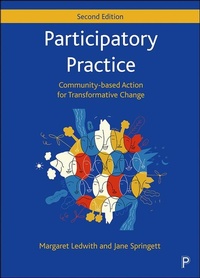
Participatory Practice
Community-based Action for Transformative Change
2nd Edition
Published on 4. April 2022
Book
Paperback/Softback
312 pages
978-1-4473-6007-0 (ISBN)
Description
In this second edition of a bestselling book, the authors' unique, holistic and radical perspective on participatory practice has been updated to reflect advances made in the past decade, the impact of neoliberalism and austerity, and the challenges of climate change and the pandemic.
Bridging the divide between community development ideas and practice, over half of this innovative book comprises new content with updated features including:
* reflective questions
* key points highlighted throughout each chapter
* a glossary of terms
The authors argue that transformative practice begins with everyday stories about people's lives and that practical theory generated from these narratives is the best way to inform both policy and practice.
This long-awaited new edition will be of interest to academics and community-based practitioners working in a range of settings, including health and education.
Bridging the divide between community development ideas and practice, over half of this innovative book comprises new content with updated features including:
* reflective questions
* key points highlighted throughout each chapter
* a glossary of terms
The authors argue that transformative practice begins with everyday stories about people's lives and that practical theory generated from these narratives is the best way to inform both policy and practice.
This long-awaited new edition will be of interest to academics and community-based practitioners working in a range of settings, including health and education.
Reviews / Votes
"Among the growing number of books on community participation and community-engaged research, Participatory Practice stands out for its accessibility to community members and practitioners alike, and its in-depth coverage of topics like the role of dialogue and critical reflection, that are so central to this enterprise. I love this book, and recommend it to anyone who wishes to work "with rather than on communities" toward truly transformative change." Meredith Minkler, University of California, Berkeley "Participatory practice requires bravery from academics - fortunately Margaret Ledwith and Jane Springett provide an insightful guide to this non-traditional form of research rigour that values the co-creation of knowledge and transformative action." Lisa Gibbs, University of MelbourneMore details
Edition
Second Edition
Language
English
Place of publication
Bristol
United Kingdom
Publishing group
Bristol University Press
Target group
Professional and scholarly
Illustrations
13 s/w Abbildungen, 3 s/w Tabellen
3 Tables, black and white; 13 Illustrations, black and white
Dimensions
Height: 172 mm
Width: 240 mm
Thickness: 31 mm
Weight
544 gr
ISBN-13
978-1-4473-6007-0 (9781447360070)
Copyright in bibliographic data and cover images is held by Nielsen Book Services Limited or by the publishers or by their respective licensors: all rights reserved.
Schweitzer Classification
Other editions
Additional editions
Margaret Ledwith | Jane Springett
Participatory Practice
Community-based Action for Transformative Change
E-Book
04/2022
2nd Edition
Policy Press
€38.99
Available for download
Margaret Ledwith | Jane Springett
Participatory Practice
Community-based Action for Transformative Change
E-Book
04/2022
2nd Edition
Policy Press
€53.99
Available for download
Margaret Ledwith | Jane Springett
Participatory practice
Community-based action for transformative change
Book
11/2009
1st Edition
Policy Press
€80.10
Article exhausted; check different version
Margaret Ledwith | Jane Springett
Participatory practice
Community-based action for transformative change
E-Book
11/2009
1st Edition
Policy Press
€46.99
Available for download
Persons
Margaret Ledwith is Emeritus Professor of Community Development and Social Justice at the University of Cumbria.
I live in Lancaster where I am Emeritus Professor of Community Development and Social Justice at the University of Cumbria. As a child, I was aware of social injustices around me, but had no understanding of the ways that power discriminates to privilege some at the expense of others. This pursuit of power followed me into classroom teaching, to work with Vietnamese Refugees in Scotland, to time spent in Nicaraguan communities after the Sandinista revolution... all of which changed my practice and my life. My thinking needed the flick of a switch, and this happened when I was introduced to the theories of Paulo Freire, Antonio Gramsci and feminism at Edinburgh University. From then on, I saw power as a tangible discriminatory force in everyday life, and began taking Freire into feminism, anti-racism and intersectionality, both as a community development practitioner and in my books.
To date, the culmination of my thought is captured in this second edition of Participatory Practice and the third edition of Community Development: A Critical and Radical Approach, published 2020. Beyond this, I am working on my lifework. I am committed to emancipatory action research as a living praxis for social and environmental justice practitioners and activists, and extremely interested in the role of storytelling as provocation to trigger critical dialogue and action for change.
Jane Springett is Emeritus Professor at the Centre for Healthy Communities, School of Public Health, University of Alberta.
I respectfully acknowledge that this book was written on Treaty 6 territory , a traditional meeting ground, gathering place and travelling route for many indigenous groups, including Cree, Saulteuax, Blackfoot, Metis, Dene and Nakota Sioux and now for many peoples from around the world. I have been privileged to live here since 2011 when I came to take up a position of the Director of the Centre for Health Promotion Studies. I have worked in a number of countries, including Sweden, Germany , Kyrgyzstan and Mexico. I have been fortunate for such a rich experience that has opened me up to the impact of colonisation and to new ways of working, while confirming my commitment to participatory practice in health promotion and research.
I am a co-founder of the International Collaboration for Participatory Health Research and a member of the coordinating group of the Collaborative Action Research Network. Indigenous cultures have an intimate spiritual connection with the land. I understand what that means and it is the land of my home country I have missed and to which I return. I take with me my new wisdom to share and inform practice in a different context.
I live in Lancaster where I am Emeritus Professor of Community Development and Social Justice at the University of Cumbria. As a child, I was aware of social injustices around me, but had no understanding of the ways that power discriminates to privilege some at the expense of others. This pursuit of power followed me into classroom teaching, to work with Vietnamese Refugees in Scotland, to time spent in Nicaraguan communities after the Sandinista revolution... all of which changed my practice and my life. My thinking needed the flick of a switch, and this happened when I was introduced to the theories of Paulo Freire, Antonio Gramsci and feminism at Edinburgh University. From then on, I saw power as a tangible discriminatory force in everyday life, and began taking Freire into feminism, anti-racism and intersectionality, both as a community development practitioner and in my books.
To date, the culmination of my thought is captured in this second edition of Participatory Practice and the third edition of Community Development: A Critical and Radical Approach, published 2020. Beyond this, I am working on my lifework. I am committed to emancipatory action research as a living praxis for social and environmental justice practitioners and activists, and extremely interested in the role of storytelling as provocation to trigger critical dialogue and action for change.
Jane Springett is Emeritus Professor at the Centre for Healthy Communities, School of Public Health, University of Alberta.
I respectfully acknowledge that this book was written on Treaty 6 territory , a traditional meeting ground, gathering place and travelling route for many indigenous groups, including Cree, Saulteuax, Blackfoot, Metis, Dene and Nakota Sioux and now for many peoples from around the world. I have been privileged to live here since 2011 when I came to take up a position of the Director of the Centre for Health Promotion Studies. I have worked in a number of countries, including Sweden, Germany , Kyrgyzstan and Mexico. I have been fortunate for such a rich experience that has opened me up to the impact of colonisation and to new ways of working, while confirming my commitment to participatory practice in health promotion and research.
I am a co-founder of the International Collaboration for Participatory Health Research and a member of the coordinating group of the Collaborative Action Research Network. Indigenous cultures have an intimate spiritual connection with the land. I understand what that means and it is the land of my home country I have missed and to which I return. I take with me my new wisdom to share and inform practice in a different context.
Content
Introduction: Our Stories
PART I: A Participatory Paradigm
1. Participatory Practice
2. Troubled Times
3. The Participatory Worldview
4. Participatory Practice in a Non-Participatory World
PART II: Participatory Praxis
5. Storytelling Praxis
6. The Role of Dialogue
7. Critical Reflection and Reflexivity
8. Transformative Practice
9. Becoming Whole
PART I: A Participatory Paradigm
1. Participatory Practice
2. Troubled Times
3. The Participatory Worldview
4. Participatory Practice in a Non-Participatory World
PART II: Participatory Praxis
5. Storytelling Praxis
6. The Role of Dialogue
7. Critical Reflection and Reflexivity
8. Transformative Practice
9. Becoming Whole