

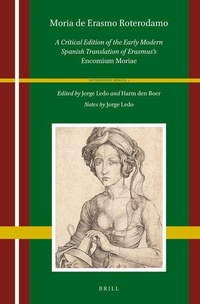
Moria de Erasmo Roterodamo
A Critical Edition of the Early Modern Spanish Translation of Erasmus's Encomium Moriae
Published on 28. October 2014
Book
Hardback
424 pages
978-90-04-23131-3 (ISBN)
Description
The existence of a early Spanish translation of Erasmus's Encomium Moriae has been matter of speculation and unsuccessful research for over a century. This volume offers for the first time the edition of a seventeenth-century manuscript discovered at Ets Haim/Livraria Montezinos (Amsterdam) by its editors. They demonstrate that it is not only the first known early modern Spanish translation of Erasmus's chef-d'oeuvre, but a copy of a much earlier version, composed in mid-sixteenth century.
This scholarly edition has been arranged for an easy textual collation with the canonical edition (ASD IV: 3) and translation (CWE 27) of Erasmus's Praise of Folly and includes an extensive apparatus of footnotes devoted both to this version and to Erasmus's Moriae Encomium itself.
This scholarly edition has been arranged for an easy textual collation with the canonical edition (ASD IV: 3) and translation (CWE 27) of Erasmus's Praise of Folly and includes an extensive apparatus of footnotes devoted both to this version and to Erasmus's Moriae Encomium itself.
Reviews / Votes
"The Encomium Moriae [...] is today given an afterlife by the knowledgeable care of Ledo and den Boer in an annotated English edition that brings to a wider academic audience versed both in Spanish and the lingua franca of the twenty-first century the trials and tribulations of a remarkable translation and a forgotten manuscript." - A. Izquierdo, Sixteenth Century Journal XLVI: 3 (2015), pp. 707-710"...the edition constitutes an important milestone in the discipline of Erasmian studies in general, and of Hispanic Erasmism in particular." - J.M. Perez Fernandez, Renaissance Quarterly LXIX:1 (2016), pp. 331-332
"I do not hesitate to say that this impressive edition will open up new lines of research for scholars of Erasmus and early modern Iberian studies and will continue to be an invaluable tool for both teachers and students for years to come." - K.D. Howard, Erasmus Studies (previously Erasmus of Rotterdam Society Yearbook) XXXVI:1 (2016), pp. 73-75
More details
Series
Edition
Critical edition
Language
English
Place of publication
Leiden
Netherlands
Target group
Professional and scholarly
Edition type
Annotated edition
Product notice
sewn/stitched
Cloth over boards
Dimensions
Height: 241 mm
Width: 160 mm
Thickness: 28 mm
Weight
780 gr
ISBN-13
978-90-04-23131-3 (9789004231313)
DOI
10.1000/b10478
Copyright in bibliographic data and cover images is held by Nielsen Book Services Limited or by the publishers or by their respective licensors: all rights reserved.
Schweitzer Classification
Persons
Harm den Boer, Ph. D (1992) in Spanish Literature is a Full Professor at the Universitaet Basel. He is author of La literatura sefardi de Amsterdam (Alcala de Henares, 1996), and a wide-ranging number of articles on Early Modern Iberian Literature.
Jorge Ledo (PhD Centre for Modern Thought, University of Aberdeen, 2009) is at present a Distiguished Researcher at the InTalent Programme (sponsored by Inditex and the Universidade da Coruna). He had previously been an Assistant Professor at the University of Michigan (2009-2011) and at the University of Basel (2011-2017). He is the chief editor of Brill's Heterodoxia Iberica Series. He is an expert in some aspects of Renaissance Studies, mainly in the history of Spanish religious and political dissidence during the Renaissance, Erasmus's Studies, History of Poetics in Europe, History of the Ideas on Communication and Dissent in Neo-Latin Culture from the fourteenth to the seventeenth centuries, and the History of Concepts and Emotions.
Jorge Ledo (PhD Centre for Modern Thought, University of Aberdeen, 2009) is at present a Distiguished Researcher at the InTalent Programme (sponsored by Inditex and the Universidade da Coruna). He had previously been an Assistant Professor at the University of Michigan (2009-2011) and at the University of Basel (2011-2017). He is the chief editor of Brill's Heterodoxia Iberica Series. He is an expert in some aspects of Renaissance Studies, mainly in the history of Spanish religious and political dissidence during the Renaissance, Erasmus's Studies, History of Poetics in Europe, History of the Ideas on Communication and Dissent in Neo-Latin Culture from the fourteenth to the seventeenth centuries, and the History of Concepts and Emotions.
Content
Acknowledgments
Introduction
1. The Spanish Moria: Toward a reappraisal of Erasmus in Spain
2. Erasmus's Moria and its sixteenth-century translations into vernacular
3. The evasive nature of the Spanish Moria
4. Description of ms. 48 E 33 Ets Haim/ Livraria Montezinos
5. A translator's profile
6. The edition of the Encomium Moriae employed by the translator
7. The Moria in the context of the Portuguese Jews of the Netherlands
8. Conclusions
9. This edition
10. Abbreviations
Moria de Erasmo Roterodamo
Appendix
Bibliography
Indexes
Introduction
1. The Spanish Moria: Toward a reappraisal of Erasmus in Spain
2. Erasmus's Moria and its sixteenth-century translations into vernacular
3. The evasive nature of the Spanish Moria
4. Description of ms. 48 E 33 Ets Haim/ Livraria Montezinos
5. A translator's profile
6. The edition of the Encomium Moriae employed by the translator
7. The Moria in the context of the Portuguese Jews of the Netherlands
8. Conclusions
9. This edition
10. Abbreviations
Moria de Erasmo Roterodamo
Appendix
Bibliography
Indexes