

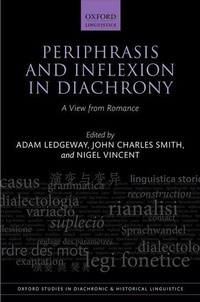
Periphrasis and Inflexion in Diachrony
A View from Romance
Published on 3. March 2022
Book
Hardback
518 pages
978-0-19-887080-7 (ISBN)
Description
This volume brings together contributions from leading specialists in syntax and morphology to explore the complex relation between periphrasis and inflexion from both a synchronic and diachronic perspective. The chapters draw on data from across the Romance language family, including standard and regional varieties and dialects.
The relation between periphrasis and inflexion raises questions for both syntax and morphology, and understanding the phenomena involved requires cooperation across these sub-domains. For example, the components that express many periphrases can be interrupted by other words in a way that is common in syntax but not in morphology, and in some contexts, a periphrastic form may be semantically equivalent to a single-word inflected form, with which it arguably forms part of a paradigmatic set. Patterns of this kind are found across Romance, albeit with significant local differences. Moreover, diachrony is essential in understanding these phenomena, and the rich historical documentation available for Romance allows an in-depth exploration of the changes and variation involved, as different members of the family may instantiate different stages of development. Studying these changes also raises important questions about the relation between attested and reconstructed patterns. Although the empirical focus of the volume is on the Romance languages, the analyses and conclusions presented shed light on the development and nature of similar structures in other language families and provide valuable insights relevant to linguistic theory more broadly.
The relation between periphrasis and inflexion raises questions for both syntax and morphology, and understanding the phenomena involved requires cooperation across these sub-domains. For example, the components that express many periphrases can be interrupted by other words in a way that is common in syntax but not in morphology, and in some contexts, a periphrastic form may be semantically equivalent to a single-word inflected form, with which it arguably forms part of a paradigmatic set. Patterns of this kind are found across Romance, albeit with significant local differences. Moreover, diachrony is essential in understanding these phenomena, and the rich historical documentation available for Romance allows an in-depth exploration of the changes and variation involved, as different members of the family may instantiate different stages of development. Studying these changes also raises important questions about the relation between attested and reconstructed patterns. Although the empirical focus of the volume is on the Romance languages, the analyses and conclusions presented shed light on the development and nature of similar structures in other language families and provide valuable insights relevant to linguistic theory more broadly.
More details
Series
Language
English
Place of publication
Oxford
United Kingdom
Product notice
sewn/stitched
Cloth over boards
Dimensions
Height: 237 mm
Width: 166 mm
Thickness: 36 mm
Weight
975 gr
ISBN-13
978-0-19-887080-7 (9780198870807)
Copyright in bibliographic data and cover images is held by Nielsen Book Services Limited or by the publishers or by their respective licensors: all rights reserved.
Schweitzer Classification
Other editions
Additional editions
Adam Ledgeway | John Charles Smith | Nigel Vincent
Periphrasis and Inflexion in Diachrony
A View from Romance
E-Book
03/2022
1st Edition
OUP eBook
€75.49
Available for download
Persons
Adam Ledgeway is Professor of Italian and Romance Linguistics at the University of Cambridge and Fellow of Downing College, Cambridge. He is a Fellow of the British Academy and holds an honorary doctorate from the University of Bucharest. His publications include From Latin to Romance: Morphosyntactic Typology and Change (OUP, 2012; paperback 2015), and, as co-editor, The Cambridge History of the Romance Languages (CUP, 2011/2013), The Oxford Guide to the Romance Languages (OUP, 2016), The Cambridge Handbook of Historical Syntax (CUP, 2017), and Italian Dialectology at the Interfaces (Benjamins, 2019). He is also co-editor of the Journal of Linguistics.
John Charles Smith is an Emeritus Fellow of St Catherine's College, Oxford (where he was Official Fellow and Tutor in French Linguistics) and Deputy Director Emeritus of the University of Oxford Research Centre for Romance Linguistics. He has also held posts at the universities of Surrey, Bath, and Manchester, as well as visiting appointments in Limoges, Paris, Berlin, Melbourne, and Philadelphia, and was created Chevalier dans l'ordre des Palmes academiques by the French government for services to the French language and French culture. He has published on a range of linguistic topics, and co-edited several volumes, including The Cambridge History of the Romance Languages (CUP, 2011/2013) and The Boundaries of Pure Morphology (OUP, 2013).
Nigel Vincent is Professor Emeritus of General and Romance Linguistics at The University of Manchester, where he was Mont Follick Chair of Comparative Philology from 1987 to 2011. He previously held posts at the Universities of London (Birkbeck College), Lancaster, Hull, and Cambridge, as well as visiting appointments in Copenhagen, Pavia, and Rome, and an Erskine Fellowship at the University of Canterbury, New Zealand. He is a Fellow of the British Academy and a Member of the Academia Europaea. His recent publications include, as co-editor and contributor, Diachrony and Dialects (OUP, 2014) and Early and Late Latin: Continuity or Change? (CUP, 2016).
John Charles Smith is an Emeritus Fellow of St Catherine's College, Oxford (where he was Official Fellow and Tutor in French Linguistics) and Deputy Director Emeritus of the University of Oxford Research Centre for Romance Linguistics. He has also held posts at the universities of Surrey, Bath, and Manchester, as well as visiting appointments in Limoges, Paris, Berlin, Melbourne, and Philadelphia, and was created Chevalier dans l'ordre des Palmes academiques by the French government for services to the French language and French culture. He has published on a range of linguistic topics, and co-edited several volumes, including The Cambridge History of the Romance Languages (CUP, 2011/2013) and The Boundaries of Pure Morphology (OUP, 2013).
Nigel Vincent is Professor Emeritus of General and Romance Linguistics at The University of Manchester, where he was Mont Follick Chair of Comparative Philology from 1987 to 2011. He previously held posts at the Universities of London (Birkbeck College), Lancaster, Hull, and Cambridge, as well as visiting appointments in Copenhagen, Pavia, and Rome, and an Erskine Fellowship at the University of Canterbury, New Zealand. He is a Fellow of the British Academy and a Member of the Academia Europaea. His recent publications include, as co-editor and contributor, Diachrony and Dialects (OUP, 2014) and Early and Late Latin: Continuity or Change? (CUP, 2016).
Editor
Professor of Italian and Romance LinguisticsProfessor of Italian and Romance Linguistics, University of Cambridge
Emeritus FellowEmeritus Fellow, St Catherine's College, University of Oxford
Professor Emeritus of General and Romance LinguisticsProfessor Emeritus of General and Romance Linguistics, The University of Manchester
Content
- Introduction
- Part I: The Status of Periphrasis and Inflexion
- 1: Adam Ledgeway and Nigel Vincent: Periphrasis and inflexion: Lessons from Romance
- 2: John Charles Smith: The boundaries of inflexion and periphrasis
- Part II: Periphrasis
- 3: Nigel Vincent and Max W. Wheeler: Layering and divergence in Romance periphrases
- 4: Sandra Paoli and Sam Wolfe: The GO-future and GO-past periphrases in Gallo-Romance: A comparative investigation
- 5: Mair Parry: The TORNARE-periphrasis in Italo-Romance: Grammaticalization 'again'!
- 6: Silvio Cruschina: Periphrastic morphomes in Italo-Romance
- Part III: Auxiliation
- 7: Xavier Bach and Pavel ?tichauer: Auxiliary selection in Italo-Romance and inflexional classes
- 8: Michele Loporcaro: The morphological nature of person-driven auxiliation: Evidence from shape conditions
- Part IV: Analysis vs Synthesis
- 9: Adina Dragomirescu, Alexandru Nicolae, and Rodica Zafiu: The loss of analyticity in the history of Romanian verbal morphology
- 10: Gabriela Pan¿ Dindelegan and Oana U¿¿ B¿rbulescu: The relationship between inflexional and analytic marking of obliques in Romanian
- 11: Rosanna Sornicola: A diachronic perspective on polymorphism, overabundance, and polyfunctionalism
- Part V: Inflexion and its Interfaces
- 12: Delia Bentley and Michela Cennamo: Thematic and lexico-aspectual constraints on V-S agreement: Evidence from Northern Italo-Romance
- 13: Mark Aronoff and Lori Repetti: Conditioned epenthesis in Romance
- 14: Paul O'Neill and Tom Finbow: Koineization and language contact: The social causes of morphological change in and with Portuguese
- References
- Index