

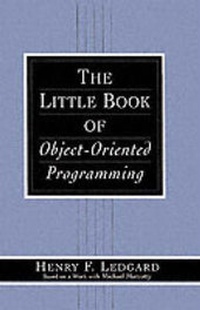
The Little Book of Object-Oriented Programming
Published on 19. December 1995
Book
Paperback/Softback
224 pages
978-0-13-396342-7 (ISBN)
Description
A mini-text or supplement for any Object-Oriented Programming or Concepts of Programming Languages course.
Based on the premise that there is much needless confusion about Object-Oriented Programming, this "mini-text" offers a very simple, clear explanation of the truly fundamental issues in OOP that can be read by any programmer. It starts from a simple programming base - independent of C, C++, and Pascal - and builds on this base to unfold the essence of OOP.
Based on the premise that there is much needless confusion about Object-Oriented Programming, this "mini-text" offers a very simple, clear explanation of the truly fundamental issues in OOP that can be read by any programmer. It starts from a simple programming base - independent of C, C++, and Pascal - and builds on this base to unfold the essence of OOP.
More details
Language
English
Place of publication
United States
Publishing group
Pearson Education (US)
Target group
College/higher education
Dimensions
Height: 228 mm
Width: 152 mm
Thickness: 9 mm
Weight
240 gr
ISBN-13
978-0-13-396342-7 (9780133963427)
Copyright in bibliographic data and cover images is held by Nielsen Book Services Limited or by the publishers or by their respective licensors: all rights reserved.
Schweitzer Classification
Content
1. Introduction.
2. Types.
2.1 Mini-language Type. 2.2 The Meaning of Type. 2.3 Primitive Types. 2.4 Composite Types. 2.5 Type Checking. Further Reading and Exercises.
3. Definition of New Types.
3.1 Mini-language Typedef. 3.2 Type Definitions. 3.3 User-defined Operators. 3.4 A Note on Pascal. Further Reading and Exercises.
4. Packages and Modules.
4.1 Mini-language Modules. 4.2 Packages and Modules. 4.3 Encapsulation and Abstraction. 4.4 Information Hiding. 4.5 Separate Compilation. 4.6 Modula-2 and Ada. Further Reading and Exercises.
5. Objects and Abstract Data Types.
5.1 Mini-language Objects. 5.2 Full Objects. 5.3 Abstract Data Types. 5.4 Turbo Pascal. Further Reading and Exercises.
6. Classes.
6.1 Mini-language Classes. 6.2 More on Objects. 6.3 Smalltalk and Eiffel. Further Reading and Exercises.
7. Inheritance.
7.1 Mini-Language Inherit. 7.2 Inheritance. 7.3 Polymorphism. 7.4 C++ and Ada 9X. Further Reading and Exercises.
8. Object-Oriented Programming.
8.1 What is an "Object"? 8.2 Variety of Objects. 8.3 Questioning Object-Oriented Programming. 8.4 Program Flash.
Appendix 1: General Exercises.
Appendix 2: Flash Source Code in C++.
Appendix 3: Glossary.
References.
Index.
2. Types.
2.1 Mini-language Type. 2.2 The Meaning of Type. 2.3 Primitive Types. 2.4 Composite Types. 2.5 Type Checking. Further Reading and Exercises.
3. Definition of New Types.
3.1 Mini-language Typedef. 3.2 Type Definitions. 3.3 User-defined Operators. 3.4 A Note on Pascal. Further Reading and Exercises.
4. Packages and Modules.
4.1 Mini-language Modules. 4.2 Packages and Modules. 4.3 Encapsulation and Abstraction. 4.4 Information Hiding. 4.5 Separate Compilation. 4.6 Modula-2 and Ada. Further Reading and Exercises.
5. Objects and Abstract Data Types.
5.1 Mini-language Objects. 5.2 Full Objects. 5.3 Abstract Data Types. 5.4 Turbo Pascal. Further Reading and Exercises.
6. Classes.
6.1 Mini-language Classes. 6.2 More on Objects. 6.3 Smalltalk and Eiffel. Further Reading and Exercises.
7. Inheritance.
7.1 Mini-Language Inherit. 7.2 Inheritance. 7.3 Polymorphism. 7.4 C++ and Ada 9X. Further Reading and Exercises.
8. Object-Oriented Programming.
8.1 What is an "Object"? 8.2 Variety of Objects. 8.3 Questioning Object-Oriented Programming. 8.4 Program Flash.
Appendix 1: General Exercises.
Appendix 2: Flash Source Code in C++.
Appendix 3: Glossary.
References.
Index.