

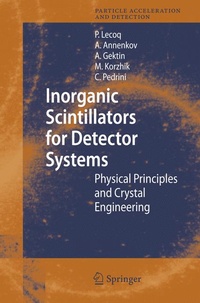
Inorganic Scintillators for Detector Systems
Physical Principles and Crystal Engineering
Published on 9. March 2006
Book
Hardback
XII, 251 pages
978-3-540-27766-8 (ISBN)
Description
Thelasttwodecadeshaveseenaspectacularincreaseofinterestforinorganic scintillators. Thishasbeentoalargepartaconsequenceofthevisibilitygiven to this ?eld by several large crystal-based detectors in particle physics. To answer the very challenging requirements for these experiments (huge data rates, linearity of response over a large dynamic range, harsh radiation en- ronment, impressive crystal quantities to be produced in a short time period andatana?ordablecost,etc...)ane?ortofcoordination was needed. S- eral groups of experts working in di?erent aspects of material science have combinedtheire?ortsininternationalandmultidisciplinarycollaborationsto better understand the fundamental mechanisms underlying the scintillation processanditse?ciency. Similarly,thestabilityofthescintillationproperties andtheroleofcolorcentershasbeenextensivelystudiedtodevelop radiation hard scintillators. Dedicated conferences on inorganic scintillators have seen an increasing participation from di?erent communities of users outside the domain of high-energy physics. This includes nuclear physics, astrophysics, security systems, industrial applications, and medical imaging.
This last - main in particular is growing very fast since a few years at the point that the volume of scintillating crystals to be produced for positron emission tom- raphy (PET) is going to exceed the one for high-energy physics. As more and more crystal producers are also attending these conferences, a very fruitful synergy was progressively built up among scienti?c experts, technologists, and end users. This aspect of a multidisciplinary collaboration is essential to helppeopledesignandbuilddetectorsofever-increasingperformancethrough the choice, optimization or development of the best scintillator, and a th- ough investigation of the technologies to produce the crystals of the highest quality.
This last - main in particular is growing very fast since a few years at the point that the volume of scintillating crystals to be produced for positron emission tom- raphy (PET) is going to exceed the one for high-energy physics. As more and more crystal producers are also attending these conferences, a very fruitful synergy was progressively built up among scienti?c experts, technologists, and end users. This aspect of a multidisciplinary collaboration is essential to helppeopledesignandbuilddetectorsofever-increasingperformancethrough the choice, optimization or development of the best scintillator, and a th- ough investigation of the technologies to produce the crystals of the highest quality.
More details
Series
Edition
2006
Language
English
Place of publication
Heidelberg
Germany
Publishing group
Springer Berlin
Target group
Professional and scholarly
Research
Illustrations
15
15 s/w Tabellen
15 black & white tables, biography
Dimensions
Height: 23.5 cm
Width: 15.5 cm
Weight
567 gr
ISBN-13
978-3-540-27766-8 (9783540277668)
DOI
10.1007/3-540-27768-4
Schweitzer Classification
Other editions
New editions
Paul Lecoq | Alexander Gektin | Mikhail Korzhik
Inorganic Scintillators for Detector Systems
Physical Principles and Crystal Engineering
Book
12/2016
2nd Edition
Springer
€149.79
Shipment within 10-15 days
Additional editions
Paul Lecoq | Alexander Annenkov | Alexander Gektin
Inorganic Scintillators for Detector Systems
Physical Principles and Crystal Engineering
Book
02/2010
Springer
€139.09
Article exhausted; check for reprint
Content
Scintillation and Inorganic Scintillators.- How User's Requirements Influence the Development of a Scintillator.- Scintillation Mechanisms in Inorganic Scintillators.- Influence of the Crystal Structure Defects on Scintillation Properties.- Crystal Engineering.- Two Examples of Recent Crystal Development.