

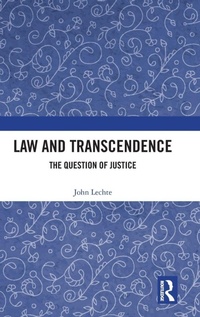
Law and Transcendence
The Question of Justice
1st Edition
Will be published approx. on 25. February 2026
Book
Hardback
202 pages
978-1-041-06470-1 (ISBN)
Description
Inspired by the philosophy of Emmanuel Levinas, this book shows that for justice to be realised law must be understood to originate in transcendence, rather than in violence, conflict and the sacred - prevalent themes in philosophies of law and the political.
To this end, the book takes up the case of 'scapegoating': evident in Carl Schmitt's influential theory of the 'friend-enemy' dichotomy as the essence of the political, and here considered as a paradigm of injustice. After considering positivist approaches to the law, as well as a case study that considers the question of what it would mean for Aboriginal peoples to be treated justly, the book shows that pragmatic, positivist and immanent approaches to the law and the scapegoat cannot deal with 'bad' law, and cannot provide an insight into the nature of justice as 'good' law. The book then draws further on Levinas to demonstrate the necessity of law's foundation, not in immanence, as is widely presupposed, but rather in transcendence.
Law and Transcendence will appeal to scholars in law, philosophy, and political theory, and especially to those with interests in sovereignty and power.
To this end, the book takes up the case of 'scapegoating': evident in Carl Schmitt's influential theory of the 'friend-enemy' dichotomy as the essence of the political, and here considered as a paradigm of injustice. After considering positivist approaches to the law, as well as a case study that considers the question of what it would mean for Aboriginal peoples to be treated justly, the book shows that pragmatic, positivist and immanent approaches to the law and the scapegoat cannot deal with 'bad' law, and cannot provide an insight into the nature of justice as 'good' law. The book then draws further on Levinas to demonstrate the necessity of law's foundation, not in immanence, as is widely presupposed, but rather in transcendence.
Law and Transcendence will appeal to scholars in law, philosophy, and political theory, and especially to those with interests in sovereignty and power.
More details
Language
English
Place of publication
London
United Kingdom
Publishing group
Taylor & Francis Ltd
Target group
College/higher education
Postgraduate
Dimensions
Height: 240 mm
Width: 161 mm
Thickness: 15 mm
Weight
461 gr
ISBN-13
978-1-041-06470-1 (9781041064701)
Copyright in bibliographic data and cover images is held by Nielsen Book Services Limited or by the publishers or by their respective licensors: all rights reserved.
Schweitzer Classification
Other editions
Additional editions
E-Book
02/2026
1st Edition
Routledge
€60.49
Available for download
E-Book
02/2026
1st Edition
Routledge
€60.49
Available for download
Person
John Lechte is Emeritus Professor in Social Theory at Macquarie University in Sydney.
Content
1. Introduction
2. The Scapegoat: Violence at the Origin - Speculatively Speaking
3. The Nature of Law and the Function of Origin
4. Justice, Morality and Law: The Hart-Fuller Debate and the Foundation of Law
5. Transcendence and Immanence and the Problem of Justice as a Substantive Goal
6. Hannah Arendt and Carl Schmitt: Totalitarianism and the Enemy as Scapegoat. Writing and Law.
7. Australia Case Study: Justice, Law and the Rule of Law in Early.
8. Beyond Immanence: Law, Justice and Transcendence in the Philosophy of Emmanuel Levinas.
9. Conclusion: Justice as Transcendence and Beyond Immanence
2. The Scapegoat: Violence at the Origin - Speculatively Speaking
3. The Nature of Law and the Function of Origin
4. Justice, Morality and Law: The Hart-Fuller Debate and the Foundation of Law
5. Transcendence and Immanence and the Problem of Justice as a Substantive Goal
6. Hannah Arendt and Carl Schmitt: Totalitarianism and the Enemy as Scapegoat. Writing and Law.
7. Australia Case Study: Justice, Law and the Rule of Law in Early.
8. Beyond Immanence: Law, Justice and Transcendence in the Philosophy of Emmanuel Levinas.
9. Conclusion: Justice as Transcendence and Beyond Immanence