

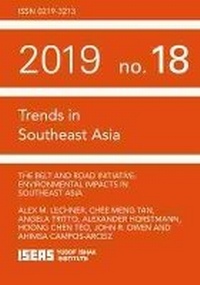
The Belt and Road Initiative
Environmental Impacts in Southeast Asia
Will be published approx. on 30. April 2020
Book
Paperback/Softback
30 pages
978-981-4881-42-5 (ISBN)
Description
China's Belt and Road Initiative (BRI) is expected to be the largest infrastructure development scheme of the twenty-first century. There is escalating concern over BRI's potential environmental impacts in Southeast Asia, a global biodiversity hotspot and a focus area of BRI development.
Case studies of Indonesia, Myanmar, Lao PDR and Malaysia show that the success of BRI in bringing about sustainable growth and opportunities depends on the Chinese government and financiers, as well as the agencies and governments involved when BRI investments take place. The adoption of best environmental practices is critical in ensuring that growth is sustainable and that bad environmental practices are not locked in for decades to come.
Case studies of Indonesia, Myanmar, Lao PDR and Malaysia show that the success of BRI in bringing about sustainable growth and opportunities depends on the Chinese government and financiers, as well as the agencies and governments involved when BRI investments take place. The adoption of best environmental practices is critical in ensuring that growth is sustainable and that bad environmental practices are not locked in for decades to come.
More details
Series
Language
English
Place of publication
Singapore
Target group
Professional and scholarly
Weight
80 gr
ISBN-13
978-981-4881-42-5 (9789814881425)
Copyright in bibliographic data and cover images is held by Nielsen Book Services Limited or by the publishers or by their respective licensors: all rights reserved.
Schweitzer Classification
Persons
Alex M. Lechner is with the School of Environmental and Geographical Sciences, University of Nottingham Malaysia, Semenyih, Malaysia.
Chee Meng Tan is with the School of Business, University of Nottingham Malaysia, Semenyih, Malaysia.
Angela Tritto is with the Institute of Emerging Market Studies, the Hong Kong University of Science and Technology, Hong Kong SAR, China Alexander Horstmann is with the School of Humanities, Tallinn University, Estonia.
Hoong Chen Teo is with the School of Environmental and Geographical Sciences, University of Nottingham Malaysia, Semenyih, Malaysia.
John R. Owen is with the Centre for Social Responsibility in Mining, University of Queensland, Brisbane, Australia.
Ahimsa Campos-Arceiz is with the School of Environmental and Geographical Sciences, University of Nottingham Malaysia, Semenyih, Malaysia.
Chee Meng Tan is with the School of Business, University of Nottingham Malaysia, Semenyih, Malaysia.
Angela Tritto is with the Institute of Emerging Market Studies, the Hong Kong University of Science and Technology, Hong Kong SAR, China Alexander Horstmann is with the School of Humanities, Tallinn University, Estonia.
Hoong Chen Teo is with the School of Environmental and Geographical Sciences, University of Nottingham Malaysia, Semenyih, Malaysia.
John R. Owen is with the Centre for Social Responsibility in Mining, University of Queensland, Brisbane, Australia.
Ahimsa Campos-Arceiz is with the School of Environmental and Geographical Sciences, University of Nottingham Malaysia, Semenyih, Malaysia.