

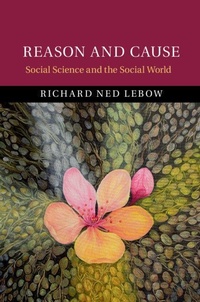
Reason and Cause
Social Science and the Social World
Published on 12. March 2020
Book
Hardback
362 pages
978-1-108-47943-1 (ISBN)
Description
Philosophy and social science assume that reason and cause are objective and universally applicable concepts. Through close readings of ancient and modern philosophy, history and literature, Richard Ned Lebow demonstrates that these concepts are actually specific to time and place. He traces their parallel evolution by focusing on classical Athens, the Enlightenment through Victorian England, and the early twentieth century. This important book shows how and why understandings of reason and cause have developed and evolved, in response to what kind of stimuli, and what this says about the relationship between social science and the social world in which it is conducted. Lebow argues that authors reflecting on their own social context use specific constructions of these categories as central arguments about the human condition. This highly original study will make an immediate impact across a number of fields with its rigorous research and the development of an innovative historicised epistemology.
More details
Language
English
Place of publication
Cambridge
United Kingdom
Target group
Professional and scholarly
Product notice
sewn/stitched
Cloth over boards
Illustrations
Worked examples or Exercises
Dimensions
Height: 229 mm
Width: 152 mm
Thickness: 21 mm
Weight
653 gr
ISBN-13
978-1-108-47943-1 (9781108479431)
Copyright in bibliographic data and cover images is held by Nielsen Book Services Limited or by the publishers or by their respective licensors: all rights reserved.
Schweitzer Classification
Other editions
Additional editions
E-Book
03/2020
Cambridge University Press
€88.99
Available for download
E-Book
03/2020
Cambridge University Press
€154.99
Available for download
Person
Richard Ned Lebow is author, co-author, or editor of forty books and over 300 peer-reviewed articles and chapters. He has made contributions to international relations, political psychology, history, political theory, philosophy of science and classics. He has taught at leading universities in the US, UK and Europe. His books have won multiple awards.
Content
1. Introduction; 2. Homer and Sophocles; 3. Thucydides; 4. David Hume; 5. Dickens, Trollope, and Collins; 6. Max Weber; 7. Thomas Mann and Franz Kafka; 8. Conclusion.