

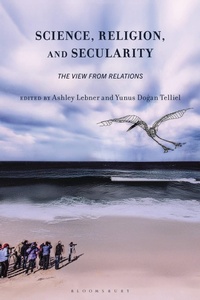
Science, Religion, and Secularity
The View from Relations
Will be published approx. on 3. September 2026
Book
Hardback
312 pages
979-8-216-38375-8 (ISBN)
Description
Can the often-conflicted relationship between science and religion be seen in new light? In this volume, Ashley Lebner, Yunus Dogan Telliel, and their contributors show that engaging secularity and its constitutive relations can take science-religion debates onto new terrain.
Increasing antagonism towards science and scientists in the twenty-first century is often explained simplistically by pointing to the rise of religiously-underpinned right-wing movements - a narrative that reinforces the idea of an age-old and inevitable clash between science and religion. This book shows that engaging the concept of secularity, which has been understudied in scholarship on science and religion, helps take the scholarly debate into productive new directions.
Focusing on contemporary issues in the study of science and religion, including UFOs, cognitive science, decolonization, the Covid-19 pandemic, and religious nationalism, the contributions in this volume consider how people support, reject and grapple with common secularist ideas. They argue that the conditions of secularity both produce and are produced through relationships - those between humans as well as those that humans have with animals, matter and the divine. Moving beyond the individualism that is typically privileged in the West, this relational perspective assumes that the web of secularity, religion and science is open to constant negotiation and transformation: people and knowledge keep changing in relation to the world.
In foregrounding relationships and their capacity for change, this volume raises important questions about the political dimension of research on science, religion, and secularity. At a time of science denial and ecological crisis, it invites us to think about how humans can live with each other - and with non-humans - in better and less destructive ways.
Increasing antagonism towards science and scientists in the twenty-first century is often explained simplistically by pointing to the rise of religiously-underpinned right-wing movements - a narrative that reinforces the idea of an age-old and inevitable clash between science and religion. This book shows that engaging the concept of secularity, which has been understudied in scholarship on science and religion, helps take the scholarly debate into productive new directions.
Focusing on contemporary issues in the study of science and religion, including UFOs, cognitive science, decolonization, the Covid-19 pandemic, and religious nationalism, the contributions in this volume consider how people support, reject and grapple with common secularist ideas. They argue that the conditions of secularity both produce and are produced through relationships - those between humans as well as those that humans have with animals, matter and the divine. Moving beyond the individualism that is typically privileged in the West, this relational perspective assumes that the web of secularity, religion and science is open to constant negotiation and transformation: people and knowledge keep changing in relation to the world.
In foregrounding relationships and their capacity for change, this volume raises important questions about the political dimension of research on science, religion, and secularity. At a time of science denial and ecological crisis, it invites us to think about how humans can live with each other - and with non-humans - in better and less destructive ways.
Reviews / Votes
Lebner and Telliel have gathered an extraordinary group of scholars for this volume, and together they have produced something quite remarkable. This book challenges old conflict models that have dominated thinking about science and religion, and in doing, reframes our understandings of secularity, relationality, and rationality. It is both historically informed and-in a world where the very foundations of knowing are being challenged in numerous ways-deeply topical. * Simon Coleman, University of Toronto * The study of science and religion is undergoing its critical turn, moving beyond narrow debates about religious and scientific absolutes, embracing instead a more capacious, dynamic, and experimental epistemology. In this sweeping volume, authors are advancing the field through brilliant and unexpected explorations of secular formations that link, reconfigure, and complicate what we know about a world too often seen through the division of faith and reason, the sacred and the profane. This is a creative, timely, and important volume. * Terence Keel, University of California, Los Angeles *More details
Series
Language
English
Place of publication
New York
United States
Publishing group
Bloomsbury Publishing Plc
Target group
Professional and scholarly
Product notice
sewn/stitched
Cloth over boards
With dust jacket
Illustrations
8 bw illus
Dimensions
Height: 229 mm
Width: 152 mm
Thickness: 25 mm
Weight
454 gr
ISBN-13
979-8-216-38375-8 (9798216383758)
Copyright in bibliographic data and cover images is held by Nielsen Book Services Limited or by the publishers or by their respective licensors: all rights reserved.
Schweitzer Classification
Other editions
Additional editions
E-Book
approx. 08/2026
Bloomsbury Academic
€94.99
Available for download
E-Book
approx. 08/2026
Bloomsbury Academic
€94.99
Available for download
Persons
Ashley Lebner is Associate Professor of Religion and Culture at Wilfrid Laurier University, Canada.
Yunus Dogan Telliel is Assistant Professor of Anthropology and Rhetoric at Worcester Polytechnic Institute, USA.
Yunus Dogan Telliel is Assistant Professor of Anthropology and Rhetoric at Worcester Polytechnic Institute, USA.
Content
Notes on Contributors
Introduction, Ashley Lebner (Wilfrid Laurier University) and Yunus Dogan Telliel (Worcester Polytechnic Institute)
Part I: In Times of Transition: Interrogating Secularism, Questioning the Individual
1: Wonder and Monstrosity: On Science as Religion, with Continual Reference to Einstein, Mary-Jane Rubenstein (Wesleyan University)
2: Faith in Science, Stephan Palmie (University of Chicago)
3: De-Extinction: A Modern Curio, Lisa H. Sideris (University of California, Santa Barbara)
4: Sickularism: An Alternate Story of "Man" in the Age of the Virus with a Crown, J. Brent Crosson (University of Texas-Austin)
5: Neural Networks: Imaginary/Biological/Artificial, John Modern (Franklin & Marshall College)
6: Saucers, Saints, and Scientists: The Uncanny Challenge of UFOs, Hussein Agrama (University of Chicago)
Part II: Secularist Post/Colonizations and What Comes Next
7: Relating to Rocks: The Geological Secular, Comparative Religion, and Charles Lyell's Visits to Niagara Falls, Pamela E. Klassen (University of Toronto)
8: Exposure and Devotion in Mexico City, Elizabeth F.S. Roberts (University of Michigan)
9: Performance and the Syneasthetic Field: Non-secular Thoughts on Senses and Absences in the Afterlife, Abou Farman (The New School)
10: Specters of the Sacred: Cultivating a Counter-Colonial Imagination, Banu Subramaniam (Wellesley College)
11: Waiting for Science: Synecdochal Misrecognition and the Rationalist Placebo in India, Jacob Copeman (University of Santiago de Compostela, Spain) and John Hagstroem (PhD, University of Edinburgh)
12: The Wonders of Materialism: Relationality and the Question of the More-Than-Human in Religious Naturalism, Carol Wayne White (Bucknell University)
Coda: Interview with Talal Asad (City University of New York)
Introduction, Ashley Lebner (Wilfrid Laurier University) and Yunus Dogan Telliel (Worcester Polytechnic Institute)
Part I: In Times of Transition: Interrogating Secularism, Questioning the Individual
1: Wonder and Monstrosity: On Science as Religion, with Continual Reference to Einstein, Mary-Jane Rubenstein (Wesleyan University)
2: Faith in Science, Stephan Palmie (University of Chicago)
3: De-Extinction: A Modern Curio, Lisa H. Sideris (University of California, Santa Barbara)
4: Sickularism: An Alternate Story of "Man" in the Age of the Virus with a Crown, J. Brent Crosson (University of Texas-Austin)
5: Neural Networks: Imaginary/Biological/Artificial, John Modern (Franklin & Marshall College)
6: Saucers, Saints, and Scientists: The Uncanny Challenge of UFOs, Hussein Agrama (University of Chicago)
Part II: Secularist Post/Colonizations and What Comes Next
7: Relating to Rocks: The Geological Secular, Comparative Religion, and Charles Lyell's Visits to Niagara Falls, Pamela E. Klassen (University of Toronto)
8: Exposure and Devotion in Mexico City, Elizabeth F.S. Roberts (University of Michigan)
9: Performance and the Syneasthetic Field: Non-secular Thoughts on Senses and Absences in the Afterlife, Abou Farman (The New School)
10: Specters of the Sacred: Cultivating a Counter-Colonial Imagination, Banu Subramaniam (Wellesley College)
11: Waiting for Science: Synecdochal Misrecognition and the Rationalist Placebo in India, Jacob Copeman (University of Santiago de Compostela, Spain) and John Hagstroem (PhD, University of Edinburgh)
12: The Wonders of Materialism: Relationality and the Question of the More-Than-Human in Religious Naturalism, Carol Wayne White (Bucknell University)
Coda: Interview with Talal Asad (City University of New York)