

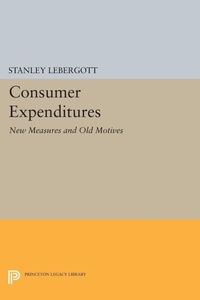
Consumer Expenditures
New Measures and Old Motives
Will be published approx. on 14. July 2014
Book
Paperback/Softback
300 pages
978-0-691-60121-2 (ISBN)
Description
Changing consumer choices have built microchip factories where cotton fields used to be and have doomed cities from New Bedford to Detroit, while the impact of these choices on jobs and tax revenues has stimulated the creation of models of consumer behavior. Even finely tuned econometric models, however, have not served well as guides for policy choices, for they have relied chiefly on data for the Great Depression and the Cold War era or on biased budget surveys. Stanley Lebergott here provides the way to greater realism with new data for the entire twentieth century, including the decades of peacetime prosperity. The new measures also permit moving from the level of the nation to the state. Analyzing our interest in individual economic well-being, Lebergott argues that consumer expenditure provides a better guide than the usual data on money income before tax. He also challenges continued reliance on a single consumption function in macro models.
In other essays he uses the new data to demonstrate that the supposed "flawed prosperity" of the 1920s was not responsible for the Great Depression; points out the limitations of the usual consumer budget surveys; and contrasts the role of age, nativity, and other factors in creating interstate differences. The new data, which link to the official BEA estimates, will provide raw material to test and extend theories of how the consumer and the economy function. Originally published in 1995. The Princeton Legacy Library uses the latest print-on-demand technology to again make available previously out-of-print books from the distinguished backlist of Princeton University Press. These editions preserve the original texts of these important books while presenting them in durable paperback and hardcover editions. The goal of the Princeton Legacy Library is to vastly increase access to the rich scholarly heritage found in the thousands of books published by Princeton University Press since its founding in 1905.
In other essays he uses the new data to demonstrate that the supposed "flawed prosperity" of the 1920s was not responsible for the Great Depression; points out the limitations of the usual consumer budget surveys; and contrasts the role of age, nativity, and other factors in creating interstate differences. The new data, which link to the official BEA estimates, will provide raw material to test and extend theories of how the consumer and the economy function. Originally published in 1995. The Princeton Legacy Library uses the latest print-on-demand technology to again make available previously out-of-print books from the distinguished backlist of Princeton University Press. These editions preserve the original texts of these important books while presenting them in durable paperback and hardcover editions. The goal of the Princeton Legacy Library is to vastly increase access to the rich scholarly heritage found in the thousands of books published by Princeton University Press since its founding in 1905.
Reviews / Votes
"Consumer expenditures is a must for anyone employing twentieth-century American consumption data. It should be read by anyone studying household spending patterns more generally, for Lebergott's embodiment of tastes in the empirical analysis. And its first eight chapters are fun for anyone looking for wit and humour in our often dry field of economic history."--Economic History ReviewMore details
Series
Language
English
Place of publication
New Jersey
United States
Target group
College/higher education
Professional and scholarly
Product notice
Paperback (trade)
Illustrations
47 tables
Dimensions
Height: 234 mm
Width: 156 mm
Thickness: 17 mm
Weight
459 gr
ISBN-13
978-0-691-60121-2 (9780691601212)
Copyright in bibliographic data and cover images is held by Nielsen Book Services Limited or by the publishers or by their respective licensors: all rights reserved.
Schweitzer Classification
Other editions
Additional editions
E-Book
07/2014
1st Edition
Princeton University Press
€53.99
Available for download
Person
Stanley Lebergott
Content
List of TablesPrefaceCh. 1Measures of Well-Being: Income versus Consumption3Ch. 2Was the Great Depression Driven by Consumption?9Ch. 3Did Underconsumption End the Boom of the 1920s?17Ch. 4Mass Consumption and "Americanization"22Ch. 5The Elite's Share of Consumption: U.S. versus USSR29Ch. 6Beyond the Consumption Function39Ch. 7Tastes - and Other Determinants of Consumption45Ch. 8Why State Consumption Patterns Differ56Ch. 9Estimating Procedures: U.S Consumption, 1900-192971Ch. 10State Consumption, 1900-1982: Estimating Procedures for Appendix B91Ch. 11Validity of Estimates125App. A. U.S. Estimates147App. B. State Estimates187Notes249Bibliography277Index285