

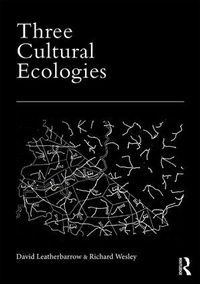
Three Cultural Ecologies
Frank Lloyd Wright and Le Corbusier
1st Edition
Published on 21. August 2017
Book
Hardback
232 pages
978-1-4724-3553-8 (ISBN)
Description
Three Cultural Ecologies reverses common conceptions of modern architecture. It reveals how selected works of two modern architects, Le Corbusier and Frank Lloyd Wright, embraced environmental and cultural conditions as reciprocal and complementary. A basic premise of this book's arguments is that cultural patterns cannot be adequately conceptualized in the terms that typically define ecology today. Instead, studies based on the natural sciences must be complemented by descriptions and interpretations of historical narratives, cultural norms, and individual expressions. Previously unpublished images and new interpretations will allow readers to rediscover works they thought they knew; Villa Savoye, Taliesin, La Tourette, and Ocatilla; as well as projects that are less well known: by Wright, the House on the Mesa and the City Residential Plan, and by Le Corbusier, the Immeuble-villas and Ilot Insalubre projects. More broadly, this study of cultural ecology at three scales - domestic, monastic, and urban - reconsiders the history of modern architecture. The conditions brought about by societal and technological modernization and confronted by modern architecture have not disappeared in our time, but have intensified, making the task of imagining how some measure of equilibrium between culture and ecology might be achieved even more pressing.
Reviews / Votes
'Three Cultural Ecologies takes obvious examples of twentieth-century architecture and shows them anew. Setting the Villa Savoye and Taliesin in their unexamined 'natural' environment renews our sense of those all-too-familiar buildings and causes us to consider afresh the entire ecological context of modern architecture.' - Joseph Rykwert CBE, Paul Philippe Cret Professor of Architecture Emeritus, University of Pennsylvania, USA"Three Cultural Ecologies presents a cultural and ecological re-examination of modern architecture at three scales-the domestic, the monastic and the urban-and thereby imparts lessons of far-reaching importance. The authors' insightful analyses of the works of Frank Lloyd Wright and Le Corbusier reveals that these architects invariably deployed their innovative modern forms in the service of achieving the ancient goal of a cultural-ecological balance between building and place, and reminds us that the most "sustainable" buildings are those in which people want to live." - Robert McCarter, Ruth and Norman Moore Professor of Architecture, Washington University in St. Louis, USA 'Three Cultural Ecologies takes obvious examples of twentieth-century architecture and shows them anew. Setting the Villa Savoye and Taliesin in their unexamined 'natural' environment renews our sense of those all-too-familiar buildings and causes us to consider afresh the entire ecological context of modern architecture.' - Joseph Rykwert CBE, Paul Philippe Cret Professor of Architecture Emeritus, University of Pennsylvania, USA
"Three Cultural Ecologies presents a cultural and ecological re-examination of modern architecture at three scales-the domestic, the monastic and the urban-and thereby imparts lessons of far-reaching importance. The authors' insightful analyses of the works of Frank Lloyd Wright and Le Corbusier reveals that these architects invariably deployed their innovative modern forms in the service of achieving the ancient goal of a cultural-ecological balance between building and place, and reminds us that the most "sustainable" buildings are those in which people want to live." - Robert McCarter, Ruth and Norman Moore Professor of Architecture, Washington University in St. Louis, USA
More details
Language
English
Place of publication
London
United Kingdom
Publishing group
Taylor & Francis Ltd
Target group
College/higher education
Illustrations
65 s/w Abbildungen, 20 farbige Abbildungen, 22 s/w Photographien bzw. Rasterbilder, 4 Farbfotos bzw. farbige Rasterbilder, 43 s/w Zeichnungen, 16 farbige Zeichnungen
16 Line drawings, color; 43 Line drawings, black and white; 4 Halftones, color; 22 Halftones, black and white; 20 Illustrations, color; 65 Illustrations, black and white
Dimensions
Height: 246 mm
Width: 174 mm
Weight
703 gr
ISBN-13
978-1-4724-3553-8 (9781472435538)
Copyright in bibliographic data and cover images is held by Nielsen Book Services Limited or by the publishers or by their respective licensors: all rights reserved.
Schweitzer Classification
Other editions
Additional editions
David Leatherbarrow | Richard Wesley
Three Cultural Ecologies
Book
06/2019
1st Edition
Routledge
€55.79
Shipment within 15-20 days
David Leatherbarrow | Richard Wesley
Three Cultural Ecologies
E-Book
08/2017
Routledge
€59.49
Available for download
David Leatherbarrow | Richard Wesley
Three Cultural Ecologies
E-Book
08/2017
Routledge
€59.49
Available for download
Persons
David Leatherbarrow is Professor of Architecture, University of Pennsylvania, where he serves as Chairman of the Graduate Group in Architecture (Ph.D. Program). He teaches architectural design as well as the history and theory of architecture, gardens, and cities. His recent books include Architecture Oriented Otherwise, Topographical Stories: studies in landscape and architecture, and Uncommon Ground: architecture, technology and topography.
Richard Wesley is Adjunct Professor of Architecture, University of Pennsylvania, where he serves as Undergraduate Chair in the Department of Architecture and teaches architectural design and theory. He has previously taught at the University of Illinois, University of Notre Dame, and Harvard University. His essays and reviews have been published in Architectural Research Quarterly, Critical Juncture, Harvard Design Magazine, Journal of the Society of Architectural Historians, Rassagna, Res, and VIA.
Richard Wesley is Adjunct Professor of Architecture, University of Pennsylvania, where he serves as Undergraduate Chair in the Department of Architecture and teaches architectural design and theory. He has previously taught at the University of Illinois, University of Notre Dame, and Harvard University. His essays and reviews have been published in Architectural Research Quarterly, Critical Juncture, Harvard Design Magazine, Journal of the Society of Architectural Historians, Rassagna, Res, and VIA.
Content
1.Speaking of Cultural Ecology 2.Pre-modern Home Economics 3.Rustica and Urbana 4.Up on the Roof 5.Pre-modern Cloisters and Precincts 6.Alone-Together Naturally 7.Into the Desert 8.Answering Disequilibrium