

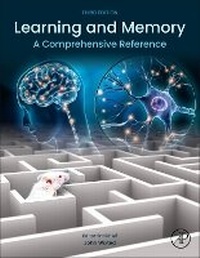
Learning and Memory: A Comprehensive Reference
Academic Press
3rd Edition
Published on 14. July 2025
Book
2400 pages
978-0-443-15754-7 (ISBN)
Description
Learning and Memory: A Comprehensive Reference, Third Edition, Four Volume Set is the authoritative resource for scientists and students interested in all facets of learning and memory. This updated edition includes chapters that reflect the rapidly evolving state-of-the-art for research in this area, from the molecular mechanisms of consolidation and forgetting to the cognitive mechanisms of eyewitness memory. No other reference work comes close to providing so much depth, hence this is a valuable tool for all academics and researchers in the field of neuroscience, psychology, psychiatry, neurobiology and neurology.
More details
Edition
3rd edition
Language
English
Place of publication
San Diego
United States
Publishing group
Elsevier Science Publishing Co Inc
Target group
Professional and scholarly
College/higher education
Dimensions
Height: 276 mm
Width: 216 mm
Weight
1000 gr
ISBN-13
978-0-443-15754-7 (9780443157547)
Copyright in bibliographic data and cover images is held by Nielsen Book Services Limited or by the publishers or by their respective licensors: all rights reserved.
Schweitzer Classification
Other editions
Additional editions
E-Book
06/2025
3rd Edition
Academic Press
€2,020.00
Available for download
Previous edition
Book
07/2017
2nd Edition
Academic Press
€1,838.40
Shipment within 10-15 days
Person
Dr. Wixted's research is concerned with the understanding of episodic memory. Much of his work investigates the cognitive mechanisms that underlie recognition memory, often using signal detection theory as a guide. A related line of research investigates how episodic memory is represented in the human hippocampus, work that is based mainly on single-unit recording studies performed with epilepsy patients. In recent years, his research has also investigated the applied implications of signal detection-based models of recognition memory. The main focus of this line of research is on the reliability of eyewitness memory.
Content
I. Neurobiology of Learning and Memory
1. The role of LTP/LTD in learning and memory
2. The role of place cells/grid cells in spatial memory and navigation
3. cAMP signaling pathway and CREB activation
4. CREB-mediated changes in neuronal excitability and memory formation
5. pigenetic mechanisms and control of RNA during learning and memory
6. Non-synaptic memory mechanisms (e.g., modification of histone proteins)
7. The role of adult neurogenesis in dentate gyrus in memory and forgetting
8. Emerging (e.g., richer, more ethologically relevant) behavioral methods
II. Computational and Theoretical Neuroscience
9. Computational Models of Synaptic Memory
10. Models of Large-Scale Neural Recordings
11. Reinforcement Learning and Memory
12. Computational Models of Motor Memory
13. Neural Oscillations and Computational Models of Time
III. Systems Neuroscience
14. Computational Models of Memory Systems
15. Declarative Memory (Hippocampus/MTL/Amnesia)
16. Functional Connectivity of Declarative Memory
17. Emotion and Memory (Amygdala/Fear/PTSD)
18. Prefrontal Cortex/Parietal Cortex/Working Memory
19. Conditioning
20. Cerebellum/Skill learning
21. Consolidation/reconsolidation/sleep
22. Neuroscience of Aging and Memory
IV. Memory and Cognition
23. Encoding and Retrieval Processes
24. Mathematical Models of Memory
25. Working Memory
26. Prospective Memory
27. Metamemory/Deja Vu
28. Developmental Psychology
29. Psychology of Aging and Memory
30. Learning and Education
31. False Memory/Eyewitness Memory
1. The role of LTP/LTD in learning and memory
2. The role of place cells/grid cells in spatial memory and navigation
3. cAMP signaling pathway and CREB activation
4. CREB-mediated changes in neuronal excitability and memory formation
5. pigenetic mechanisms and control of RNA during learning and memory
6. Non-synaptic memory mechanisms (e.g., modification of histone proteins)
7. The role of adult neurogenesis in dentate gyrus in memory and forgetting
8. Emerging (e.g., richer, more ethologically relevant) behavioral methods
II. Computational and Theoretical Neuroscience
9. Computational Models of Synaptic Memory
10. Models of Large-Scale Neural Recordings
11. Reinforcement Learning and Memory
12. Computational Models of Motor Memory
13. Neural Oscillations and Computational Models of Time
III. Systems Neuroscience
14. Computational Models of Memory Systems
15. Declarative Memory (Hippocampus/MTL/Amnesia)
16. Functional Connectivity of Declarative Memory
17. Emotion and Memory (Amygdala/Fear/PTSD)
18. Prefrontal Cortex/Parietal Cortex/Working Memory
19. Conditioning
20. Cerebellum/Skill learning
21. Consolidation/reconsolidation/sleep
22. Neuroscience of Aging and Memory
IV. Memory and Cognition
23. Encoding and Retrieval Processes
24. Mathematical Models of Memory
25. Working Memory
26. Prospective Memory
27. Metamemory/Deja Vu
28. Developmental Psychology
29. Psychology of Aging and Memory
30. Learning and Education
31. False Memory/Eyewitness Memory