

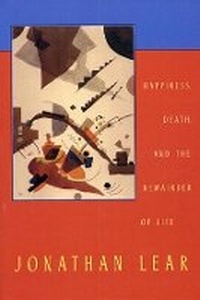
Happiness, Death, and the Remainder of Life
Published on 15. February 2002
Book
Paperback/Softback
204 pages
978-0-674-00674-4 (ISBN)
Description
Separated by millennia, Aristotle and Sigmund Freud gave us disparate but compelling pictures of the human condition. But if, with Jonathan Lear, we scrutinize these thinkers' attempts to explain human behavior in terms of a higher principle-whether happiness or death-the pictures fall apart.
Aristotle attempted to ground ethical life in human striving for happiness, yet he didn't understand what happiness is any better than we do. Happiness became an enigmatic, always unattainable, means of seducing humankind into living an ethical life. Freud fared no better when he tried to ground human striving, aggression, and destructiveness in the death drive, like Aristotle attributing purpose where none exists. Neither overarching principle can guide or govern "the remainder of life," in which our inherently disruptive unconscious moves in breaks and swerves to affect who and how we are. Lear exposes this tendency to self-disruption for what it is: an opening, an opportunity for new possibilities. His insights have profound consequences not only for analysis but for our understanding of civilization and its discontent.
Aristotle attempted to ground ethical life in human striving for happiness, yet he didn't understand what happiness is any better than we do. Happiness became an enigmatic, always unattainable, means of seducing humankind into living an ethical life. Freud fared no better when he tried to ground human striving, aggression, and destructiveness in the death drive, like Aristotle attributing purpose where none exists. Neither overarching principle can guide or govern "the remainder of life," in which our inherently disruptive unconscious moves in breaks and swerves to affect who and how we are. Lear exposes this tendency to self-disruption for what it is: an opening, an opportunity for new possibilities. His insights have profound consequences not only for analysis but for our understanding of civilization and its discontent.
Reviews / Votes
Today, the domain of psychology is hopelessly split between the 'high' theory, caught in its expert language, and the popular self-help manuals addressing people's actual crises and dilemmas. The miracle of Lear's book is that he effortlessly unites these two seemingly incompatible dimensions. Through the most stringent conceptual analysis of the basic notions of the Freudian edifice, he asks the simple crucial questions that gnaw us all: What is happiness? How does psychoanalysis enable us to orient ourselves in today's reality? With envy and admiration, I still wonder how Lear was able to do it! -- Slavoj Zizek, author of <i>The Sublime Object of Ideology</i> Jonathan Lear has done it again! Bringing sophisticated psychoanalytic understanding to a close textual analysis of the Nichomachean Ethics, he demonstrates how both Aristotle's contemplative life and Freud's death instinct were designed to defend against a fundamental problem in constructing a unified view of man, and suggests the outline of a new and original approach-one that will allow us to think of self-disrupting minds in creative but non-principled ways. Lear has continued the rich dialogue that he began in Open Minded, and that spans centuries, cultures, and great minds-from Plato's and Aristotle's Athens, to Freud's Vienna, and finally to Lear's America. This book is essential reading for students of philosophy, ethics, psychoanalysis, and Western civilization. -- Robert Michels, M.D., former Dean, Cornell Medical School These deeply thoughtful and provocative lectures present, dissect, and critique the attempts of both ancient Greek ethics and modern psychoanalytic theory to come to grips with purposefulness in human life. Lear's elegant interweaving of textual exegesis, philosophical reflection, and psychoanalytic theorizing is at once a welcome contribution to scholarship and a highly accessible exploration of the sense that something is missing in life. -- Alan Code, Nicholas C. Petris Professor of Greek Studies, University of California, Berkeley In this book Jonathan Lear provides an invaluable and necessary link between psychoanalysis and philosophy. He describes the break that was introduced into earlier world views by Freud's discovery of the unavoidably irrational and chaotic unconscious part of our mind, and the way the mind internally attacks itself (Freud's death instinct). Lear shows how such a 'break' can be a breakdown or a breakthrough, opening new possibilities and enlarging our horizons. -- Hanna Segal, Training Analyst, British Institute of Psychoanalysis, author of <i>Dream, Phantasy and Art</i> Not many people are equally appreciative of Plato and Freud, and fewer still are able to move back and forth between contemporary discussions among philosophers and the highly technical literature of psychoanalysis as easily as Lear does... Daring and provocative. -- Richard Rorty * New York Times Book Review * Here's an intricate, heavyweight treatment of Aristotle's eudaimonia, Freud's Thanatos, and the role of the unconscious in ethical life that demands a lot of intellectual effort. Yet there's no jargon or obfuscation in it. Lear is doing real philosophical work-engaging both with ideas and with us. -- Norah Vincent * Village Voice * An extended meditation on Aristotle's conception of happiness and Freud's approach to death, the book argues that both thinkers fell prey to a similar illusion...[the thought] that our desires can ever come to an end... There is great depth to Happiness, Death, and the Remainder of Life. -- Andrew Stark * Times Literary Supplement *More details
Series
Language
English
Place of publication
Cambridge, Mass
United States
Target group
College/higher education
Illustrations
none
Dimensions
Height: 210 mm
Width: 140 mm
Thickness: 13 mm
Weight
277 gr
ISBN-13
978-0-674-00674-4 (9780674006744)
Copyright in bibliographic data and cover images is held by Nielsen Book Services Limited or by the publishers or by their respective licensors: all rights reserved.
Schweitzer Classification
Person
Jonathan Lear is John U. Nef Distinguished Service Professor on the Committee on Social Thought and in the Department of Philosophy at the University of Chicago. His works include Wisdom Won from Illness, Radical Hope, A Case for Irony, and Happiness, Death, and the Remainder of Life.