

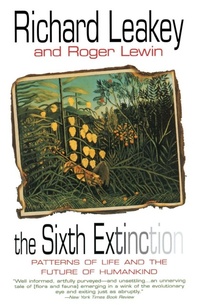
The Sixth Extinction
Patterns of Life and the Future of Humankind
Published on 1. October 1996
Book
Paperback/Softback
288 pages
978-0-385-46809-1 (ISBN)
Description
Richard Leakey, One Of The World's Foremost Experts On Man's Evolutionary Past, Now Turns His Eye To The Future And Doesn't Like What He Sees.
To the philosophical the earth is eternal, while the human race -- presumptive keeper of the world's history -- is a mere speck in the rich stream of life. It is known that nothing upon Earth is forever; geography, climate, and plant and animal life are all subject to radical change. On five occasions in the past, catastrophic natural events have caused mass extinctions on Earth. But today humans stand alone, in dubious distinction, among Earth's species: Homo Sapiens possesses the ability to destroy entire species at will, to trigger the sixth extinction in the history of life. In The Sixth Extinction, Richard Leakey and Roger Lewin consider how the grand sprawl of human life is inexorably wreaking havoc around the world. The authors of Origins and Origins Reconsidered, unimpeachable authorities on the human fossil record, turn their attention to the most uncharted anthropological territory of all: the future, and man's role in defining it. According to Leakey and Lewin, man and his surrounding species are end products of history and chance. Now, however, humans have the unique opportunity to recognize their influence on the global ecosystem, and consciously steer the outcome in order to avoid triggering an unimaginable upheaval.
To the philosophical the earth is eternal, while the human race -- presumptive keeper of the world's history -- is a mere speck in the rich stream of life. It is known that nothing upon Earth is forever; geography, climate, and plant and animal life are all subject to radical change. On five occasions in the past, catastrophic natural events have caused mass extinctions on Earth. But today humans stand alone, in dubious distinction, among Earth's species: Homo Sapiens possesses the ability to destroy entire species at will, to trigger the sixth extinction in the history of life. In The Sixth Extinction, Richard Leakey and Roger Lewin consider how the grand sprawl of human life is inexorably wreaking havoc around the world. The authors of Origins and Origins Reconsidered, unimpeachable authorities on the human fossil record, turn their attention to the most uncharted anthropological territory of all: the future, and man's role in defining it. According to Leakey and Lewin, man and his surrounding species are end products of history and chance. Now, however, humans have the unique opportunity to recognize their influence on the global ecosystem, and consciously steer the outcome in order to avoid triggering an unimaginable upheaval.
More details
Language
English
Place of publication
New York
United States
Publishing group
Bantam Doubleday Dell Publishing Group Inc
Product notice
Paperback (trade)
Dimensions
Height: 203 mm
Width: 132 mm
Thickness: 16 mm
Weight
324 gr
ISBN-13
978-0-385-46809-1 (9780385468091)
Copyright in bibliographic data and cover images is held by Nielsen Book Services Limited or by the publishers or by their respective licensors: all rights reserved.
Schweitzer Classification
Persons
Richard Leakey is the world’s most famous living paleoanthropologist. He resigned from his position as chairman of the National Museums of Kenya when Kenya’s president, Daniel arap Moi appointed him to head the Kenya Wildlife Service. His parents were the archaeologists Louis Leakey and Mary Leakey. His half-brother is the leading plant scientist, Colin Leakey.
Roger Lewin, PhD, is a biochemist, the former deputy editor of the British magazine New Scientist, and the author of Making Waves: Irving Dardik and His Superwave Principle, as well as many other highly praised books on biology such as Complexity: Life at the Edge of Chaos and Patterns in Evolution: The New Molecular View.
Roger Lewin, PhD, is a biochemist, the former deputy editor of the British magazine New Scientist, and the author of Making Waves: Irving Dardik and His Superwave Principle, as well as many other highly praised books on biology such as Complexity: Life at the Edge of Chaos and Patterns in Evolution: The New Molecular View.