

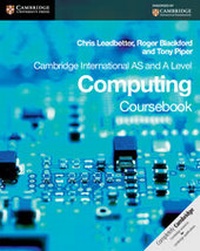
Cambridge International AS and A Level Computing Coursebook
1st Edition
Published on 1. March 2012
Book
Paperback/Softback
444 pages
978-0-521-18662-9 (ISBN)
Description
Written for the University of Cambridge International Examinations' AS and A Level Computing syllabus (9691) by experienced authors and a CIE examiner. It is written with clear explanations using diagrams, screenshots and photos, making it accessible for International students. Self-assessment questions in each chapter and answers at the back of the book give students the opportunity to assess their own revision needs. Exam questions at the end of each Module give the students plenty of practice and a chapter devoted to exam preparation will help them get ready. A detailed Glossary allows quick access to key and/or difficult terms.
More details
Language
English
Place of publication
Cambridge
United Kingdom
Target group
Primary & secondary/elementary & high school
Product notice
Paperback (trade)
Dimensions
Height: 276 mm
Width: 220 mm
Thickness: 17 mm
Weight
1100 gr
ISBN-13
978-0-521-18662-9 (9780521186629)
Copyright in bibliographic data and cover images is held by Nielsen Book Services Limited or by the publishers or by their respective licensors: all rights reserved.
Schweitzer Classification
Other editions
New editions
Sylvia Langfield | Dave Duddell
Cambridge International AS and A Level Computer Science Coursebook
Book
12/2015
Cambridge University Press
€51.38
No shipping information available
Content
Module 1. Computer Systems, Communications and Software: 1.1. Components of a computer system and modes of use; 1.2. System software; 1.3. Data: its representation, structure and management; 1.4. Hardware; 1.5. Data transmission and networking; 1.6. Systems development life cycle; 1.7. Choosing appropriate application software; 1.8. Handling of data in information systems; 1.9. Designing the user interface; 1.10. Logic gates; Module 2. Practical Programming Techniques: 2.1. Designing solutions to problems; 2.2. The structure of procedural programs; 2.3. Data types and data structures; 2.4. Common facilities of procedural languages; 2.5. Writing maintainable programs; 2.6. Testing and running a solution; Module 3. Systems Software Mechanisms, Machine Architecture, Database Theory, Programming Paradigms and Integrated Information Systems: 3.1. The functions of operating systems; 3.2. The function and purpose of translators; 3.3. Computer architectures and the fetch-execute cycle; 3.4. Data representation, data structures and data manipulation; 3.5. Programming paradigms; 3.6. Databases; 3.7. Simulation and real-time processing; 3.8. Networking; Module 4. Computing Project: 4.1. Report; 4.2. Definition, investigation and analysis; 4.3. Design; 4.4. Software development, programming, testing and implementation; 4.5. Documentation; 4.6 Evaluation.