

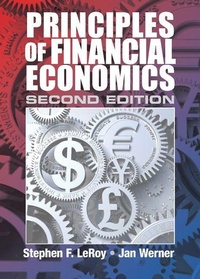
Principles of Financial Economics
2nd Edition
Published on 11. August 2014
Book
Hardback
370 pages
978-1-107-02412-0 (ISBN)
Description
This second edition provides a rigorous yet accessible graduate-level introduction to financial economics. Since students often find the link between financial economics and equilibrium theory hard to grasp, less attention is given to purely financial topics, such as valuation of derivatives, and more emphasis is placed on making the connection with equilibrium theory explicit and clear. This book also provides a detailed study of two-date models because almost all of the key ideas in financial economics can be developed in the two-date setting. Substantial discussions and examples are included to make the ideas readily understandable. Several chapters in this new edition have been reordered and revised to deal with portfolio restrictions sequentially and more clearly, and an extended discussion on portfolio choice and optimal allocation of risk is available. The most important additions are new chapters on infinite-time security markets, exploring, among other topics, the possibility of price bubbles.
Reviews / Votes
'With this new edition, LeRoy and Werner have solidified the standing of their Principles of Financial Economics as the ideal introduction to neoclassical asset pricing models. The coverage is authoritative, rigorous, elegant, and now even more comprehensive.' Darrell Duffie, Dean Witter Distinguished Professor of Finance, Graduate School of Business, Stanford University, California 'This remains the best textbook that marries general equilibrium foundations to the insights and tools of finance, with the addition of a wonderfully lucid analysis of infinite horizon models - with bubbles or au naturel. This is a required text for my introductory graduate finance course.' Stephen A. Ross, Franco Modigliani Professor of Financial Economics, Sloan School, Massachusetts Institute of Technology 'A tour de force of rigor, readability, and clarity. The book seamlessly introduces the beginning doctoral student to financial economics as a natural extension of microeconomic and general equilibrium theory. The book, written by two of the profession's leading experts, is unique.' Rajnish Mehra, Arizona State UniversityMore details
Edition
2nd Revised edition
Language
English
Place of publication
Cambridge
United Kingdom
Target group
Professional and scholarly
Edition type
Revised edition
Illustrations
19 Line drawings, unspecified
Dimensions
Height: 260 mm
Width: 183 mm
Thickness: 24 mm
Weight
890 gr
ISBN-13
978-1-107-02412-0 (9781107024120)
Copyright in bibliographic data and cover images is held by Nielsen Book Services Limited or by the publishers or by their respective licensors: all rights reserved.
Schweitzer Classification
Other editions
Additional editions
Stephen F. LeRoy
Principles of Financial Economics
E-Book
08/2014
Cambridge University Press
€35.49
Available for download
Stephen F. LeRoy | Jan Werner
Principles of Financial Economics
E-Book
08/2014
2nd Edition
Cambridge University Press
€41.49
Available for download
Previous edition
Stephen F. LeRoy | Jan Werner
Principles of Financial Economics
Book
11/2000
Cambridge University Press
€61.90
Article exhausted; check for reprint
Persons
Stephen F. LeRoy is Professor of Economics Emeritus at the University of California, Santa Barbara. Early in his career, he was an economist in the research departments of the Federal Reserve Bank of Kansas City and the Board of Governors of the Federal Reserve System. He then moved to the economics department at the University of California, Santa Barbara. He also served as Carlson Professor of Finance in the Carlson School of Management, University of Minnesota. He has had visiting appointments at the University of California, Berkeley, the University of California, Davis, the California Institute of Technology, and the University of Chicago. He earned his PhD in economics from the University of Pennsylvania. Jan Werner is Professor of Economics at the University of Minnesota. He has taught at the Pompeu Fabra University, Barcelona, the Institute for Advanced Studies in Vienna, and the Central University of Finance and Economics, Beijing. He has had visiting appointments at the University of Bonn, the European University Institute, Florence, and Universite Paris Dauphine. He serves on the editorial boards of Economic Theory, the Journal of Mathematical Economics, the Annals of Finance, and the Central European Journal of Economic Modeling and Econometrics. He earned his PhD in economics from the University of Bonn.
Content
Preface; Part I. Equilibrium and Arbitrage: 1. Equilibrium in security markets; 2. Linear pricing; 3. Arbitrage and positive pricing; Part II. Valuation: 4. Valuation; 5. State prices and risk-neutral probabilities; Part III. Portfolio Restrictions: 6. Portfolio restrictions; 7. Valuation under portfolio restrictions; Part IV. Risk: 8. Expected utility; 9. Risk aversion; 10. Risk; Part V. Optimal Portfolios: 11. Optimal portfolios with one risky security; 12. Comparative statics of optimal portfolios; 13. Optimal portfolios with several risky securities; Part VI. Equilibrium Prices and Allocations: 14. Consumption-based security pricing; 15. Complete markets and Pareto-optimal allocations of risk; 16. Optimality in incomplete markets; Part VII. Mean-Variance Analysis: 17. The expectations and pricing kernels; 18. The mean-variance frontier payoffs; 19. Capital asset pricing model; 20. Factor pricing; Part VIII. Multidate Security Markets: 21. Equilibrium in multidate security markets; 22. Multidate arbitrage and positivity; 23. Dynamically complete markets; 24. Valuation; Part IX. Martingale Property of Security Prices: 25. Event prices, risk-neutral probabilities, and the pricing kernel; 26. Martingale property of gains; 27. Conditional consumption-based security pricing; 28. Conditional beta pricing and the CAPM; Part X. Infinite-Time Security Markets: 29. Equilibrium in infinite-time security markets; 30. Arbitrage, valuation, and price bubbles; 31. Arrow-Debreu equilibrium in infinite time.