

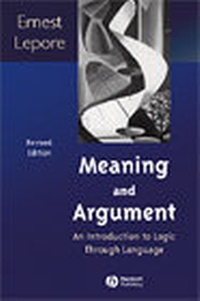
Meaning and Argument
An Introduction to Logic Through Language
2nd Edition
Published on 11. April 2003
Book
Paperback/Softback
456 pages
978-1-4051-0783-9 (ISBN)
Description
Meaning and Argument shifts introductory logic from the traditional emphasis on proofs to the symbolization of arguments. Another distinctive feature of this book is that it shows how the need for expressive power and for drawing distinctions forces formal language development. This volume is ideal as an introduction to formal logic, philosophical logic, and philosophy of language. At each stage of system elaboration and development, the book answers metalogical questions. Why is a particular formalism needed? What must go into such a formalism and why? These questions engage students in a collective inquiry which allows them to see logical studies as a human enterprise aimed at achieving well understood purposes - clarity and good reasoning. This revised edition includes expanded sections, additional exercises, and an updated bibliography.Visit the book's website at: www .meaningargument.com
Reviews / Votes
"Here is logic as it ought to be presented to philosophers, linguists, and anyone else who is interested in how language is organized. In Ernie Lepore's hands grammar comes alive. I recommend this book to all who want to learn what logic is, how to use it, a nd what it is good for." Donald Davidson, University of California Berkeley "With care, imagination, and infectious enthusiasm, Lepore develops a novel and effective general technique of formalization which complete beginners should be able to grasp and use to deal with virtually any example in a first logic course." Bob Hale, University of Glascow"Meaning and Argument is especially strong on the subtleties of translating natural language into formal language, as a necessary step in the clarification of expression and the evaluation of arguments. The range of natural language constructions surveyed is broader and richer than in any competing intro logic text that I am aware of. As such the book provides a solid and attractive introduction to logic not only for philosophy students but for linguists as well." Richard Larson, The University at Stony BrookMore details
Edition
2nd Revised edition
Language
English
Place of publication
Oxford
United Kingdom
Publishing group
John Wiley and Sons Ltd
Target group
College/higher education
Professional and scholarly
graduate and advanced undergraduate students, academics and general readers in philosophy
Edition type
Revised edition
Dimensions
Height: 229 mm
Width: 152 mm
ISBN-13
978-1-4051-0783-9 (9781405107839)
Copyright in bibliographic data and cover images is held by Nielsen Book Services Limited or by the publishers or by their respective licensors: all rights reserved.
Schweitzer Classification
Other editions
Previous edition

Book
01/2000
Blackwell Publishers
€44.75
Article exhausted; check for reprint
Person
Ernest Lepore is Director of the Center for Cognitive Science at Rutgers University. He is the author of numerous articles in philosophy of mind and is co-author (with Jerry Fodor) of Holism (Blackwell, 1991). He is editor of Truth and Interpretation (Blackwell, 1989). He is co-editor (with Zenon Pylyshyn) of What is Cognitive Science? (Blackwell, 1999), and co-editor (with Robert Van Gulick) of John Searle and His Critics (Blackwell, 1992), as well as general editor of the series Philosophers and Their Critics, also published by Blackwell.
Content
Preface to Revised Edition.Acknowledgements. Introduction. 1. A Brief Introduction to Key Terms. 2. Argument Forms and Propositional Logic. 3. Conjunction. 4. Negation. 5. Truth Tables. 6. Disjunction. 7. Conditional. 8. Truth Trees. 9. Property Predicate Logic. 10. Evaluating Arguments in Property Predicate Logic. 11. Property Predicate Logic Refinements. 12. Relational Predicate Logic. 13. Relational Predicate Logic with Nested Quantifiers. 14. Extending the Truth Tree Method to RPL. 15. Negation, Only, and Restrictive Relative Clauses. 16. Relational Predicate Logic with Identity. 17. Verbs and their Modifiers. Appendix. Answers for Selected Exercises. Logical Symbols. Index.