

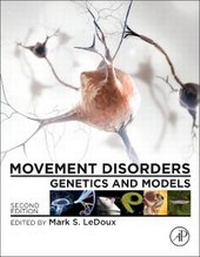
Movement Disorders
Genetics and Models
2nd Edition
Published on 28. November 2014
Book
Hardback
1258 pages
978-0-12-405195-9 (ISBN)
Description
The use of animal models is a key aspect of scientific research in numerous fields of medicine. Movement Disorders, Second Edition vigorously examines the important contributions and application of animal models to the understanding of human movement disorders, and serves as an essential resource for basic neuroscientists engaged in movement disorders research. Academic clinicians, translational researchers and basic scientists are brought together to connect experimental findings made in different animal models to the clinical features, pathophysiology and treatment of human movement disorders.
The book is divided into sections on Parkinson's disease, Huntington's disease, dystonia, tremor, paroxysmal movement disorders, ataxia, myoclonus, restless legs syndrome, drug-induced movement disorders, multiple system atrophy, progressive supranuclear palsy/corticobasal degeneration, and spasticity. This book serves as an essential resource for both clinicians interested in the science being generated with animal models and basic scientists studying the pathogenesis of particular movement disorders.
The book is divided into sections on Parkinson's disease, Huntington's disease, dystonia, tremor, paroxysmal movement disorders, ataxia, myoclonus, restless legs syndrome, drug-induced movement disorders, multiple system atrophy, progressive supranuclear palsy/corticobasal degeneration, and spasticity. This book serves as an essential resource for both clinicians interested in the science being generated with animal models and basic scientists studying the pathogenesis of particular movement disorders.
Reviews / Votes
Praise for the first edition:"The book is a timely review of animal models of movement disorders...The text is an excellent resource for neurologists and researchers specializing in movement disorders. In addition, this book will undoubtedly be a useful reference source for general neurologists, neurology residents, and basic science fellow and students." --Zbigniew K. Wszolek, Department of Neurology, Mayo Clinic Jacksonville in PARKINSONISM AND RELATED DISORDERS (September 2005)"...this new textbook provides a comprehensive treatment of animal models used to study human movement disorders and should serve the neurologist, researcher, and other interested scientists very well." --Dr. A.S. Fix, Central Product Safety, The Proctor and Gamble Co, Miami Valley Innovation Center, Cincinnati, OH, in VETERINARY PATHOLOGY (43:5) 2006
More details
Edition
2nd edition
Language
English
Place of publication
San Diego
United States
Publishing group
Elsevier Science Publishing Co Inc
Target group
Professional and scholarly
General neurologists, neurologists with subspecialty interest in movement disorders, neuroscientists, rehabilitation physicians, psychiatrists, and academic veterinarians with an interest in animal models.
Illustrations
Approx. 200 illustrations (50 in full color)
Dimensions
Height: 276 mm
Width: 216 mm
Weight
2760 gr
ISBN-13
978-0-12-405195-9 (9780124051959)
Copyright in bibliographic data and cover images is held by Nielsen Book Services Limited or by the publishers or by their respective licensors: all rights reserved.
Schweitzer Classification
Other editions
Additional editions
E-Book
10/2014
2nd Edition
Academic Press
€230.00
Available for download
Previous edition
Book
01/2005
Academic Press
€266.17
Withdrawn from sale
Person
Mark S. LeDoux, MD, PhD is a physician-scientist at the University of Tennessee Health Science Center. At present he holds a joint appointment as Professor in the Departments of Neurology, and Anatomy and Neurobiology. He specializes in the neurological subspecialty of movement disorders and treats patients at the University of Tennessee Medical Group and Memphis VA hospital. As an active clinical researcher, Dr. LeDoux's work has focused on the genetics and treatment of dystonia, Parkinson disease and Huntington disease. He has described Huntington disease in a nonagenarian and reported one of the world's largest pedigrees with HDL2. In the laboratory, Dr. LeDoux has published extensively on the genetics and molecular biology of dystonia, mechanisms of cell death in Parkinson's disease, animal models of dystonia and autism, and the neuroanatomy of motor systems. His work with the dt rat engendered paradigm shifts in dystonia and motor systems research. Dr. LeDoux's lab showed that familial and sporadic adult-onset primary dystonia may be associated with rare sequence variants in THAP1 and CIZ1.
Content
Section I. Scientific Foundations
Section II. Parkinson Disease
Section III. Dystonia; Dystonia: Phenotypes and Genetics
Section IV. Huntington Disease
Section V. Tremor
Section VI. Myoclonus
Section VII. Tics
Section VIII. Paroxysmal Movement Disorders
Section IX. Tauopathies
Section X. Other Parkinsonian Syndromes: NBIA, MSA, PD+spasticity, PD+dystonia
Section XI. Ataxias
Section XII. Hereditary Spastic Paraplegia
Section XIII. Restless Legs Syndrome
Section II. Parkinson Disease
Section III. Dystonia; Dystonia: Phenotypes and Genetics
Section IV. Huntington Disease
Section V. Tremor
Section VI. Myoclonus
Section VII. Tics
Section VIII. Paroxysmal Movement Disorders
Section IX. Tauopathies
Section X. Other Parkinsonian Syndromes: NBIA, MSA, PD+spasticity, PD+dystonia
Section XI. Ataxias
Section XII. Hereditary Spastic Paraplegia
Section XIII. Restless Legs Syndrome