

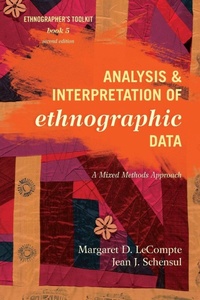
Analysis and Interpretation of Ethnographic Data
A Mixed Methods Approach
2nd Edition
Published on 5. September 2012
Book
Paperback/Softback
358 pages
978-0-7591-2207-9 (ISBN)
Description
This is Book 5 of 7 in the Ethnographer's Toolkit, Second Edition.
Treating analysis as both a mechanical and a cognitive process, Book 5 begins by describing why analysis and interpretation of data are necessary. In the first two chapters the book points out the importance of beginning ethnographic analysis in the field, during the earliest stages of data collection, and how to move between induction and deduction, the concrete and the abstract, in a process informed by an emerging and increasingly refined conceptual model. The middle section tackles the challenge of transforming huge piles of text, audio, and visual information into
an ethnographic whole through generic and specific coding and quantification of qualitative data, using multiple extended examples. Chapters show how to use computers in analysis of qualitative data and ways to integrate the results of quantitative and qualitative data into a comprehensive picture of a complex whole. Chapter 9 presents a rare and comprehensive description of the statistics
regularly used by ethnographers to analyze ethnographic surveys. Chapters 10 and 11 show how researchers create and then fine-tune preliminary results into an integrated whole, display them for multiple audiences, and write them up. The final chapter illustrates how ethnographers can share the meaning of results with local communities and constituents and with other professional researchers.
Other books in the set:
Book 1:
Designing and Conducting Ethnographic Research: An Introduction, Second Edition
by Margaret D. LeCompte and Jean J. Schensul
9780759118690
Book 2:
Initiating Ethnographic Research: A Mixed Methods Approach
by Stephen L. Schensul, Jean J. Schensul, and Margaret D. LeCompte
9780759122017
Book 3:
Essential Ethnographic Methods: A Mixed Methods Approach, Second Edition
by Jean J. Schensul and Margaret D. LeCompte
9780759122031
Book 4:
Specialized Ethnographic Methods: A Mixed Methods Approach
edited by Jean J. Schensul and Margaret D. LeCompte
9780759122055
Book 6:
Ethics in Ethnography: A Mixed Methods Approach
by Margaret D. LeCompte and Jean J. Schensul
9780759122093
Book 7:
Ethnography in Action: A Mixed Methods Approach
by Jean J. Schensul and Margaret D. LeCompte
9780759122116
Treating analysis as both a mechanical and a cognitive process, Book 5 begins by describing why analysis and interpretation of data are necessary. In the first two chapters the book points out the importance of beginning ethnographic analysis in the field, during the earliest stages of data collection, and how to move between induction and deduction, the concrete and the abstract, in a process informed by an emerging and increasingly refined conceptual model. The middle section tackles the challenge of transforming huge piles of text, audio, and visual information into
an ethnographic whole through generic and specific coding and quantification of qualitative data, using multiple extended examples. Chapters show how to use computers in analysis of qualitative data and ways to integrate the results of quantitative and qualitative data into a comprehensive picture of a complex whole. Chapter 9 presents a rare and comprehensive description of the statistics
regularly used by ethnographers to analyze ethnographic surveys. Chapters 10 and 11 show how researchers create and then fine-tune preliminary results into an integrated whole, display them for multiple audiences, and write them up. The final chapter illustrates how ethnographers can share the meaning of results with local communities and constituents and with other professional researchers.
Other books in the set:
Book 1:
Designing and Conducting Ethnographic Research: An Introduction, Second Edition
by Margaret D. LeCompte and Jean J. Schensul
9780759118690
Book 2:
Initiating Ethnographic Research: A Mixed Methods Approach
by Stephen L. Schensul, Jean J. Schensul, and Margaret D. LeCompte
9780759122017
Book 3:
Essential Ethnographic Methods: A Mixed Methods Approach, Second Edition
by Jean J. Schensul and Margaret D. LeCompte
9780759122031
Book 4:
Specialized Ethnographic Methods: A Mixed Methods Approach
edited by Jean J. Schensul and Margaret D. LeCompte
9780759122055
Book 6:
Ethics in Ethnography: A Mixed Methods Approach
by Margaret D. LeCompte and Jean J. Schensul
9780759122093
Book 7:
Ethnography in Action: A Mixed Methods Approach
by Jean J. Schensul and Margaret D. LeCompte
9780759122116
More details
Series
Edition
2nd edition
Language
English
Place of publication
California
United States
Target group
Professional and scholarly
Dimensions
Height: 229 mm
Width: 152 mm
Thickness: 19 mm
Weight
522 gr
ISBN-13
978-0-7591-2207-9 (9780759122079)
Copyright in bibliographic data and cover images is held by Nielsen Book Services Limited or by the publishers or by their respective licensors: all rights reserved.
Schweitzer Classification
Other editions
Additional editions
Margaret D. LeCompte | Jean J. Schensul
Analysis and Interpretation of Ethnographic Data
A Mixed Methods Approach
E-Book
09/2012
2nd Edition
AltaMira Press
€47.49
Available for download
Margaret D. LeCompte | Jean J. Schensul
Analysis and Interpretation of Ethnographic Data
A Mixed Methods Approach
E-Book
09/2012
2nd Edition
Bloomsbury eBooks US
€47.49
Available for download
Persons
Margaret D. LeCompte is professor emerita of education and sociology at the University of Colorado, Boulder.
Jean J. Schensul is founding director and senior scientist at the Institute for Community Research, Hartford, Connecticut.
Jean J. Schensul is founding director and senior scientist at the Institute for Community Research, Hartford, Connecticut.
Content
List of Tables and Figures
List of Examples
Introduction
Chapter 1: Why Are Analysis and Interpretation Necessary?
Chapter 2: Analysis in the Field
Chapter 3: Tidying Up, Cataloging, and Creating Data Inventories
Chapter 4: Recursivity, Induction, and Deduction: Moving Between Levels of Abstraction
Chapter 5: Ways to Begin Analysis
Chapter 6: Specific Coding and Initial Quantification
Chapter 7: Coding and Creating Qualitative Code Books
Chapter 8: Managing Qualitative and Quantitative Data with Computers
Chapter 9: Analyzing Ethnographically Based Survey Data
Chapter 10: Creating Preliminary Results: Putting Parts Together
Chapter 11: Fine Tuning Results and Beginning the Write-Up
Chapter 12: Creating Interpretations
References
Index
About the Authors and Artists
List of Examples
Introduction
Chapter 1: Why Are Analysis and Interpretation Necessary?
Chapter 2: Analysis in the Field
Chapter 3: Tidying Up, Cataloging, and Creating Data Inventories
Chapter 4: Recursivity, Induction, and Deduction: Moving Between Levels of Abstraction
Chapter 5: Ways to Begin Analysis
Chapter 6: Specific Coding and Initial Quantification
Chapter 7: Coding and Creating Qualitative Code Books
Chapter 8: Managing Qualitative and Quantitative Data with Computers
Chapter 9: Analyzing Ethnographically Based Survey Data
Chapter 10: Creating Preliminary Results: Putting Parts Together
Chapter 11: Fine Tuning Results and Beginning the Write-Up
Chapter 12: Creating Interpretations
References
Index
About the Authors and Artists