

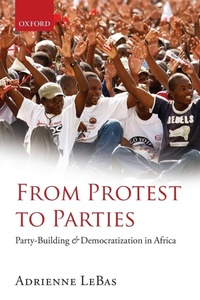
From Protest to Parties
Party-Building and Democratization in Africa
Published on 23. May 2013
Book
Paperback/Softback
316 pages
978-0-19-967300-1 (ISBN)
Description
Why do strong opposition party organizations emerge in some democratizing countries, while those in others remain weak or quickly fragment on ethnic lines? From Protest to Parties provides an explanation for differences in opposition party strength in democratizing regimes in Africa that remain far from democratic. The book argues that strong parties benefit from pre-existing mobilizing structures that transcend ethnic and other cleavages. These mobilizing structures are a legacy of authoritarian rule. Where authoritarian states relied on alliances with corporate actors, notably organized labor, they unintentionally armed their allies, providing them with structures and resources that could later be used to effectively challenge the state. Secondly, opposition parties are more likely to maintain their organizational cohesion and the commitment of activists when they use strategies and appeals that escalate conflict and reorient social boundaries around the lines of partisan affiliation. Polarization forges stronger parties, but it also increases the likelihood of violence and authoritarian retrenchment.
From Protest to Parties draws upon an in-depth analysis of three countries in Anglophone Africa: Zimbabwe, Zambia and Kenya. Though these countries share similar institutional frameworks, including electoral rules, opposition party development takes a different route in each. In addition to providing a unique window into the politics of mobilization and protest in closed political regimes, the book sheds light on how the choices of political elites affect organizational development.
From Protest to Parties draws upon an in-depth analysis of three countries in Anglophone Africa: Zimbabwe, Zambia and Kenya. Though these countries share similar institutional frameworks, including electoral rules, opposition party development takes a different route in each. In addition to providing a unique window into the politics of mobilization and protest in closed political regimes, the book sheds light on how the choices of political elites affect organizational development.
Reviews / Votes
This book is a major contribution. Nearly all political scientists agree that strong parties are critical to achieving and sustaining democracy, but party-building in the developing world has proven far more difficult than many scholars anticipated. From Protest to Parties offers a new - and highly compelling - theory of why strong opposition parties emerge in some contexts but not others. Based on impressive field research in Kenya, Zambia, and Zimbabwe, the book shows that robust party organizations are often forged during periods of intense polarization and conflict. This book is helping to reshape scholarly debates about party formation. It should be required reading for anyone interested in parties and party organization in the developing world. * Steve Levitsky, Professor of Government, Harvard University * The intricate exploration of the origins and outcomes of political party development in From Protest to Parties shows that conflict is a double-edged sword. It can amplify popular protests and make parties stronger, thereby promoting democracy, but it can also trigger authoritarian backlash. By comparing well-chosen cases from three African countries, LeBas helps move forward our understanding of the divergent dynamics of contemporary political change. * Michael Bratton, University Distinguished Professor of Political Science and African Studies, Michigan State University * How can activists build strong opposition parties to overturn single-party rule? And how can they build such parties despite ethnic divisions and the ever-present threat of repression? She shows that the strategies of both rulers and activists, with their frequently unintended consequences, provide the main answers. Polarization and conflict, LeBas finds, can encourage democratization as much as consensus and negotiation - even as they increase the risk of a repressive backlash by rulers. This important book will interest many audiences, including scholars of social movements and "contentious politics." * Jeff Goodwin, New York University * Following giants like Jackson and Rosberg, LeBas masterfully refines our understanding of how variation - not uniformity - in authoritarian experience continues to shape democratization in sub-Saharan Africa. At the same time, she captures the critical role that choices of elite actors play. The systematic juxtaposition of "Legacy and Choice" is at the heart of this splendid book. * Staffan I. Lindberg, Associate Professor of Political Science, University of Gothenburg & University of Florida * Extensive interviews, sometimes under difficult circumstances, paved the way for this innovative and thought-provoking book ... [LeBas] has produced an important piece of research that will leave scholars thinking for some time to come. * Comparative Political Studies * I strongly recommend this book to students, analysts, and policy makers who are interested in contemporary African politics and processes of democratization. The central arguments are clear, original, and persuasive; the analyses encourage one to think about democratization and political parties in new ways; and I, for one, learnt a lot about the three country case studies discussed. * Gabrielle Lynch, African Affairs *More details
Language
English
Place of publication
Oxford
United Kingdom
Target group
College/higher education
Dimensions
Height: 234 mm
Width: 156 mm
Thickness: 17 mm
Weight
483 gr
ISBN-13
978-0-19-967300-1 (9780199673001)
Copyright in bibliographic data and cover images is held by Nielsen Book Services Limited or by the publishers or by their respective licensors: all rights reserved.
Schweitzer Classification
Other editions
Additional editions

Book
04/2011
1st Edition
Oxford University Press
€180.60
Shipment within 15-20 days
Person
Adrienne LeBas is an Assistant Professor of Government at the School of Public Affairs, American University, Washington, DC. She previously taught at Michigan State University and was a Postdoctoral Prize Research Fellow at Nuffield College, University of Oxford. Her current work examines popular responses to political violence in Kenya.
Content
PART I: INTRODUCTION; PART II: HISTORICAL LEGACIES; PART III: THE ORGANIZATION OF PROTEST; PART IV: THE FORMATION OF PARTIES