

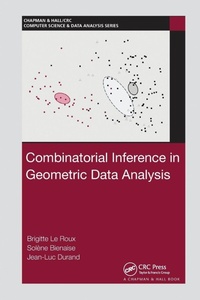
Combinatorial Inference in Geometric Data Analysis
1st Edition
Published on 30. June 2021
Book
Paperback/Softback
268 pages
978-1-032-09373-4 (ISBN)
Description
Geometric Data Analysis designates the approach of Multivariate Statistics that conceptualizes the set of observations as a Euclidean cloud of points. Combinatorial Inference in Geometric Data Analysis gives an overview of multidimensional statistical inference methods applicable to clouds of points that make no assumption on the process of generating data or distributions, and that are not based on random modelling but on permutation procedures recasting in a combinatorial framework.
It focuses particularly on the comparison of a group of observations to a reference population (combinatorial test) or to a reference value of a location parameter (geometric test), and on problems of homogeneity, that is the comparison of several groups for two basic designs. These methods involve the use of combinatorial procedures to build a reference set in which we place the data. The chosen test statistics lead to original extensions, such as the geometric interpretation of the observed level, and the construction of a compatibility region.
Features:
Defines precisely the object under study in the context of multidimensional procedures, that is clouds of points
Presents combinatorial tests and related computations with R and Coheris SPAD software
Includes four original case studies to illustrate application of the tests
Includes necessary mathematical background to ensure it is self-contained
This book is suitable for researchers and students of multivariate statistics, as well as applied researchers of various scientific disciplines. It could be used for a specialized course taught at either master or PhD level.
It focuses particularly on the comparison of a group of observations to a reference population (combinatorial test) or to a reference value of a location parameter (geometric test), and on problems of homogeneity, that is the comparison of several groups for two basic designs. These methods involve the use of combinatorial procedures to build a reference set in which we place the data. The chosen test statistics lead to original extensions, such as the geometric interpretation of the observed level, and the construction of a compatibility region.
Features:
Defines precisely the object under study in the context of multidimensional procedures, that is clouds of points
Presents combinatorial tests and related computations with R and Coheris SPAD software
Includes four original case studies to illustrate application of the tests
Includes necessary mathematical background to ensure it is self-contained
This book is suitable for researchers and students of multivariate statistics, as well as applied researchers of various scientific disciplines. It could be used for a specialized course taught at either master or PhD level.
More details
Series
Language
English
Place of publication
Oxford
United Kingdom
Publishing group
Taylor & Francis Ltd
Target group
College/higher education
Illustrations
145 s/w Abbildungen
145 Illustrations, black and white
Dimensions
Height: 234 mm
Width: 156 mm
Thickness: 15 mm
Weight
415 gr
ISBN-13
978-1-032-09373-4 (9781032093734)
Copyright in bibliographic data and cover images is held by Nielsen Book Services Limited or by the publishers or by their respective licensors: all rights reserved.
Schweitzer Classification
Other editions
Additional editions
Brigitte Le Roux | Solene Bienaise | Jean-Luc Durand
Combinatorial Inference in Geometric Data Analysis
E-Book
03/2019
1st Edition
Chapman & Hall/CRC
€61.99
Available for download
Brigitte Le Roux | Solene Bienaise | Jean-Luc Durand
Combinatorial Inference in Geometric Data Analysis
E-Book
03/2019
1st Edition
Chapman & Hall/CRC
€61.99
Available for download
Brigitte Le Roux | Solene Bienaise | Jean-Luc Durand
Combinatorial Inference in Geometric Data Analysis
Book
02/2019
1st Edition
Chapman & Hall/CRC
€165.40
Shipment within 15-20 days
Persons
Brigitte Le Roux is associate researcher at Laboratoire de Mathematiques Appliquees (MAP5/CNRS) of the Paris Descartes university and at the political research center of Sciences-Po Paris (CEVIPOF/CNRS). She completed her doctoral dissertation in applied mathematics at the Faculte des Sciences de Paris in 1970 that was supervised by Jean-Paul Benzecri. She has contributed to numerous theoretical research works and full scale empirical studies involving Geometric Data Analysis. She has authored and co-authored nine books, especially on Geometric Data Analysis (2004, Kluwer Academic Publishers) and Multiple Correspondence Analysis (2010, QASS series of Sage publications, n degrees 163).
Solene Bienaise is data scientist at Coheris (company). She completed her doctoral dissertation in applied mathematics in 2013 at the Paris Dauphine University, under the direction of Pierre Cazes and Brigitte Le Roux.
Jean-Luc Durand is associate professor at the Psychology department and researcher at LEEC (Laboratoire d'Ethologie Experimentale et Comparee) of Paris 13 University. He completed his doctoral dissertation in Psychology at Paris Descartes University in 1989, supervised by Henry Rouanet. He teaches statistical methodology in psychology and ethology.
Solene Bienaise is data scientist at Coheris (company). She completed her doctoral dissertation in applied mathematics in 2013 at the Paris Dauphine University, under the direction of Pierre Cazes and Brigitte Le Roux.
Jean-Luc Durand is associate professor at the Psychology department and researcher at LEEC (Laboratoire d'Ethologie Experimentale et Comparee) of Paris 13 University. He completed his doctoral dissertation in Psychology at Paris Descartes University in 1989, supervised by Henry Rouanet. He teaches statistical methodology in psychology and ethology.
Content
Euclidean Cloud. Geometric Typicality Test. Set-Theoretic Typicality Test. Homogeneity Tests. Mathematical Bases. Research Case Studies.