

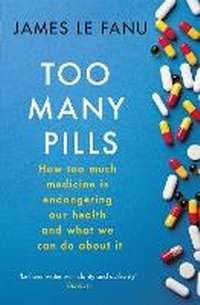
Too Many Pills
How Too Much Medicine is Endangering Our Health and What We Can Do About It
Published on 24. May 2018
Book
Paperback/Softback
320 pages
978-1-4087-0977-1 (ISBN)
Description
The number of prescriptions issued by family doctors has soared threefold in just fifteen years with millions now committed to taking a cocktail of half a dozen (or more) different pills to lower the blood pressure and sugar levels, statins, bone strengthening and cardio protective drugs. In Too Many Pills, doctor and writer James Le Fanu examines how this progressive medicalisation of people's lives now poses a major threat to their health and wellbeing, responsible for a hidden epidemic of drug induced illness (muscular aches and pains, lethargy, insomnia, impaired memory and general decrepitude), a sharp increase in the number of emergency hospital admissions for serious side effects and implicated in the recently noted decline in life expectancy.
The paradoxically harmful, if increasingly well recognised, consequences of too much medicine are illustrated by the remarkable personal testimony of the readers of James Le Fanu's weekly medical column, coerced into taking drugs they do not need, debilitated by their adverse effects - and their almost miraculous recovery on discontinuing them. The only solution, he argues, is for the public to take the initiative. His review of the relevant evidence for the efficacy, or otherwise, of commonly prescribed drugs should allow readers of Too Many Pills to ask much more searching questions about the benefits and risks of the medicines they are taking.
The paradoxically harmful, if increasingly well recognised, consequences of too much medicine are illustrated by the remarkable personal testimony of the readers of James Le Fanu's weekly medical column, coerced into taking drugs they do not need, debilitated by their adverse effects - and their almost miraculous recovery on discontinuing them. The only solution, he argues, is for the public to take the initiative. His review of the relevant evidence for the efficacy, or otherwise, of commonly prescribed drugs should allow readers of Too Many Pills to ask much more searching questions about the benefits and risks of the medicines they are taking.
Reviews / Votes
James Le Fanu meticulously dissects the science, spin and unethical practices -- Gavin Francis * The Times * This is a profoundly disturbing book . . . written with a passionate clarity that illuminates the most complex matters -- Bryan Appleyard * Sunday Times * James Le Fanu is our most incisive medical journalist, and in his excellent new book he turns his attention to the dangerous and expensive phenomenon of over-prescribing . . . Too Many Pills is above praise for its clarity, its elegance of argumentation, its humanity and its uncommon common sense * Literary Review * Le Fanu writes with great clarity. He makes complex synthesised data available and clear to the non-specialist, without ever dumbing down * Telegraph *More details
Language
English
Place of publication
London
United Kingdom
Publishing group
Little, Brown Book Group
Product notice
Paperback (UK-trade)
Dimensions
Height: 158 mm
Width: 235 mm
Thickness: 23 mm
Weight
415 gr
ISBN-13
978-1-4087-0977-1 (9781408709771)
Copyright in bibliographic data and cover images is held by Nielsen Book Services Limited or by the publishers or by their respective licensors: all rights reserved.
Schweitzer Classification
Person
James Le Fanu has combined a career as a General Practitioner in South London with writing about medicine and science for the Sunday and Daily Telegraph. He has also contributed articles and reviews to The Times, Spectator, New Statesman, Literary Review, British Medical Journal and Journal of The Royal Society of Medicine. His much acclaimed 'The Rise and Fall of Modern Medicine' won the Los Angeles Times book prize in 2001. His most recent book, 'Why Us?', was published jointly by HarperCollins in the UK and Random House in the US in 2009. He was elected a Fellow of the Royal College of Physicians in 2014.