

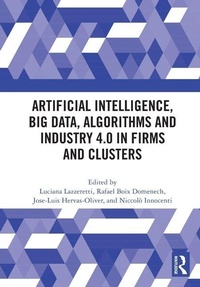
Artificial Intelligence, Big Data, Algorithms and Industry 4.0 in Firms and Clusters
1st Edition
Will be published approx. on 20. July 2026
Book
Paperback/Softback
196 pages
978-1-032-84853-2 (ISBN)
Description
This volume offers a wide-ranging discussion on the interrelations among AI, algorithms, big data, and Industry 4.0 to understand the importance of these new paradigms for the development of firms, districts, clusters, cities, regions, and innovation.
Drawing on theoretical, empirical, and qualitative studies and using local perspectives, the chapters in this book explore theoretical aspects of AI and its evolution in social sciences, focusing on industry 4.0, smart cities, big data, and other related topics. They examine the role of industrial robots in employment, productivity, and knowledge absorption in industrial districts. They also discuss innovation in the context of local production systems, AI ecosystems, and the growth and potential of the Metaverse. Taken together, the book offers insights to help understand the new dynamics generated by the advent of these technologies and how they may affect regions, cities, clusters, industries, and organizations, and identifies avenues for future research in the development of new trajectories for clusters and firms.
This book will be a key resource for scholars and advanced students in the fields of economics, geography, architecture, planning, and management as well as for interdisciplinary researchers who want to learn more about the development of new technologies, the relevance of AI, Big Data and I4.0 for firms and in relation to their adoption in clusters. This book was originally published as a special issue of European Planning Studies.
Drawing on theoretical, empirical, and qualitative studies and using local perspectives, the chapters in this book explore theoretical aspects of AI and its evolution in social sciences, focusing on industry 4.0, smart cities, big data, and other related topics. They examine the role of industrial robots in employment, productivity, and knowledge absorption in industrial districts. They also discuss innovation in the context of local production systems, AI ecosystems, and the growth and potential of the Metaverse. Taken together, the book offers insights to help understand the new dynamics generated by the advent of these technologies and how they may affect regions, cities, clusters, industries, and organizations, and identifies avenues for future research in the development of new trajectories for clusters and firms.
This book will be a key resource for scholars and advanced students in the fields of economics, geography, architecture, planning, and management as well as for interdisciplinary researchers who want to learn more about the development of new technologies, the relevance of AI, Big Data and I4.0 for firms and in relation to their adoption in clusters. This book was originally published as a special issue of European Planning Studies.
More details
Language
English
Place of publication
London
United Kingdom
Publishing group
Taylor & Francis Ltd
Target group
College/higher education
Postgraduate, Undergraduate Advanced, and Undergraduate Core
Dimensions
Height: 246 mm
Width: 174 mm
ISBN-13
978-1-032-84853-2 (9781032848532)
Copyright in bibliographic data and cover images is held by Nielsen Book Services Limited or by the publishers or by their respective licensors: all rights reserved.
Schweitzer Classification
Other editions
Additional editions
Luciana Lazzeretti | Rafael Boix-Domenech | Jose-Luis Hervas-Oliver
Artificial Intelligence, Big Data, Algorithms and Industry 4.0 in Firms and Clusters
Book
10/2024
1st Edition
Routledge
€230.60
Shipment within 10-20 days
Luciana Lazzeretti | Rafael Boix-Domenech | Jose-Luis Hervas-Oliver
Artificial Intelligence, Big Data, Algorithms and Industry 4.0 in Firms and Clusters
E-Book
10/2024
1st Edition
Routledge
€212.99
Available for download
Luciana Lazzeretti | Rafael Boix-Domenech | Jose-Luis Hervas-Oliver
Artificial Intelligence, Big Data, Algorithms and Industry 4.0 in Firms and Clusters
E-Book
10/2024
1st Edition
Routledge
€212.99
Available for download
Persons
Luciana Lazzeretti is Full professor of Management at the Department of Economics and Management, University of Florence, Italy.
Rafael Boix Domenech is Full professor of Economic Structure at the Faculty of Economics, Department of Economic Structure, University of Valencia, Spain.
Jose-Luis Hervas-Oliver is Full professor of Management at the Departamento de Organizacion de Empresas, Universitat Politecnica de Valencia, Spain.
Niccolo Innocenti is Assistant professor of Management at the Department of Economics and Management, University of Florence, Italy.
Rafael Boix Domenech is Full professor of Economic Structure at the Faculty of Economics, Department of Economic Structure, University of Valencia, Spain.
Jose-Luis Hervas-Oliver is Full professor of Management at the Departamento de Organizacion de Empresas, Universitat Politecnica de Valencia, Spain.
Niccolo Innocenti is Assistant professor of Management at the Department of Economics and Management, University of Florence, Italy.
Content
Introduction: Artificial intelligence, big data, algorithms and Industry 4.0 in firms and clusters 1. The emergence of artificial intelligence in the regional sciences: a literature review 2. Artificial intelligence in hospitality and tourism. State of the art and future research avenues 3. Learning as imitation or mimesis: how 'smart' is machine learning for its planning controllers? 4. Does regional innovation policy really work for Industry 4.0? Evidence for industrial districts 5. The actors' role in industrial districts facing the challenge of technologies 4.0 between absorption and dissemination 6. Robots and the productivity of local manufacturing systems in Emilia-Romagna: the mediating role of occupational similarity and complexity 7. Living innovation machines: modelling innovation in time and space variable-geometry territorial units using machine learning 8. The mechanisms underlying the emergence of innovation ecosystems: the case of the AI ecosystem in Montreal 9. How real will the metaverse be? Exploring the spatial impact of virtual worlds