

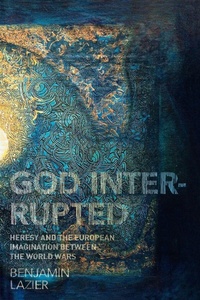
God Interrupted
Heresy and the European Imagination between the World Wars
Will be published approx. on 24. June 2012
Book
Paperback/Softback
272 pages
978-0-691-15541-8 (ISBN)
Description
Could the best thing about religion be the heresies it spawns? Leading intellectuals in interwar Europe thought so. They believed that they lived in a world made derelict by God's absence and the interruption of his call. In response, they helped resurrect gnosticism and pantheism, the two most potent challenges to the monotheistic tradition. In God Interrupted, Benjamin Lazier tracks the ensuing debates about the divine across confessions and disciplines. He also traces the surprising afterlives of these debates in postwar arguments about the environment, neoconservative politics, and heretical forms of Jewish identity. In lively, elegant prose, the book reorients the intellectual history of the era. God Interrupted also provides novel accounts of three German-Jewish thinkers whose ideas, seminal to fields typically regarded as wildly unrelated, had common origins in debates about heresy between the wars. Hans Jonas developed a philosophy of biology that inspired European Greens and bioethicists the world over. Leo Strauss became one of the most important and controversial political theorists of the twentieth century.
Gershom Scholem, the eminent scholar of religion, radically recast what it means to be a Jew. Together they help us see how talk about God was adapted for talk about nature, politics, technology, and art. They alert us to the abiding salience of the divine to Europeans between the wars and beyond--even among those for whom God was long missing or dead.
Gershom Scholem, the eminent scholar of religion, radically recast what it means to be a Jew. Together they help us see how talk about God was adapted for talk about nature, politics, technology, and art. They alert us to the abiding salience of the divine to Europeans between the wars and beyond--even among those for whom God was long missing or dead.
Reviews / Votes
Winner of the 2008 John Templeton Award for Theological Promise Co-Winner of the 2008 Best First Book in the History of Religions, American Academy of Religion "Elegant... Heresies, Lazier argues, represented an object of interest and inspiration. Yet his finely wrought analyses demonstrate that while all his subjects were indeed fascinated by the issues these heresies raised, they were less a source of inspiration than challenges in need of resistance, reworking, and overcoming."--Steven E. Aschheim, Times Literary Supplement "God Interrupted is intellectual history of a high order: eye-opening, skillfully wrought, rich in implication and touched with literary flair... [I]n writing of a pivotal moment in modern theology's history and its reverberations, he has not only made his case for its wide historical significance but also crafted a book that provoke those still struggling to determine the amplitude and frequency of the God's oft-interrupted call."--Robert Westbrook, Christian Century "[W]onderful, erudite, and beautifully written ... "--Anna Yeatman, H-Net "The brilliant scholar Benjamin Lazier makes a convincing case that two religious heresies exerted far-reaching influence on Weimar-era thought well beyond the confines of religion... Lazier navigates the eddies and tributaries of these intellectual currents with astonishing clarity, erudition, confidence, and wit. This book is a landmark, a tour de force of both synthesis and original thought."--Jewish Book World "What Commonweal readers would find most rewarding about ... Lazier's intellectual history is that [it] succeed[s] in giving a sense of the organic environment ... in which the philosopher's intellectual life was rooted and from which it richly sprang. For the same reason, Commonweal readers might also find [this] book somewhat disturbing, for [it] serve[s] as [a] reminder of a deep anti-Semitism that, as the recent controversy over Pope Benedict's rehabilitation of the Society of St. Pius X indicated, has not been entirely uprooted from Christianity to this day."--Bernard G. Prusak, Commonweal "It is quite the conceptual task to bring together these three seemingly disparate thinkers under a coherent conceptual roof. The way that the gnosticism-pantheism dialectic threads together these three thinkers is impressive. It is perhaps no surprise that Lazier received the 2008 Templeton Award for Theological Promise."--Clarence W. Joldersma, Perspectives on Science and Christian Faith "This rich and informative intellectual history is a compelling challenge to historians to take theology seriously by convincingly arguing for the importance of the theology of heresy ... for a comprehensive understanding of these three scholars' life and work... Grippingly persuasive."--Yotam Hotam, Journal of Modern History "This book is highly recommended for those who want to catch a theological-philosophical glimpse into the challenges faced by those who lived during the interwar period."--Wessel Bentley, Studia Historiae EcclesiasticaeMore details
Language
English
Place of publication
New Jersey
United States
Target group
College/higher education
Professional and scholarly
Product notice
Paperback (trade)
Dimensions
Height: 234 mm
Width: 156 mm
Thickness: 15 mm
Weight
418 gr
ISBN-13
978-0-691-15541-8 (9780691155418)
Copyright in bibliographic data and cover images is held by Nielsen Book Services Limited or by the publishers or by their respective licensors: all rights reserved.
Schweitzer Classification
Other editions
Additional editions
E-Book
11/2010
1st Edition
Princeton University Press
€36.99
Available for download
Person
Benjamin Lazier is assistant professor of history and humanities at Reed College. He is a recipient of the 2008 John Templeton Award for Theological Promise.
Content
Preface and Acknowledgments xi Introduction 1 Part One: Overcoming Gnosticism Chapter One: The Gnostic Return 27 Chapter Two: Romans in Weimar 37 Chapter Three: Overcoming Gnosticism 49 Chapter Four: After Auschwitz, Earth 60 Part Two: The Pantheism Controversy Chapter Five: Pantheism Revisited 73 Chapter Six: The Pantheism Controversy 93 Chapter Seven: From God to Nature 111 Chapter Eight: Natural Right and Judaism 127 Part Three: Redemption through Sin Chapter Nine: Redemption through Sin 139 Chapter Ten: Jewish Gnosticism 146 Chapter Eleven: Raising Pantheism 161 Chapter Twelve: From Nihilism to Nothingness 172 Chapter Thirteen: Scholem's Golem 191 Epilogue 201 Notes 205 Index 245