

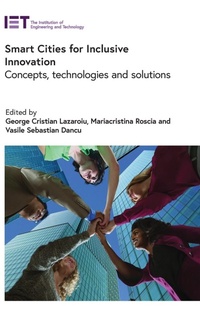
Smart Cities for Inclusive Innovation
Concepts, technologies and solutions
Published on 22. April 2025
Book
Hardback
320 pages
978-1-83953-441-6 (ISBN)
Description
Cities that promote inclusion not only ensure greater opportunities for their citizens but often reap large economic benefits. In recent years, smart cities have exploited and used technologies to guarantee a better quality of services and to predictively analyse and provide responses to urban changes in a proactive way. However, it has become clear that some initiatives have made existing inequalities stronger by failing to address the needs of all citizens. Today, more than ever, it is necessary to address inclusiveness in smart cities from the ground up. Sustainable solutions and energy efficient methods have led to cleaner energy, pollution reduction, improvements in the life of citizens, and transformed environments and regulatory structures to be more inclusive. This is creating smarter cities where citizens, inclusivity and sustainability are at the core.
Designing a new smart city is much simpler than incorporating new technologies into an already built urban space. This book covers technology advances, innovative concepts, solutions and applications in smart cities, both from engineering and social perspectives.
Smart Cities for Inclusive Innovation: Concepts, technologies and solutions is a useful resource for researchers and engineers in smart cities and their associated technologies as well as specialists such as planners, decision-makers and stakeholders in urban communities and local governments, and administrators involved in current and impending smart cities-related activities.
Designing a new smart city is much simpler than incorporating new technologies into an already built urban space. This book covers technology advances, innovative concepts, solutions and applications in smart cities, both from engineering and social perspectives.
Smart Cities for Inclusive Innovation: Concepts, technologies and solutions is a useful resource for researchers and engineers in smart cities and their associated technologies as well as specialists such as planners, decision-makers and stakeholders in urban communities and local governments, and administrators involved in current and impending smart cities-related activities.
More details
Series
Language
English
Place of publication
Stevenage
United Kingdom
Target group
College/higher education
Professional and scholarly
Product notice
sewn/stitched
Cloth over boards
Dimensions
Height: 234 mm
Width: 156 mm
Thickness: 19 mm
Weight
626 gr
ISBN-13
978-1-83953-441-6 (9781839534416)
Copyright in bibliographic data and cover images is held by Nielsen Book Services Limited or by the publishers or by their respective licensors: all rights reserved.
Schweitzer Classification
Persons
George Cristian Lazaroiu is a professor at the National University of Science and Technology POLITEHNICA Bucharest, Romania. His research interests cover the fields of smart cities, energy systems, renewable energy sources, and optimization of power systems operation. He is energy executive editor of UPB Scientific Bulletin, editorial board member of Renewable Energy, and editorial board member of Smart Cities. He holds a PhD degree in electrical engineering from Politecnico di Milano, Italy. He is a senior member of the IEEE, member and secretary of the Energy Commission within Engineering Sciences Section of the Romanian Academy.
Mariacristina Roscia is an associate professor in the Department of Engineering and Applied Sciences, and research fund manager on smart city for the University of Bergamo, Italy. Her research interests include the fields of smart homes and buildings, smart cities, energy engineering, and sustainable and intelligent transport. She was involved in the drafting of an action plan for sustainable efficiency for the EU. She is a member of the reviewer board for IEEE-ICHQP and IEEE PES General Meeting. She holds a PhD degree in electronics and electrical engineering from the University of Naples "Federico II," Italy.
Vasile Sebastian Dancu is a professor in the Department of Sociology and Social Work at the University of Bucharest, Romania. He is the former minister of public information, president of governmental strategies agency, and former vice-minister of regional development and public administration in Romania. He elaborated the Romanian Territory Development Strategy (2016-2035). His research focuses on smart services, sociology, and regional developments. He holds a PhD degree in sociology from the University Babes Bolyai, Romania.
Mariacristina Roscia is an associate professor in the Department of Engineering and Applied Sciences, and research fund manager on smart city for the University of Bergamo, Italy. Her research interests include the fields of smart homes and buildings, smart cities, energy engineering, and sustainable and intelligent transport. She was involved in the drafting of an action plan for sustainable efficiency for the EU. She is a member of the reviewer board for IEEE-ICHQP and IEEE PES General Meeting. She holds a PhD degree in electronics and electrical engineering from the University of Naples "Federico II," Italy.
Vasile Sebastian Dancu is a professor in the Department of Sociology and Social Work at the University of Bucharest, Romania. He is the former minister of public information, president of governmental strategies agency, and former vice-minister of regional development and public administration in Romania. He elaborated the Romanian Territory Development Strategy (2016-2035). His research focuses on smart services, sociology, and regional developments. He holds a PhD degree in sociology from the University Babes Bolyai, Romania.
Content
Chapter 1: Inclusive transformation: toward an ecosystem of social innovation
Chapter 2: Smart cities' key indicators
Chapter 3: Smart cities' development roadmap: case of the urban digital twin for the city of Berkane, Morocco
Chapter 4: Expansion and optimization of multi-carrier infrastructure in smart cities
Chapter 5: Smart sensors for smart environment
Chapter 6: Positive energy districts
Chapter 7: Wastes integration for increasing energy efficiency in smart cities
Chapter 8: Smart transport services in large urban cities
Chapter 9: Economic feasibility: key points analysis of smart cities projects
Chapter 10: Smart governance and e-public administration in smart cities
Chapter 11: Smart education
Chapter 12: Facing pandemics through smart cities
Chapter 13: Conclusion: future perspectives and new research directions
Chapter 2: Smart cities' key indicators
Chapter 3: Smart cities' development roadmap: case of the urban digital twin for the city of Berkane, Morocco
Chapter 4: Expansion and optimization of multi-carrier infrastructure in smart cities
Chapter 5: Smart sensors for smart environment
Chapter 6: Positive energy districts
Chapter 7: Wastes integration for increasing energy efficiency in smart cities
Chapter 8: Smart transport services in large urban cities
Chapter 9: Economic feasibility: key points analysis of smart cities projects
Chapter 10: Smart governance and e-public administration in smart cities
Chapter 11: Smart education
Chapter 12: Facing pandemics through smart cities
Chapter 13: Conclusion: future perspectives and new research directions