

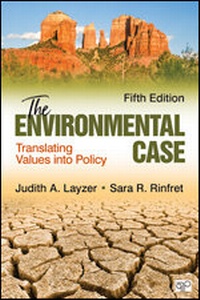
The Environmental Case
Translating Values Into Policy
5th Edition
Published on 15. October 2019
Book
Paperback/Softback
664 pages
978-1-5063-9696-5 (ISBN)
Description
Answers to environmental issues are not black and white. Debates around policy are often among those with fundamentally different values, and the way that problems and solutions are defined plays a central role in shaping how those values are translated into policy. The Environmental Case captures the real-world complexity of creating environmental policy, and this much-anticipated Fifth Edition contains fifteen carefully constructed cases. Through her analysis, Sara Rinfret continues the work of Judith Layzer and explores the background, players, contributing factors, and outcomes of each case, and gives readers insight into some of the most interesting and controversial issues in U.S. environmental policymaking.
More details
Edition
5th Revised edition
Language
English
Place of publication
Washington
United States
Publishing group
SAGE Publications Inc
Target group
College/higher education
Edition type
Revised edition
Dimensions
Height: 229 mm
Width: 152 mm
Weight
952 gr
ISBN-13
978-1-5063-9696-5 (9781506396965)
Copyright in bibliographic data and cover images is held by Nielsen Book Services Limited or by the publishers or by their respective licensors: all rights reserved.
Schweitzer Classification
Other editions
Previous edition
Book
11/2015
4th Edition
CQ Press
€88.09
Article exhausted; check for reprint
Persons
Judith A. Layzer was professor of environmental policy in the Department of Urban Studies and Planning at the Massachusetts Institute of Technology (MIT) until her death in 2015. She earned a Ph.D. in political science at MIT. After four years at Middlebury College in Vermont she returned to MIT, where she taught courses in science and politics in environmental policymaking, ecosystem-based management, food systems and the environment, urban sustainability, energy and environmental politics, and public policy.
Layzer's research focused on several aspects of U.S. environmental politics, including the roles of science, values, and storytelling in environmental politics, as well as on the effectiveness of different approaches to environmental planning and management. A recent project asked: Do urban sustainability initiatives significantly reduce cities' ecological footprints? And which aspects of "green cities" are most effective at reducing cities' environmental impacts? In addition to The Environmental Case, Layzer was the author of Natural Experiments: Ecosystem-Based Management and the Environment (2008) and Open for Business: Conservatives' Opposition to Environmental Regulation (2012).
Layzer was an athlete as well as a scholar. In addition to having finished five Boston marathons, she shared nine national championship titles and one world championship trophy with her teammates on Lady Godiva, formerly Boston's premier women's Ultimate Frisbee team.
Judith A. Layzer
1961-2015
Dr. Sara R. Rinfret is currently a Professor of Public Administration and Associate Vice Provost of Faculty Affairs at Northern Arizona University. She has more than a decade of higher education administrative experience and is a nationally recognized scholar in regulatory policy, environmental policy, and public administration. She previously served as the Acting Dean for the Alexander Blewett School of Law, Chair of the Department of Public Administration and Policy, and the Director of Master of Public Administration at the University of Montana. To date, she has published 8 books and more than 40 peer reviewed articles, and several book chapters. She is the recipient of the Fulbright Specialist Program in public administration and studied with scholars at the University of Aarhus (Denmark, 2016). She holds an MPA from the John Glenn College of Public Affairs (Ohio State), and PhD in political science from Northern Arizona University.
Layzer's research focused on several aspects of U.S. environmental politics, including the roles of science, values, and storytelling in environmental politics, as well as on the effectiveness of different approaches to environmental planning and management. A recent project asked: Do urban sustainability initiatives significantly reduce cities' ecological footprints? And which aspects of "green cities" are most effective at reducing cities' environmental impacts? In addition to The Environmental Case, Layzer was the author of Natural Experiments: Ecosystem-Based Management and the Environment (2008) and Open for Business: Conservatives' Opposition to Environmental Regulation (2012).
Layzer was an athlete as well as a scholar. In addition to having finished five Boston marathons, she shared nine national championship titles and one world championship trophy with her teammates on Lady Godiva, formerly Boston's premier women's Ultimate Frisbee team.
Judith A. Layzer
1961-2015
Dr. Sara R. Rinfret is currently a Professor of Public Administration and Associate Vice Provost of Faculty Affairs at Northern Arizona University. She has more than a decade of higher education administrative experience and is a nationally recognized scholar in regulatory policy, environmental policy, and public administration. She previously served as the Acting Dean for the Alexander Blewett School of Law, Chair of the Department of Public Administration and Policy, and the Director of Master of Public Administration at the University of Montana. To date, she has published 8 books and more than 40 peer reviewed articles, and several book chapters. She is the recipient of the Fulbright Specialist Program in public administration and studied with scholars at the University of Aarhus (Denmark, 2016). She holds an MPA from the John Glenn College of Public Affairs (Ohio State), and PhD in political science from Northern Arizona University.
Content
Preface
Acknowledgments
About the Authors
CHAPTER 1 * A Policymaking Framework: Defining Problems and Portraying Solutions in U.S. Environmental Politics
Two Critical Features of U.S. Environmental Policymaking
Major Actors in Environmental Policymaking
The Environmental Policymaking Process
Case Selection
Getting the Most Out of the Cases
Notes
PART I * REGULATING POLLUTERS
CHAPTER 2 * The Nation Tackles Air and Water Pollution: The Environmental Protection Agency and the Clean Air and Clean Water Acts
Background
The Case
Outcomes
Conclusions
Questions to Consider
Notes
CHAPTER 3 * Love Canal: Hazardous Waste and the Politics of Fear
Background
The Case
Outcomes
Conclusions
Questions to Consider
Notes
CHAPTER 4 * Ecosystem-Based Management in the Chesapeake Bay
Background
The Case
Outcomes
Conclusions
Questions to Consider
Notes
CHAPTER 5 * Market-Based Solutions: Acid Rain and the Clean Air Act Amendments of 1990
Background
The Case
Outcomes
Conclusions
Questions to Consider
Notes
PART II * HISTORY, CHANGING VALUES, AND NATURAL RESOURCE MANAGEMENT
CHAPTER 6 * Oil Versus Wilderness in the Arctic National Wildlife Refuge
Background
The Case
Obama Legacy
Outcomes
Conclusions
Questions to Consider
Notes
CHAPTER 7 * Federal Grazing Policy: Some Things Never Change
Background
The Case
Outcomes
Conclusions
Questions to Consider
Notes
CHAPTER 8 * Jobs Versus the Environment: Saving the Northern Spotted Owl
Background
The Case
Outcomes
Conclusions
Questions to Consider
Notes
CHAPTER 9 * Playground or Paradise? Snowmobiles in Yellowstone National Park
Background
The Case
Outcomes
Conclusions
Questions to Consider
Notes
CHAPTER 10 * Crisis and Recovery in the New England Fisheries
Background
The Case
Outcomes
Conclusions
Questions to Consider
Notes
CHAPTER 11 * The Deepwater Horizon Disaster: The High Cost of Offshore Oil
Background
The Case
Outcomes
Conclusions
Questions to Consider
Notes
PART III * NEW ISSUES, NEW POLITICS
CHAPTER 12 * Climate Change: The Crisis of Our Time
Background
The Case
Outcomes
Conclusions
Questions to Consider
Notes
CHAPTER 13 * Cape Wind: If Not Here, Where? If Not Now, When?
Background
The Case
Outcomes
Conclusions
Questions to Consider
Notes
CHAPTER 14 * Fracking Wars: Local and State Responses to Unconventional Shale Gas Development
Background
The Case
Outcomes
Conclusions
Questions to Consider
Notes
CHAPTER 15 * Making Trade-Offs: Urban Sprawl and the Evolving System of Growth Management in Portland, Oregon
Background
The Case
Outcomes
Conclusions
Questions to Consider
Notes
CHAPTER 16 * Post-Katrina: Lessons From a Disaster
Background
The Case
Outcomes
Conclusions
Questions to Consider
Notes
CHAPTER 17 * Conclusions: Politics, Values, and Environmental Policy Change
The Strength of the Status Quo
Legislative Policy Change
Administrative Policy Change
Acknowledging the Role of Values
Notes
Index
Acknowledgments
About the Authors
CHAPTER 1 * A Policymaking Framework: Defining Problems and Portraying Solutions in U.S. Environmental Politics
Two Critical Features of U.S. Environmental Policymaking
Major Actors in Environmental Policymaking
The Environmental Policymaking Process
Case Selection
Getting the Most Out of the Cases
Notes
PART I * REGULATING POLLUTERS
CHAPTER 2 * The Nation Tackles Air and Water Pollution: The Environmental Protection Agency and the Clean Air and Clean Water Acts
Background
The Case
Outcomes
Conclusions
Questions to Consider
Notes
CHAPTER 3 * Love Canal: Hazardous Waste and the Politics of Fear
Background
The Case
Outcomes
Conclusions
Questions to Consider
Notes
CHAPTER 4 * Ecosystem-Based Management in the Chesapeake Bay
Background
The Case
Outcomes
Conclusions
Questions to Consider
Notes
CHAPTER 5 * Market-Based Solutions: Acid Rain and the Clean Air Act Amendments of 1990
Background
The Case
Outcomes
Conclusions
Questions to Consider
Notes
PART II * HISTORY, CHANGING VALUES, AND NATURAL RESOURCE MANAGEMENT
CHAPTER 6 * Oil Versus Wilderness in the Arctic National Wildlife Refuge
Background
The Case
Obama Legacy
Outcomes
Conclusions
Questions to Consider
Notes
CHAPTER 7 * Federal Grazing Policy: Some Things Never Change
Background
The Case
Outcomes
Conclusions
Questions to Consider
Notes
CHAPTER 8 * Jobs Versus the Environment: Saving the Northern Spotted Owl
Background
The Case
Outcomes
Conclusions
Questions to Consider
Notes
CHAPTER 9 * Playground or Paradise? Snowmobiles in Yellowstone National Park
Background
The Case
Outcomes
Conclusions
Questions to Consider
Notes
CHAPTER 10 * Crisis and Recovery in the New England Fisheries
Background
The Case
Outcomes
Conclusions
Questions to Consider
Notes
CHAPTER 11 * The Deepwater Horizon Disaster: The High Cost of Offshore Oil
Background
The Case
Outcomes
Conclusions
Questions to Consider
Notes
PART III * NEW ISSUES, NEW POLITICS
CHAPTER 12 * Climate Change: The Crisis of Our Time
Background
The Case
Outcomes
Conclusions
Questions to Consider
Notes
CHAPTER 13 * Cape Wind: If Not Here, Where? If Not Now, When?
Background
The Case
Outcomes
Conclusions
Questions to Consider
Notes
CHAPTER 14 * Fracking Wars: Local and State Responses to Unconventional Shale Gas Development
Background
The Case
Outcomes
Conclusions
Questions to Consider
Notes
CHAPTER 15 * Making Trade-Offs: Urban Sprawl and the Evolving System of Growth Management in Portland, Oregon
Background
The Case
Outcomes
Conclusions
Questions to Consider
Notes
CHAPTER 16 * Post-Katrina: Lessons From a Disaster
Background
The Case
Outcomes
Conclusions
Questions to Consider
Notes
CHAPTER 17 * Conclusions: Politics, Values, and Environmental Policy Change
The Strength of the Status Quo
Legislative Policy Change
Administrative Policy Change
Acknowledging the Role of Values
Notes
Index