

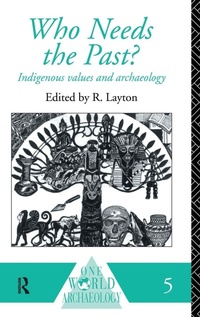
Who Needs the Past?
Indigenous Values and Archaeology
2nd Edition
Published on 27. January 2017
Book
Hardback
240 pages
978-1-138-15479-7 (ISBN)
Description
This book offers a critique of the all pervasive Western notion that other communities often live in a timeless present. Who Needs the Past? provides first-hand evidence of the interest non-Western, non-academic communities have in the past.
Reviews / Votes
`Take(s) us from issues of cultural identity and its archaeological recognition through varying concepts of the past to issues of how the past may be used and ultimately to conflicts in values and ethical obligations. It is an important journey of exploration - Antiquity`The variety of organizational systems for the past that emerge from these papers is examined in Layton's introduction, itself a substantial contribution and a valuable discussion of the significance of the papers in the context of anthropological and archaeological thought' - Journal of the Anthropolological Society of Oxford
More details
Series
Edition
2nd edition
Language
English
Place of publication
London
United Kingdom
Publishing group
Taylor & Francis Ltd
Target group
College/higher education
Dimensions
Height: 240 mm
Width: 161 mm
Thickness: 18 mm
Weight
529 gr
ISBN-13
978-1-138-15479-7 (9781138154797)
Copyright in bibliographic data and cover images is held by Nielsen Book Services Limited or by the publishers or by their respective licensors: all rights reserved.
Schweitzer Classification
Other editions
Additional editions
E-Book
11/2012
2nd Edition
Routledge
€69.99
Available for download
E-Book
11/2012
2nd Edition
Routledge
€69.99
Available for download
Book
08/1994
2nd Edition
Routledge
€76.40
Shipment within 15-20 days
Person
Layton, R.
Content
List of contributors Foreword Preface Introduction The Heritage of Eurocentricity 1. The Western world view in archaeological atlases 2. Public presentations and private concerns: archaeology in the pages of National Geographic 3. American nationality and ethnicity in the depicted past 4. Afro-Americans in the Massachusetts historical landscape 5. Black people and museums: the Caribbean Heritage Project in Southampton 6. `Volk und Germanentum': the presentation of the past in Nazi Germany Rulers and Ruled 7. Maori control of the Maori heritage 8. Nga Tukemata: Nga Taonga o Ngati Kahungunu (The awakening: the treasures of Ngati Kahungunu) 9. God's police and damned whores: images of archaeology in Hawaii 10. Aborignial perceptions of the past: the implications for cultural resource management in Australia 11. Search for the missing link: archaeology and the public in Lebanon 12. The legacy of Eve 13. Museums: two case studies of reaction to colonialism Politics and Administration 14. Cultural education in West Africa: archaeological perspectives 15. The development of museums in Botswana: dilemmas and tensions in a front-line state 16. A past abandoned? Some experiences of a regional museum in Botswana 17. Archaeology and museum work in the Solomon Islands 18. Fifty years of conservation experience on Easter Island (Rapa Nui), Chile Archaeology and the People 19. Didactic presentations of the past: some retrospective considerations in relation to the Archaeological and Ethnographical Museum, Lodz, Poland 20. Reconstruction as interpretation: the example of the Jorvik Viking Centre, York 21. Fort Loudoun, Tennessee, a mid-18th century British fortification: a case study in research archaeology, reconstruction, and interpretive exhibits 22. Conservation and information in the display of prehistoric sites 23. The epic of the Ekpu: ancestor figures of Oron, south-east Nigeria Conclusion: archaeologists and others Index