

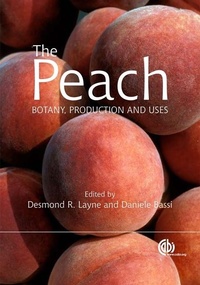
Peach
Botany, Production and Uses
Published on 29. September 2008
Book
Hardback
632 pages
978-1-84593-386-9 (ISBN)
Description
The Peach provides a comprehensive up to date reference work, summarizing our knowledge of peaches and their production worldwide and includes an extensive colour plates section. Chapters written by international authorities address botany and taxonomy, breeding and genetics of cultivars and rootstocks, propagation, physiology and planting systems, crop and pest management and postharvest physiology. The book also includes a contribution on the history of cultivation and production trends in China with historical references dating back to 1100 BC for the first time in the English language.
More details
Series
Language
English
Place of publication
Wallingford
United Kingdom
Target group
College/higher education
Professional and scholarly
Product notice
Unsewn / adhesive bound
Paper over boards
Dimensions
Height: 244 mm
Width: 175 mm
Thickness: 38 mm
Weight
1633 gr
ISBN-13
978-1-84593-386-9 (9781845933869)
Copyright in bibliographic data and cover images is held by Nielsen Book Services Limited or by the publishers or by their respective licensors: all rights reserved.
Schweitzer Classification
Persons
Ted DeJong is emeritus professor at the University of California at Davis, and has been doing research on fruit trees for 40 years. He has published about 300 scientific papers, most of which are on some aspect of the functioning of fruit trees. See his webpage at https://dejong.ucdavis.edu/ Rich Marini, PhD is a Professor of Horticulture with Penn State University, specializing in tree and small fruit physiology, data analysis and fruit production systems. Carlos H. Crisosto is Director of the Fruit and Nut Research and Information Center, UC Davis. The focus of his research and extension program is the postharvest biology and technology of fruits, especially peaches, nectarines, plums, apricots, table grapes, figs, kiwifruits, olives, and persimmons, as well as pistachios, almonds and walnuts. The goal of his research program is to develop a better understanding of the orchard factors and postharvest factors that control fruit flavor and shelf life and to develop technology to overcome fruit industry problems. He applies genomic techniques to identify gene(s) responsible for fruit sensory attributes (both desirable and undesirable), and investigating physiological disorders such as chilling injury.
Editor
DirectorAuburn University, USA
Contributions
Lushan Botanical Garden, Chinese Academy of Sciences, China
National Institute for Agronomical Research (INRA), France
Clemson University, USA
Queensland Horticulture Institute, Australia
USDA-ARS, USA
University of California, USA
Clemson University, USA
University of Pisa, Italy
Series Editor
Content
1: Botany and Taxonomy 2: History of Cultivation and Trends in China 3: Classical Genetics and Breeding 4: Genetic Engineering and Genomics 5: Low-Chill Cultivar Development 6: Fresh Market Cultivar Development 7: Processing Peach Cultivar Development 8: Rootstock Development 9: Propagation Techniques 10: Carbon Assimilation, Partitioning and Budget Modeling 11: Orchard Planting Systems 12: Crop Load Management 13: Nutrient and Water Requirements of Peach Trees 14: Orchard Floor Management Systems 15: Diseases of Peach Caused by Fungi and Fungal-Like Organisms: Biology, Epidemiology, and Management 16: Diseases Caused by Prokaryotes - Bacteria and Phytoplasmas 17: Viruses and Viroids of Peach Trees 18: Insects and Mites 19: Nematodes 20: Preharvest Factors Affecting Peach Quality 21: Ripening, Nutrition, and Postharvest Physiology 22: Harvesting and Postharvest Handling of Peaches for the Fresh Market"