

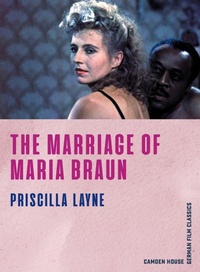
The Marriage of Maria Braun
Published on 17. September 2024
Book
Paperback/Softback
128 pages
978-1-57113-504-9 (ISBN)
Description
A new reading of Fassbinder's most popular film that highlights the roles of race and gender.
The Marriage of Maria Braun is the most popular film by the enfant terrible director Rainer Werner Fassbinder, the leading exponent of the "New German Cinema" of the early sixties to early eighties. It exemplifies his use and abuse of the genre of melodrama. Set in the immediate postwar period and centered around a strong female protagonist, Maria Braun (1978) was the first film in a trilogy that attempts to work through West Germany's fraught past and the legacy of Nazi Germany through the eyes of characters marginalized by their gender, race, sexuality, or (dis)ability. Maria attempts to navigate the poverty and sexism of the immediate postwar years by making her relationships with men, including the Black American G.I., Bill, as beneficial as possible. In the end, she discovers she has been a pawn in a power game between her husband, Hermann, for whom she has been pining while he has been in prison, and her lover, the industrialist Oswald. Yet Maria is also complicit in racism and white patriarchy, a fact that scholarship on the film has barely registered. In her new reading, Priscilla Layne draws on archival research, Critical Race Theory, Black Feminist Thought, and Critical Whiteness Studies to expand on the role of race and gender in the film.
The Marriage of Maria Braun is the most popular film by the enfant terrible director Rainer Werner Fassbinder, the leading exponent of the "New German Cinema" of the early sixties to early eighties. It exemplifies his use and abuse of the genre of melodrama. Set in the immediate postwar period and centered around a strong female protagonist, Maria Braun (1978) was the first film in a trilogy that attempts to work through West Germany's fraught past and the legacy of Nazi Germany through the eyes of characters marginalized by their gender, race, sexuality, or (dis)ability. Maria attempts to navigate the poverty and sexism of the immediate postwar years by making her relationships with men, including the Black American G.I., Bill, as beneficial as possible. In the end, she discovers she has been a pawn in a power game between her husband, Hermann, for whom she has been pining while he has been in prison, and her lover, the industrialist Oswald. Yet Maria is also complicit in racism and white patriarchy, a fact that scholarship on the film has barely registered. In her new reading, Priscilla Layne draws on archival research, Critical Race Theory, Black Feminist Thought, and Critical Whiteness Studies to expand on the role of race and gender in the film.
More details
Series
Edition
Paperback original
Language
English
Place of publication
Columbia, MD
United States
Publishing group
Boydell & Brewer Ltd
Target group
Professional and scholarly
Product notice
Paperback (trade)
Illustrations
42 colour and 1 b/w illus.
Dimensions
Height: 186 mm
Width: 135 mm
Thickness: 8 mm
Weight
178 gr
ISBN-13
978-1-57113-504-9 (9781571135049)
Copyright in bibliographic data and cover images is held by Nielsen Book Services Limited or by the publishers or by their respective licensors: all rights reserved.
Schweitzer Classification
Other editions
Additional editions
Priscilla Layne
Marriage of Maria Braun
E-Book
09/2024
1st Edition
Boydell & Brewer
€14.99
Available for download
Person
PRISCILLA LAYNE is Professor of German, with an adjunct appointment in African, African American and Diaspora Studies, at the University of North Carolina.
Content
Rising from the Ashes
Race and Gender in Postwar German Society
An Explosive Beginning
Milking Melodrama
Drama in Black and White
Love Stories Set in a War Zone
Undermining Melodrama
Fassbinder's Style
Music
A War Widow?
Coca Cola-nization
Intersectionality
The Melodrama of Race
Economic Wonderwoman
An Explosive Ending
Afterlife on the Stage
Credits
Notes
Race and Gender in Postwar German Society
An Explosive Beginning
Milking Melodrama
Drama in Black and White
Love Stories Set in a War Zone
Undermining Melodrama
Fassbinder's Style
Music
A War Widow?
Coca Cola-nization
Intersectionality
The Melodrama of Race
Economic Wonderwoman
An Explosive Ending
Afterlife on the Stage
Credits
Notes