

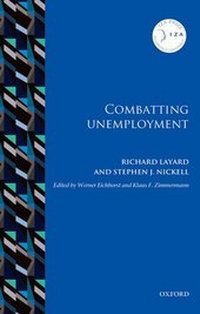
Combatting Unemployment
Published on 16. June 2016
Book
Paperback/Softback
268 pages
978-0-19-877993-3 (ISBN)
Description
Why is unemployment higher in some countries than others? Why does it fluctuate between decades? Why are some people at greater risk than others?
Layard and Nickell have worked on these issues for thirty years. Their famous model, first published in 1986, is now used throughout the world. It asserts that unemployment must be high enough to reduce the real wages for which workers settle to the level justified by productivity. So what affects 'wage push'? The authors showed early on that the key factors affecting 'wage push' are how unemployed workers are treated and how wages are negotiated. If unemployed people get benefits without being required to accept jobs, vacancies go unfilled and mass unemployment results. The solution is welfare-to-work policies like those now introduced in most parts of the world.
The authors have proposed these policies for the last twenty-five years in a series of key articles reproduced in this book. Their original analysis explains the subsequent movement of unemployment over the last two decades. They conclude the book with a new chapter on what should be done in the recession: no-one, they say, should be given unemployment benefit beyond a year, after which they should be offered work.
Layard and Nickell have worked on these issues for thirty years. Their famous model, first published in 1986, is now used throughout the world. It asserts that unemployment must be high enough to reduce the real wages for which workers settle to the level justified by productivity. So what affects 'wage push'? The authors showed early on that the key factors affecting 'wage push' are how unemployed workers are treated and how wages are negotiated. If unemployed people get benefits without being required to accept jobs, vacancies go unfilled and mass unemployment results. The solution is welfare-to-work policies like those now introduced in most parts of the world.
The authors have proposed these policies for the last twenty-five years in a series of key articles reproduced in this book. Their original analysis explains the subsequent movement of unemployment over the last two decades. They conclude the book with a new chapter on what should be done in the recession: no-one, they say, should be given unemployment benefit beyond a year, after which they should be offered work.
Reviews / Votes
should be on the reading list of all serious students of economics * Arnaud Vaganay, Journal of Social Policy * A brief review like this cannot do justice to the depth and breadth of the research of Layard and Nickell. Their path-breaking work has motivated numerous related labour studies. ... This book is essential reading for economists, politicians and social scientists. * G.C. Lim, The Economic Record *More details
Series
Language
English
Place of publication
Oxford
United Kingdom
Target group
College/higher education
Professional and scholarly
Illustrations
32 Figures, 48 Tables
Dimensions
Height: 215 mm
Width: 140 mm
Thickness: 15 mm
Weight
336 gr
ISBN-13
978-0-19-877993-3 (9780198779933)
Copyright in bibliographic data and cover images is held by Nielsen Book Services Limited or by the publishers or by their respective licensors: all rights reserved.
Schweitzer Classification
Other editions
Additional editions
Richard Layard | Stephen J. Nickell | Werner Eichhorst
Combatting Unemployment
Book
05/2011
1st Edition
Oxford University Press
€114.30
Shipment within 15-20 days
Persons
Until 2003 Richard Layard was the founder-director of the Centre for Economic Performance at the London School of Economics. He now heads the Centre's Programme on Well-Being. He has worked on unemployment, inflation, education, inequality, and post-Communist reform. He was an early advocate of the welfare-to-work approach to European unemployment, and with S. Nickell and R. Jackman authored Unemployment: Macroeconomic Performance and the Labour Market (OUP 1991, 2e 2005). Their ideas have been implemented in many countries including in Britain's New Deal, to which Layard was a consultant. His book Happiness - Lessons from a New Science (2005) appears in 20 languages. Richard Layard was also an active member of The Children's Society Inquiry into The Good Childhood and was co-author of its recent report: A Good Childhood (Penguin, 2009). Layard is a fellow of the British Academy and of the Econometric Society. Since 2000 he has been a member of the House of Lords.
Stephen J. Nickell is Chairman of The Advisory Committee on Civil Costs (MOJ) and a Board Member of the UK Statistics Authority. Previously he has held Economics Professorships at both LSE and Oxford and was President of the Royal Economic Society from 2000 to 2003. He was a member of the Bank of England Monetary Policy Committee from 2000 to 2006. He is a Fellow of the Econometric Society and the British Academy, as well as a foreign honorary member of the American Economic Association and the American Academy of Arts and Sciences.
Stephen J. Nickell is Chairman of The Advisory Committee on Civil Costs (MOJ) and a Board Member of the UK Statistics Authority. Previously he has held Economics Professorships at both LSE and Oxford and was President of the Royal Economic Society from 2000 to 2003. He was a member of the Bank of England Monetary Policy Committee from 2000 to 2006. He is a Fellow of the Econometric Society and the British Academy, as well as a foreign honorary member of the American Economic Association and the American Academy of Arts and Sciences.
Content
Introduction by the Editors: A New Understanding of Labor Market Institutions- Layard and Nickell on Labor Economics and Policy Making 1: The Labor Market 2: Why Does Unemployment Persist? 3: Combatting Unemployment: Is Flexibility Enough? 4: Labor Market Institutions and Economic Performance 5: Unemployment: Macroeconomic Performance and the Labor Market 6: Policies For Full Employment 7: A Final Note: Unemployment and the Current Recession