

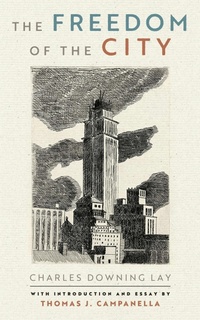
The Freedom of the City
Published on 30. June 2023
Book
Paperback/Softback
128 pages
978-1-64283-295-2 (ISBN)
Description
"Congestion is the life of the city . . . it is what we came for, what we stay for, what we hunger for", wrote Charles Downing Lay, prominent American landscape architect and planner of the early 1920s. These words are relevant today as density and congestion are once again under siege, especially in our most productive and thriving cities.
Published in 1926, The Freedom of the City by Charles Downing Lay is an eloquent and timely defence of urbanism and city life. Award-winning author and urban historian Thomas J. Campanella has given Lay's text new life and relevance, with the addition of explanatory notes, imagery, an introduction, and biographical essay, to bring this important work to a new generation of urbanists.
Lay was decades ahead of his time, writing The Freedom of the City as Americans were just beginning to fall in love with the automobile and leave town for a romanticised life on the suburban fringe. Planners and theorists were arguing that heavily congested cities were a form of cancer, that great metropolitan centres like London and New York City must be decanted into a leafy "garden cities" in the countryside. Lay saved his sharpest pen for these anti-urbanists in his own profession of city and regional planning.
Lay writes of the delights of city life and - especially - that importance of the singular, essential ingredient that makes it all possible: "congestion" (closest in definition to "density" today). Congestion, to Lay, is the secret sauce of cities, the singular element that gives London, Paris, or New York its dynamism and magic. He believed that the amenities and affordances of a city are "the direct result of its great congestion"; indeed, congestion is "the life of the city. Reduce it below a certain point and much of our ease and convenience disappears.
Campanella writes "for all his blind spots, Lay's core argument still obtains. The Freedom of the City was prescient in 1926 and timely now. Certainly, the essentials of good urbanism extolled in the book- human scale, diversity, walkability, the serendipities of the street; above all, density - are articles of faith among architects and urbanists today."
Published in 1926, The Freedom of the City by Charles Downing Lay is an eloquent and timely defence of urbanism and city life. Award-winning author and urban historian Thomas J. Campanella has given Lay's text new life and relevance, with the addition of explanatory notes, imagery, an introduction, and biographical essay, to bring this important work to a new generation of urbanists.
Lay was decades ahead of his time, writing The Freedom of the City as Americans were just beginning to fall in love with the automobile and leave town for a romanticised life on the suburban fringe. Planners and theorists were arguing that heavily congested cities were a form of cancer, that great metropolitan centres like London and New York City must be decanted into a leafy "garden cities" in the countryside. Lay saved his sharpest pen for these anti-urbanists in his own profession of city and regional planning.
Lay writes of the delights of city life and - especially - that importance of the singular, essential ingredient that makes it all possible: "congestion" (closest in definition to "density" today). Congestion, to Lay, is the secret sauce of cities, the singular element that gives London, Paris, or New York its dynamism and magic. He believed that the amenities and affordances of a city are "the direct result of its great congestion"; indeed, congestion is "the life of the city. Reduce it below a certain point and much of our ease and convenience disappears.
Campanella writes "for all his blind spots, Lay's core argument still obtains. The Freedom of the City was prescient in 1926 and timely now. Certainly, the essentials of good urbanism extolled in the book- human scale, diversity, walkability, the serendipities of the street; above all, density - are articles of faith among architects and urbanists today."
More details
Language
English
Place of publication
Washington
United States
Product notice
Paperback (trade)
Unsewn / adhesive bound
Dimensions
Height: 201 mm
Width: 124 mm
Thickness: 10 mm
Weight
204 gr
ISBN-13
978-1-64283-295-2 (9781642832952)
Copyright in bibliographic data and cover images is held by Nielsen Book Services Limited or by the publishers or by their respective licensors: all rights reserved.
Schweitzer Classification
Other editions
Additional editions
Charles Downing Lay
The Freedom of the City
E-Book
04/2023
Princeton University Press
€26.49
Available for download
Persons
Charles Downing Lay (1877-1956) was a landscape architect, city planner, artist, author, and essayist. Born in the Hudson Valley and raised in New York City, he studied with Frederick Law Olmsted, Jr. at Harvard before taking a leadership post with the New York City Department of Parks. Thomas J. Campanella is Professor of City and Regional Planning at Cornell University and Historian-in-Residence of the New York City Parks Department. He has held Guggenheim and Fulbright fellowships and is a Fellow of the American Academy in Rome. His most recent book, Brooklyn: The Once and Future City (2019), was a finalist for the Brendan Gill Prize from the Municipal Arts Society of New York.
Content
Introduction: The Necessity for Congestion by Thomas J. Campanella The Life and Work of Charles Downing Lay by Thomas J. Campanella The Freedom of the City by Charles Downing Lay Notes Index About the Authors