

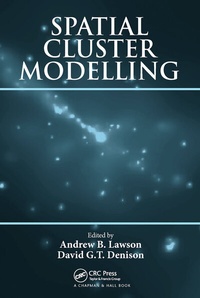
Spatial Cluster Modelling
1st Edition
Published on 29. January 2020
Book
Paperback/Softback
308 pages
978-0-367-45491-3 (ISBN)
Description
Research has generated a number of advances in methods for spatial cluster modelling in recent years, particularly in the area of Bayesian cluster modelling. Along with these advances has come an explosion of interest in the potential applications of this work, especially in epidemiology and genome research.
In one integrated volume, this book reviews the state-of-the-art in spatial clustering and spatial cluster modelling, bringing together research and applications previously scattered throughout the literature. It begins with an overview of the field, then presents a series of chapters that illuminate the nature and purpose of cluster modelling within different application areas, including astrophysics, epidemiology, ecology, and imaging. The focus then shifts to methods, with discussions on point and object process modelling, perfect sampling of cluster processes, partitioning in space and space-time, spatial and spatio-temporal process modelling, nonparametric methods for clustering, and spatio-temporal cluster modelling.
Many figures, some in full color, complement the text, and a single section of references cited makes it easy to locate source material. Leading specialists in the field of cluster modelling authored each chapter, and an introduction by the editors to each chapter provides a cohesion not typically found in contributed works. Spatial Cluster Modelling thus offers a singular opportunity to explore this exciting new field, understand its techniques, and apply them in your own research.
In one integrated volume, this book reviews the state-of-the-art in spatial clustering and spatial cluster modelling, bringing together research and applications previously scattered throughout the literature. It begins with an overview of the field, then presents a series of chapters that illuminate the nature and purpose of cluster modelling within different application areas, including astrophysics, epidemiology, ecology, and imaging. The focus then shifts to methods, with discussions on point and object process modelling, perfect sampling of cluster processes, partitioning in space and space-time, spatial and spatio-temporal process modelling, nonparametric methods for clustering, and spatio-temporal cluster modelling.
Many figures, some in full color, complement the text, and a single section of references cited makes it easy to locate source material. Leading specialists in the field of cluster modelling authored each chapter, and an introduction by the editors to each chapter provides a cohesion not typically found in contributed works. Spatial Cluster Modelling thus offers a singular opportunity to explore this exciting new field, understand its techniques, and apply them in your own research.
Reviews / Votes
"This text provides an effective treatment and review of several ways to view a clustering pattern, depending on the context. Examples include image segmentation, spatial epidemiology, and object recognition using partition models. ... Each of the 14 chapters has multiple authors, each aware of the book's content so there is effective cross-referencing. I strongly recommend this book for anybody who is serious about spatial clustering. ..."-Tom Burr Statistics in Medicine, Vol. 23, 2004
"[This book] is a collection of contributions by leading specialist in the field, which are brought together coherently with unified notation. ... Overall, the book is an excellent, well and up-to-date referenced presentation of the current state of research in spatial cluster analysis ... an insightful reference not only for the statistician, but also for scientists ... ."
-Zentralblatt MATH, 1046
"The chapter authors are all recognized for their excellence in research. ... the text is well written and informative, and is a worthy addition to the library of anyone wishing to keep up to date on current research in spatial cluster modeling."
-Journal of the American Statistical Association, Vol. 99, No. 467, September 2004
More details
Language
English
Place of publication
Oxford
United Kingdom
Publishing group
Taylor & Francis Ltd
Target group
Professional and scholarly
Professional
Illustrations
60 s/w Abbildungen, 9 farbige Abbildungen, 4 s/w Photographien bzw. Rasterbilder, 10 s/w Tabellen
10 Tables, black and white; 4 Halftones, black and white; 9 Illustrations, color; 60 Illustrations, black and white
Dimensions
Height: 234 mm
Width: 156 mm
Weight
453 gr
ISBN-13
978-0-367-45491-3 (9780367454913)
Copyright in bibliographic data and cover images is held by Nielsen Book Services Limited or by the publishers or by their respective licensors: all rights reserved.
Schweitzer Classification
Other editions
Additional editions
Andrew B. Lawson | David G.T. Denison
Spatial Cluster Modelling
Book
05/2002
1st Edition
Chapman & Hall/CRC
€237.70
Article not available at the moment
Andrew B. Lawson | David G.T. Denison
Spatial Cluster Modelling
E-Book
05/2002
Chapman & Hall/CRC
€89.99
Available for download
Andrew B. Lawson | David G.T. Denison
Spatial Cluster Modelling
E-Book
05/2002
Chapman and Hall
€89.99
Available for download
Persons
Andrew B. Lawson, David G.T. Denison
Content
Spatial Cluster Modelling: An Overview. POINT PROCESS CLUSTER MODELLING: Significance in Scale-Space for Clustering. Statistical Inference for Cox Processes. Extrapolating and Interpolating Spatial Patterns. Perfect Sampling for Point Process Cluster Modelling. Bayesian Estimation and Segmentation of Spatial Point Processes Using Voronoi Tilings. SPATIAL PROCESS CLUSTER MODELLING: Partition Modelling. Cluster Modelling for Disease Rate Mapping. Analyzing Spatial Data Using Skew-Gaussian Processes. Accounting for Absorption Lines In Images Obtained With The Chandra X-Ray Observatory. Spatial Modelling of Count Data: A Case Study in Modelling Breeding Bird Survey Data on Large Spatial Domains. SPATIO-TEMPORAL CLUSTER MODELLING: Modelling Strategies for Spatial-Temporal Data. Spatio-Temporal Partition Modelling: An Example FROM Neurophysiology. Spatio-Temporal Cluster Modelling of Small Area Health Data. References. Index. Author Index.