

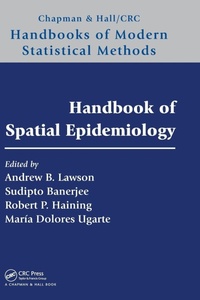
Handbook of Spatial Epidemiology
1st Edition
Published on 4. April 2016
Book
Hardback
702 pages
978-1-4822-5301-6 (ISBN)
Description
Handbook of Spatial Epidemiology explains how to model epidemiological problems and improve inference about disease etiology from a geographical perspective. Top epidemiologists, geographers, and statisticians share interdisciplinary viewpoints on analyzing spatial data and space-time variations in disease incidences. These analyses can provide important information that leads to better decision making in public health.
The first part of the book addresses general issues related to epidemiology, GIS, environmental studies, clustering, and ecological analysis. The second part presents basic statistical methods used in spatial epidemiology, including fundamental likelihood principles, Bayesian methods, and testing and nonparametric approaches. With a focus on special methods, the third part describes geostatistical models, splines, quantile regression, focused clustering, mixtures, multivariate methods, and much more. The final part examines special problems and application areas, such as residential history analysis, segregation, health services research, health surveys, infectious disease, veterinary topics, and health surveillance and clustering.
Spatial epidemiology, also known as disease mapping, studies the geographical or spatial distribution of health outcomes. This handbook offers a wide-ranging overview of state-of-the-art approaches to determine the relationships between health and various risk factors, empowering researchers and policy makers to tackle public health problems.
The first part of the book addresses general issues related to epidemiology, GIS, environmental studies, clustering, and ecological analysis. The second part presents basic statistical methods used in spatial epidemiology, including fundamental likelihood principles, Bayesian methods, and testing and nonparametric approaches. With a focus on special methods, the third part describes geostatistical models, splines, quantile regression, focused clustering, mixtures, multivariate methods, and much more. The final part examines special problems and application areas, such as residential history analysis, segregation, health services research, health surveys, infectious disease, veterinary topics, and health surveillance and clustering.
Spatial epidemiology, also known as disease mapping, studies the geographical or spatial distribution of health outcomes. This handbook offers a wide-ranging overview of state-of-the-art approaches to determine the relationships between health and various risk factors, empowering researchers and policy makers to tackle public health problems.
Reviews / Votes
"In 2008, CRC Press started publishing the Handbooks of Modern Statistical Methods. Apparently the series is popular as it is growing rapidly, with 13 volumes printed now and 7 announced. It is easy to understand why: the books are attractive in content, presentation and price. The present volume is no exception. The book has been edited by first-class experts, who also contributed a number of chapters. The book's website gives a table of the contents of the 35 chapters. It documents the rich variety of subjects. ... I can only recommend this book."-Paul Eilers, ISCB News, May 2017
More details
Series
Language
English
Place of publication
Boca Raton
United States
Publishing group
Taylor & Francis Inc
Target group
College/higher education
Professional and scholarly
Illustrations
129 s/w Abbildungen, 28 s/w Tabellen
28 Tables, black and white; 129 Illustrations, black and white
Dimensions
Height: 260 mm
Width: 183 mm
Thickness: 42 mm
Weight
1497 gr
ISBN-13
978-1-4822-5301-6 (9781482253016)
Copyright in bibliographic data and cover images is held by Nielsen Book Services Limited or by the publishers or by their respective licensors: all rights reserved.
Schweitzer Classification
Other editions
Additional editions
Andrew B. Lawson | Sudipto Banerjee | Robert P. Haining
Handbook of Spatial Epidemiology
Book
06/2020
1st Edition
Chapman & Hall/CRC
€106.60
Shipment within 15-20 days
Andrew B. Lawson | Sudipto Banerjee | Robert P. Haining
Handbook of Spatial Epidemiology
E-Book
04/2016
Chapman & Hall/CRC
€100.99
Available for download
Andrew B. Lawson | Sudipto Banerjee | Robert P. Haining
Handbook of Spatial Epidemiology
E-Book
04/2016
1st Edition
Chapman and Hall
€100.99
Available for download
Persons
Andrew B. Lawson is a professor of biostatistics in the Division of Biostatistics, Department of Public Health Sciences, College of Medicine at the Medical University of South Carolina (MUSC). He is an MUSC eminent scholar and American Statistical Association (ASA) fellow. He is also an advisor in disease mapping and risk assessment for the World Health Organization, the founding editor of the journal Spatial and Spatio-Temporal Epidemiology, and the author of eight books, including the highly regarded Chapman & Hall/CRC book Bayesian Disease Mapping: Hierarchical Modeling in Spatial Epidemiology, Second Edition. He has published more than 150 journal articles on spatial epidemiology, spatial statistics, and related areas. He earned a PhD in spatial statistics from the University of St. Andrews.
Sudipto Banerjee is a professor and chair in the Department of Biostatistics at the University of California, Los Angeles. He is an elected fellow of the ASA, the Institute of Mathematical Statistics, and the International Statistical Institute. He is also a recipient of the Mortimer Spiegelman Award from the American Public Health Association. He is the author/coauthor of more than 100 peer-reviewed publications and two highly regarded Chapman & Hall/CRC books: Hierarchical Modeling and Analysis for Spatial Data, Second Edition and Linear Algebra and Matrix Analysis for Statistics. His research interests include hierarchical modeling and Bayesian inference for spatially referenced data.
Robert Haining retired as a professor of human geography from the University of Cambridge in September 2015. He is the author/coauthor of more than 150 articles and two books. His research focuses on the quantitative analysis of geographical data, including the geography of health, spatial representation, spatial sampling, exploratory data analysis, small-area estimation and hypothesis testing, spatial data analysis, and spatial econometrics. His past work has involved the evaluation of the impact of air pollution on health status using small-area statistics as well as the development of new methods for evaluating the effectiveness of small-area targeted police interventions.
Maria Dolores Ugarte is a professor of statistics at the Public University of Navarre. She is the author/coauthor of many papers on statistics and epidemiology and several books, including the recent Chapman & Hall/CRC book Probability and Statistics with R, Second Edition. She is also an associate editor for Statistical Modelling, TEST, and Computational Statistics and Data Analysis as well as an editorial panel member of Spatial and Spatio-Temporal Epidemiology. Her research focuses on spatiotemporal disease mapping and small-area estimation with applications in several fields. She earned a PhD in statistics from the Public University of Navarre.
Sudipto Banerjee is a professor and chair in the Department of Biostatistics at the University of California, Los Angeles. He is an elected fellow of the ASA, the Institute of Mathematical Statistics, and the International Statistical Institute. He is also a recipient of the Mortimer Spiegelman Award from the American Public Health Association. He is the author/coauthor of more than 100 peer-reviewed publications and two highly regarded Chapman & Hall/CRC books: Hierarchical Modeling and Analysis for Spatial Data, Second Edition and Linear Algebra and Matrix Analysis for Statistics. His research interests include hierarchical modeling and Bayesian inference for spatially referenced data.
Robert Haining retired as a professor of human geography from the University of Cambridge in September 2015. He is the author/coauthor of more than 150 articles and two books. His research focuses on the quantitative analysis of geographical data, including the geography of health, spatial representation, spatial sampling, exploratory data analysis, small-area estimation and hypothesis testing, spatial data analysis, and spatial econometrics. His past work has involved the evaluation of the impact of air pollution on health status using small-area statistics as well as the development of new methods for evaluating the effectiveness of small-area targeted police interventions.
Maria Dolores Ugarte is a professor of statistics at the Public University of Navarre. She is the author/coauthor of many papers on statistics and epidemiology and several books, including the recent Chapman & Hall/CRC book Probability and Statistics with R, Second Edition. She is also an associate editor for Statistical Modelling, TEST, and Computational Statistics and Data Analysis as well as an editorial panel member of Spatial and Spatio-Temporal Epidemiology. Her research focuses on spatiotemporal disease mapping and small-area estimation with applications in several fields. She earned a PhD in statistics from the Public University of Navarre.
Content
Introduction. Basic Methods. Special Methods. Special Problems and Applications. Index.