

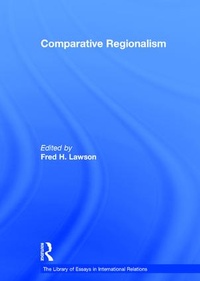
Comparative Regionalism
1st Edition
Published on 1. September 2009
Book
Hardback
592 pages
978-0-7546-2836-1 (ISBN)
Description
Regionalism has regained momentum in the post-Cold War era. New economic groupings continue to spring up across the globe, while older regional organizations have strengthened their institutional bases and broadened their scope. Explaining the reinvigoration of regionalism requires comparative analyses that not only highlight the commonalities that characterize various regional experiments but also account for the differential outcomes and divergent trajectories such projects exhibit. This collection of seminal articles on regionalism advances theoretical concepts that can stimulate useful comparisons, along with scholarly surveys of important instances of regionalism in the contemporary world. Besides classic studies of the European Union, the volume includes authoritative overviews and case studies of regionalist projects in East Asia, Sub-Saharan Africa, Latin America, the Middle East and Central Eurasia. An introductory essay situates these articles in the context of the five decade-long research program on regional integration theory.
More details
Series
Language
English
Place of publication
London
United Kingdom
Publishing group
Taylor & Francis Ltd
Target group
College/higher education
Professional and scholarly
Dimensions
Height: 246 mm
Width: 174 mm
Weight
1338 gr
ISBN-13
978-0-7546-2836-1 (9780754628361)
Copyright in bibliographic data and cover images is held by Nielsen Book Services Limited or by the publishers or by their respective licensors: all rights reserved.
Schweitzer Classification
Other editions
Additional editions
Person
Fred H. Lawson is Professor in the Department of Government at Mills College, Oakland, CA.
Content
Contents: Introduction; Part I General: Comparative regional integration: concept and measurement, Joseph S. Nye; Explaining the resurgence of regionalism in world politics, Andrew Hurrell; The new wave of regionalism, Edward D. Mansfield and Helen V. Milner. Part II Sub-Saharan Africa: Regional integration and the crisis in sub-Saharan Africa, Peter Robson; Africa's record of regional co-operation and integration, Percy S. Mistry; The African Union and the new partnership for Africa's development: strong institutions for weak states?, Keith Gottschalk and Siegmar Schmidt. Part III East Asia: 30 years of ASEAN: achievements and challenges, JA?rn Dosch and Manfred Mols; 2 funerals and a wedding? The ups and downs of regionalism in East Asia and Asia-Pacific after the Asian crisis, Douglas Webber; ASEAN plus 3: emerging East Asian regionalism?, Richard Stubbs; A 3 bloc world? The new East Asian regionalism, John Ravenhill; The social construction of international institutions: the case of ASEAN+3, Dirk Nabers. Part IV Latin America: On the road to Southern Cone economic integration, Jeffrey Cason; Regionalist governance in the new political economy of development: 'relaunching' the Mercosur, Nicola Phillips; Explaining Latin American economic integration: the case of Mercosur, Karl Kaltenthaler and Frank O. Mora. Part V Middle East and North Africa: Regional economic union in the Maghreb, Ahmed Aghrout and Keith Sutton; Theories of integration in a new context: the Gulf Cooperation Council, Fred H. Lawson. Part VI Central Eurasia: Inter-state cooperation in Central Asia from the CIS to the Shanghai Forum, Gregory Gleason; Regionalism, regional structures and security management in Central Asia, Roy Allison. Part VII Western Europe: Preferences and power in the European Community: a liberal intergovernmentalist approach, Andrew Moravcsik; A constructivist approach to understanding the European Union as a federal polity, Rey Koslowski; The institutional foundations of intergovernmentalism and supranationalism in the European Union, George Tsebelis and Geoffrey Garrett; Name index.