

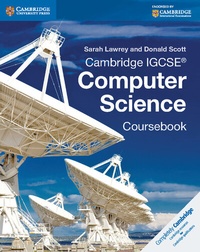
Cambridge IGCSE (R) Computer Science Coursebook
Published on 12. November 2015
Book
Paperback/Softback
232 pages
978-1-107-51869-8 (ISBN)
Description
Cambridge IGCSE Computer Science Coursebook is designed to provide up to date and comprehensive material to cover recent developments in computer science. The content has been written by experienced IGCSE teachers and computer science trainers, offering readers support on the theoretical and practical aspects of the course. It contains detailed explanations of concepts, with examples and tasks to help students consolidate their skills.
More details
Series
Language
English
Place of publication
Cambridge
United Kingdom
Target group
Primary & secondary/elementary & high school
US School Grade: From Fourth Grade to Sixth Grade, Interest Age: From 14 to 16 years
Product notice
Paperback (trade)
Illustrations
Worked examples or Exercises
Dimensions
Height: 275 mm
Width: 218 mm
Thickness: 10 mm
Weight
580 gr
ISBN-13
978-1-107-51869-8 (9781107518698)
Copyright in bibliographic data and cover images is held by Nielsen Book Services Limited or by the publishers or by their respective licensors: all rights reserved.
Schweitzer Classification
Other editions
New editions
Sarah Lawrey | Victoria Ellis
Cambridge IGCSE (TM) and O Level Computer Science Coursebook with Digital Access (2 Years)
Book
04/2021
2nd Edition
Cambridge University Press
€56.50
Shipment within 15-20 days
Additional editions
Sarah Lawrey | Donald Scott
Cambridge IGCSE® Computer Science Coursebook Digital Edition
E-Book
03/2016
Cambridge University Press
€28.49
Available for download
Previous edition
Chris Leadbetter | Stewart Wainwright | Alan Stinchcombe
Cambridge IGCSE Computer Studies Coursebook with CD-ROM
Book
08/2011
Cambridge University Press
€27.73
Article exhausted; check for reprint
Content
Part 1: Theory of Computer Science: 1. Data representation; 2. Communication and Internet technologies; 3. Computer architecture, languages and operating systems; 4. Logic gates and circuits; 5. Input devices; 6. Sensors; 7. Output devices; 8. Memory, storage devices and media; 9. Security; 10. Ethics. Part 2: Practical Problem-solving and Programming; 11. Problem solving and design without pseudocode; 12. Pseudocode; 13. Program design with pseudocode; 14. Programming; 15. Databases