

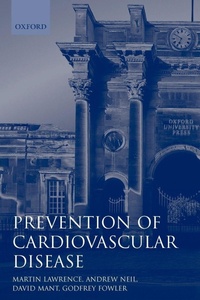
Prevention of Cardiovascular Disease
An Evidence-Based Approach
Published on 30. May 1996
Book
Paperback/Softback
352 pages
978-0-19-262397-3 (ISBN)
Description
Cardiovascular disease remains the greatest cause of morbidity and mortality. Over the past 10-15 years many studies have clarified the risks that are important, and the interventions which are effective.
This book breaks new ground in both providing clear recommendations on what should be done, and the evidence on which these recommendations are based. It accords with current views that guidelines should be based on evidence, and that the evidence should be clear. The book is split into three sections: the first reviews the risk factors for cardiovascular disease and the clinical effectiveness of reducing them; the second examines methods of implementation in practice; and the final section makes practical recommendations, explicitly based on the evidence in the fist two sections.
This book breaks new ground in both providing clear recommendations on what should be done, and the evidence on which these recommendations are based. It accords with current views that guidelines should be based on evidence, and that the evidence should be clear. The book is split into three sections: the first reviews the risk factors for cardiovascular disease and the clinical effectiveness of reducing them; the second examines methods of implementation in practice; and the final section makes practical recommendations, explicitly based on the evidence in the fist two sections.
Reviews / Votes
This book tackles a large subject and deals with much epidemiological evidence. This is done effectively, each chapter written clearly, a tribute to both contributors and the editors ... a readable and digestible book. It is possible to use it as a quick reference guide or as a starting point in a more thorough search. I also found it useful as a quick reference for both my clinical work and as a teaching text. I will certainly recommend it as a reference text for medical students. * Tom Fahey, Family Practice, Vol. 14, No. 1, 1997 * Overall rating: Good. Strengths: Good discussion of all major cardiovascular clinical trials and their practical implications for recommendations to patients. ... Chapters are well organized and each ends with a summary of major clinical points. Statements are well referenced with articles as recent as 1995. * Canadian Family Physician, vol.43, May 1997 * a very comprehensive, accessible and authoritative tect ... the material is laid out and delivered in such a manageable and attractive style that one is tempted to return to it at frequent intervals ... a very useful and enjoyable text ... I shall recommend this book widely, in particular to practice nurses, as essential reading and the ideal textbook for students of preventive cardiology and health promotion. * Mary Walker, Royal Free Hospital School of Medicine, Psychology, Health & Medicine, Vol. 2, No. 3, 1997 *More details
Series
Language
English
Place of publication
Oxford
United Kingdom
Target group
Professional and scholarly
Illustrations
figures and tables
Dimensions
Height: 234 mm
Width: 156 mm
Thickness: 19 mm
Weight
541 gr
ISBN-13
978-0-19-262397-3 (9780192623973)
Copyright in bibliographic data and cover images is held by Nielsen Book Services Limited or by the publishers or by their respective licensors: all rights reserved.
Schweitzer Classification
Persons
Editor
University Department of Public Health and Primary CareUniversity Department of Public Health and Primary Care, Radcliffe Infirmary, Oxford
University Lecturer and Honorary Consultant Physician, University Department of Public Health and Primary CareUniversity Lecturer and Honorary Consultant Physician, University Department of Public Health and Primary Care, Radcliffe Infirmary, Oxford
University Department of Public Health and Primary CareUniversity Department of Public Health and Primary Care, Radcliffe Infirmary, Oxford
University Department of Public Health and Primary CareUniversity Department of Public Health and Primary Care, Radcliffe Infirmary, Oxford
Content
Part I: Evidence for reducible risk ; 1. Smoking ; 2. Hypertension ; 3. Lipids and lipoproteins ; 4. Nutrition ; 5. Exercise ; 6. Alcohol ; 7. Personality and psychological environment ; 8. Diabetes ; 9. Social Deprivation ; 10. Hormone replacement therapy ; 11. Haemostasis ; 12. Antioxidants ; 13. Prevention of Stroke ; 14. Secondary prevention ; 15. Multiple risk ; Part II: Evidence for the effectiveness of implementation ; 16. Community-based interventions ; 17. Individual interventions and behaviour change ; 18. Taking the initiative: strategies and implications ; 19. Issues in Measurement ; 20. Screening policy ; Part III: Implementation ; 21. The population and individual strategies ; 22. Preparing the practice ; 23. Principles of patient management