

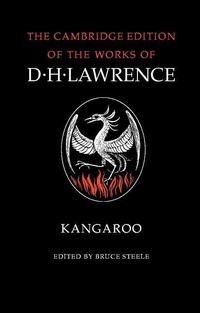
Kangaroo
Edited by Bruce Steele
Published on 11. April 2002
Book
Paperback/Softback
552 pages
978-0-521-00711-5 (ISBN)
Description
Kangaroo is D. H. Lawrence's eighth novel, set in Australia. He wrote the first draft in just forty-five days while living south of Sydney, in 1922, and revised it three months later in New Mexico. The descriptions of the country are vivid and sympathetic and the book fuses lightly disguised autobiography with an exploration of political ideas at an immensely personal level. Based on a collation of the manuscript, typescripts and first editions, this text of Kangaroo is closest to what Lawrence would have expected to see in print. There is a full textual apparatus of variants, a comprehensive introduction giving the background and history of composition and publication and a summary of contemporary reviewers' opinions. Explanatory notes elucidate the many geographical, political and literary allusions in the text; there are three maps and an appendix detailing Australian locations.
More details
Series
Language
English
Place of publication
Cambridge
United Kingdom
Target group
Professional and scholarly
Product notice
Paperback (trade)
Illustrations
3 Maps
Dimensions
Height: 216 mm
Width: 140 mm
Thickness: 32 mm
Weight
770 gr
ISBN-13
978-0-521-00711-5 (9780521007115)
Copyright in bibliographic data and cover images is held by Nielsen Book Services Limited or by the publishers or by their respective licensors: all rights reserved.
Schweitzer Classification
Other editions
Persons
David Herbert Richards "D. H." Lawrence (11 September 1885 - 2 March 1930) was an English novelist, poet, playwright, essayist, literary critic and painter. His collected works represent, among other things, an extended reflection upon the dehumanising effects of modernity and industrialisation. Some of the issues Lawrence explores are emotional health, vitality, spontaneity and instinct.
Lawrence's opinions earned him many enemies and he endured official persecution, censorship, and misrepresentation of his creative work throughout the second half of his life, much of which he spent in a voluntary exile which he called his "savage pilgrimage." At the time of his death, his public reputation was that of a pornographer who had wasted his considerable talents. E. M. Forster, in an obituary notice, challenged this widely held view, describing him as, "The greatest imaginative novelist of our generation."
Lawrence is perhaps best known for his novels Sons and Lovers, The Rainbow, Women in Love and Lady Chatterley's Lover. Within these Lawrence explores the possibilities for life within an industrial setting. In particular Lawrence is concerned with the nature of relationships that can be had within such a setting. Though often classed as a realist, Lawrence in fact uses his characters to give form to his personal philosophy. His depiction of sexual activity, though seen as shocking when he first published in the early 20th century, has its roots in this highly personal way of thinking and being. It is worth noting that Lawrence was very interested in the sense of touch and that his focus on physical intimacy has its roots in a desire to restore an emphasis on the body, and re-balance it with what he perceived to be Western civilisation's over-emphasis on the mind.
Content
General editor's preface; Acknowledgements; Chronology; Cue-titles; Introduction; Kangaroo; Explanatory notes; Textual apparatus; Appendix; A note on pounds, shillings and pence.