

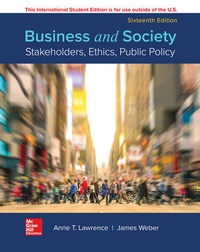
ISE Business and Society: Stakeholders, Ethics, Public Policy
16th Edition
Published on 5. May 2019
Book
Paperback/Softback
576 pages
978-1-260-56560-7 (ISBN)
Description
In a world economy that is becoming increasingly integrated and interdependent, the relationship between business and society is becoming ever more complex. The globalization of business, the emergence of civil society organizations in many nations, and new government regulations and international agreements have significantly altered the job of managers and the nature of strategic decision making within the firm. The Sixteenth Edition of Business and Society: Stakeholders, Ethics, Public Policy draws on the latest research to address the challenges facing business organizations and their stakeholders. The text builds on its legacy of market leadership by reexamining central issues.
More details
Edition
16th edition
Language
English
Place of publication
OH
United States
Target group
College/higher education
US School Grade: From College Freshman to College Graduate Student
Illustrations
89 Illustrations
Dimensions
Height: 252 mm
Width: 201 mm
Thickness: 20 mm
Weight
862 gr
ISBN-13
978-1-260-56560-7 (9781260565607)
Copyright in bibliographic data and cover images is held by Nielsen Book Services Limited or by the publishers or by their respective licensors: all rights reserved.
Schweitzer Classification
Persons
Anne T. Lawrence is professor of management emerita at San Josi? State University. She holds a Ph.D. from the University of California, Berkeley, and completed two years of post-doctoral study at Stanford University. Her articles, cases, and reviews have appeared in many journals, including the Academy of Management Review, Administrative Science Quarterly, Case Research Journal, Journal of Management Education, California Management Review, Business and Society Review, Research in Corporate Social Performance and Policy, and Journal of Corporate Citizenship. Her cases in business and society have been reprinted in many textbooks and anthologies. She has served as guest editor of the Case Research Journal. She served as president of both the North American Case Research Association (NACRA) and of the Western Case writers Association and is a Fellow of NACRA, from which she received a Distinguished Contributor Award in 2014. She received the Emerson Center Award for Outstanding Case in Business Ethics (2004) and the Curtis E. Tate Award for Outstanding Case of the Year (1998, 2009, and 2015). At San Josi? State University, she was named Outstanding Professor of the Year in 2005. In 2015, she received a Master Teacher in Ethics Award from The Wheatley Institution at Brigham Young University. She currently serves as chair of the board of the Case Research Foundation.
James Weber is a professor of management and business ethics at Duquesne University. He also serves as the executive director of the Institute for Ethics in Business, and coordinates the Masters of Science in Leadership and Business Ethics program at Duquesne. He holds a Ph.D. from the University of Pittsburgh and has taught at the University of San Francisco, University of Pittsburgh, and Marquette University. His areas of interest and research include managerial and organizational values, cognitive moral reasoning, business ethics, ethics training and education, eastern religions' ethics, and corporate social audit and performance. His work has appeared in Organization Science, Human Relations, Business & Society, Journal of Business Ethics, Academy of Management Perspectives, and Business Ethics Quarterly. He received the SIM Sumner Marcus Award for lifetime contribution to the Social Issues in Management division of the Academy of Management in 2013, and the Best Reviewer Award from Business & Society in 2015. He was recognized by the Social Issues in Management division with the Best Paper Award in 1989 and 1994, and received the Best Article Award from the International Association for Business and Society (IABS) in 1998. He has served as division and program chair of the Social Issues in Management division of the Academy of Management. He has also served as president and program chair of the IABS.
James Weber is a professor of management and business ethics at Duquesne University. He also serves as the executive director of the Institute for Ethics in Business, and coordinates the Masters of Science in Leadership and Business Ethics program at Duquesne. He holds a Ph.D. from the University of Pittsburgh and has taught at the University of San Francisco, University of Pittsburgh, and Marquette University. His areas of interest and research include managerial and organizational values, cognitive moral reasoning, business ethics, ethics training and education, eastern religions' ethics, and corporate social audit and performance. His work has appeared in Organization Science, Human Relations, Business & Society, Journal of Business Ethics, Academy of Management Perspectives, and Business Ethics Quarterly. He received the SIM Sumner Marcus Award for lifetime contribution to the Social Issues in Management division of the Academy of Management in 2013, and the Best Reviewer Award from Business & Society in 2015. He was recognized by the Social Issues in Management division with the Best Paper Award in 1989 and 1994, and received the Best Article Award from the International Association for Business and Society (IABS) in 1998. He has served as division and program chair of the Social Issues in Management division of the Academy of Management. He has also served as president and program chair of the IABS.
Content
PART ONE
Business in Society
1. The Corporation and Its Stakeholders
2. Managing Public Issues and StakeholderRelationships
3. Corporate Social Responsibility andCitizenship
4. Business in a Globalized World
PART TWO
Business and Ethics
5. Ethics and Ethical Reasoning
6. Organizational Ethics
PART THREE
Business and Public Policy
7. BusinessGovernment Relations
8. Influencing the Political Environment
PART FOUR
Business and the Natural Environment
9. Sustainable Development andGlobal Business
10. Managing for Sustainability
PART FIVE
Business and Technology 231
11. The Role of Technology
12. Regulating and Managing InformationTechnology
PART SIX
Business and Its Stakeholders
13. Shareholder Rights and Corporate Governance
14. Consumer Protection
15. Employees and the Corporation
16. Managing a Diverse Workforce
17. Business and Its Suppliers
18. The Community and the Corporation
19. The Public and Corporate Reputation
CASES IN BUSINESS AND SOCIETY
1. Profiting from Pain: Business and the U.S.Opioid Epidemic
2. Wells Fargo's Unauthorized Customer Accounts
3. The Carlson Company and Protecting Childrenin the Global Tourism Industry
4. BP Blowout: The Aftermath of the Gulf OilDisaster
5. Google and the Right to Be Forgotten
6. General Motors and the Ignition SwitchRecalls
7. The Upper Big Branch Mine Disaster
8. After Rana Plaza
9. The Boycott of Stoli Vodka
Business in Society
1. The Corporation and Its Stakeholders
2. Managing Public Issues and StakeholderRelationships
3. Corporate Social Responsibility andCitizenship
4. Business in a Globalized World
PART TWO
Business and Ethics
5. Ethics and Ethical Reasoning
6. Organizational Ethics
PART THREE
Business and Public Policy
7. BusinessGovernment Relations
8. Influencing the Political Environment
PART FOUR
Business and the Natural Environment
9. Sustainable Development andGlobal Business
10. Managing for Sustainability
PART FIVE
Business and Technology 231
11. The Role of Technology
12. Regulating and Managing InformationTechnology
PART SIX
Business and Its Stakeholders
13. Shareholder Rights and Corporate Governance
14. Consumer Protection
15. Employees and the Corporation
16. Managing a Diverse Workforce
17. Business and Its Suppliers
18. The Community and the Corporation
19. The Public and Corporate Reputation
CASES IN BUSINESS AND SOCIETY
1. Profiting from Pain: Business and the U.S.Opioid Epidemic
2. Wells Fargo's Unauthorized Customer Accounts
3. The Carlson Company and Protecting Childrenin the Global Tourism Industry
4. BP Blowout: The Aftermath of the Gulf OilDisaster
5. Google and the Right to Be Forgotten
6. General Motors and the Ignition SwitchRecalls
7. The Upper Big Branch Mine Disaster
8. After Rana Plaza
9. The Boycott of Stoli Vodka