

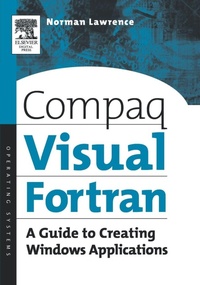
Compaq Visual Fortran
A Guide to Creating Windows Applications
Published on 8. January 2002
Book
Paperback/Softback
600 pages
978-1-55558-249-4 (ISBN)
Description
Compaq Visual Fortran: A Guide to Creating Windows Applications is the only book that shows developers how to create Windows applications using Visual Fortran software. It complements Digital Press's successful reference, the Digital Visual Fortran Programmer's Guide. Lawrence details development methods and techniques for creating Fortran applications for Windows, the platform upon which developers can use Compaq Visual Fortran (CVF; to be Intel Visual Fortran in the future) to create applications.
The book teaches CVF programming progressively, beginning with simple tasks and building up to writing professional-level Win32 applications. Readers will learn about the powerful new CVF graphical user interface, as well as the intricacies of Windows development from a CVF perspective. They can master QuickWin, the Win32 APIs including multiple document interfaces, and Open GL with 3D and interactive graphics.
The book teaches CVF programming progressively, beginning with simple tasks and building up to writing professional-level Win32 applications. Readers will learn about the powerful new CVF graphical user interface, as well as the intricacies of Windows development from a CVF perspective. They can master QuickWin, the Win32 APIs including multiple document interfaces, and Open GL with 3D and interactive graphics.
Reviews / Votes
"Dr. Lawrence's book is what Visual Fortran users have been waiting for-a thorough and detailed tutorial showing how to take full advantage of the richness of the Windows programming environment from Fortran."-Steve Lionel, Visual Fortran Engineering, Intel Corporation"This book is a natural extension of the Visual Fortran documentation. Dr. Lawrence uses many annotated example programs to show how to call Win32 routines and display graphics using various methods."-Michael Etzel, Visual Fortran Writing, Intel Corporation
More details
Language
English
Place of publication
Oxford
United Kingdom
Publishing group
Elsevier Science & Technology
Target group
Professional and scholarly
Programmers in the scientific, engineering and educational communities who have a background knowledge of FORTRAN (77, 90/95 and/or CVF) but no knowledge of C; developers interested in using Windows APIs for scientific programming
Product notice
Paperback (trade)
Illustrations
Approx. 150 illustrations; Illustrations
Dimensions
Height: 235 mm
Width: 177 mm
Thickness: 29 mm
Weight
925 gr
ISBN-13
978-1-55558-249-4 (9781555582494)
Copyright in bibliographic data and cover images is held by Nielsen Book Services Limited or by the publishers or by their respective licensors: all rights reserved.
Schweitzer Classification
Other editions
Additional editions
E-Book
01/2002
Elsevier
€64.95
Available for download
Person
Norman Lawrence, MEd, PhD is Head of the Department of Maritime Engineering at the Australian Maritime College. He has been programming personal computers for over 20 years for a variety of applications that include numerical analysis, heat transfer, simulation, and real time data acquisition. Lawrence has taught FORTRAN 77 to engineering students and is the author of numerous papers and articles on engineering applications developed using Fortran. His interests away from the keyboard include racing and vintage cars, sailing, and working with the local church community. He received his doctorate from Brighton Polytechnic (now University of Brighton) in England for heat transfer research in diesel engines.
Content
Getting Started; QuickWin Basics; User Interfaces; Using Resources; Graphics; Creating WIN32 API Applications; Dialog Boxes and Controls; Common Dialog Boxes; Vector Graphics; Bitmap Graphics; More Common Controls; Multiple Document Interface (MDI) Applications; Finishing Touches; Creating Help Files; OpenGL Basics; More OpenGL; Interactive OpenGL Applications; Appendixes: Overview of C for Fortran Programmers; HTML Help Files; Auxiliary Library OpenGL Three-Dimensional Models; GLUT and f90gl