

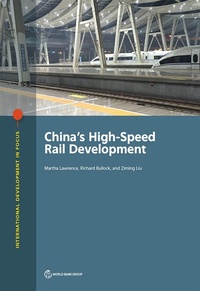
China's High-Speed Rail Development
Published on 24. June 2019
Book
Paperback/Softback
96 pages
978-1-4648-1425-9 (ISBN)
Description
Over the past decade, China has built 25,000 km of dedicated high-speed railway - more than the rest of the world combined. What can we learn from this remarkable experience?
China's High-Speed Rail Development examines the Chinese experience to draw lessons for countries considering investing in high-speed rail. The report scrutinises the planning and delivery mechanisms that enabled the rapid construction of the high-speed rail system, and highlights the role of long-term planning, consistent plan execution, and a joint venture structure that ensures active participation of provincial and local governments in project planning and financing.
The study examines the characteristics of the markets for which high-speed rail is competitive in China. It discusses the pricing and service design considerations that go into making high-speed rail services competitive with other modes and factors, such as good urban connectivity, that make the service attractive to customers.
One of the most remarkable aspects of the Chinese experience is the rapid pace of high-quality construction. The report looks at the role of strong capacity development within and cooperation among China Railway Corporation, rail manufacturers, universities, research institutions, laboratories, and engineering centres that allowed for rapid technological advancement and localisation of technology. It describes the project delivery structures and incentives for delivering quality and timely results.
Finally, the report analyses the financial and economic sustainability of the investment in high-speed rail. It finds that a developing country can price high-speed rail services affordably and still achieve financial viability, but this requires very high passenger density. Economic viability similarly depends on high passenger density.
China's High-Speed Rail Development examines the Chinese experience to draw lessons for countries considering investing in high-speed rail. The report scrutinises the planning and delivery mechanisms that enabled the rapid construction of the high-speed rail system, and highlights the role of long-term planning, consistent plan execution, and a joint venture structure that ensures active participation of provincial and local governments in project planning and financing.
The study examines the characteristics of the markets for which high-speed rail is competitive in China. It discusses the pricing and service design considerations that go into making high-speed rail services competitive with other modes and factors, such as good urban connectivity, that make the service attractive to customers.
One of the most remarkable aspects of the Chinese experience is the rapid pace of high-quality construction. The report looks at the role of strong capacity development within and cooperation among China Railway Corporation, rail manufacturers, universities, research institutions, laboratories, and engineering centres that allowed for rapid technological advancement and localisation of technology. It describes the project delivery structures and incentives for delivering quality and timely results.
Finally, the report analyses the financial and economic sustainability of the investment in high-speed rail. It finds that a developing country can price high-speed rail services affordably and still achieve financial viability, but this requires very high passenger density. Economic viability similarly depends on high passenger density.
More details
Series
Language
English
Place of publication
Washington
United States
Target group
Professional and scholarly
Product notice
Paperback (trade)
Unsewn / adhesive bound
Dimensions
Height: 279 mm
Width: 216 mm
Thickness: 6 mm
Weight
336 gr
ISBN-13
978-1-4648-1425-9 (9781464814259)
Copyright in bibliographic data and cover images is held by Nielsen Book Services Limited or by the publishers or by their respective licensors: all rights reserved.
Schweitzer Classification