

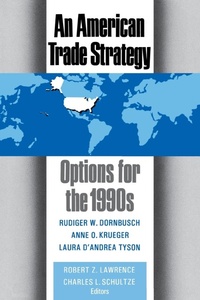
An American Trade Strategy
Options for the 1990s
Published on 1. September 1990
Book
Paperback/Softback
234 pages
978-0-8157-5179-3 (ISBN)
Description
The world trading envionment changed dramatically in the 1980s. America's trade balance declined sharply, while Japan, Germany, and the newly industrialized countries of Asia built up large, continuing surpluses. Such developments led many people to question whether the traditional postwar strategy of reliance on multilateral free trade agreements is still the best course for the United States, or even a viable one.
The challenges to the multilateral system are both practical and theoretical. Various nations are already forming ""free trade"" blocs-- notably the Europe 1992 and the Canadian-American trade arrangements. The United States has increasingly bypassed the GATT and bargained bilaterally in trade disputes, especially with Japan. Several prominent economists have developed new theories that support a more active role for the government to help shape technological change and improve the competitive position of the United States in world markets. Others strongly defend the current arrangements and caution that greater reliance on bilateral bargaining and trading blocs will lead to fragmented world trade and cartel-like arrangements among a few major producers. They are even more skeptical of an interventionist government successfully ""managing"" trade.
An American Trade Strategy assesses options for the decade ahead, examining the case for mulitlateral free trade, aggressive bilateralism, and managed trade, as well as their shortcomings. The editors and contributors evaluate the alternative strategies and reflect on their implications for the future direction of American trade policy.
The challenges to the multilateral system are both practical and theoretical. Various nations are already forming ""free trade"" blocs-- notably the Europe 1992 and the Canadian-American trade arrangements. The United States has increasingly bypassed the GATT and bargained bilaterally in trade disputes, especially with Japan. Several prominent economists have developed new theories that support a more active role for the government to help shape technological change and improve the competitive position of the United States in world markets. Others strongly defend the current arrangements and caution that greater reliance on bilateral bargaining and trading blocs will lead to fragmented world trade and cartel-like arrangements among a few major producers. They are even more skeptical of an interventionist government successfully ""managing"" trade.
An American Trade Strategy assesses options for the decade ahead, examining the case for mulitlateral free trade, aggressive bilateralism, and managed trade, as well as their shortcomings. The editors and contributors evaluate the alternative strategies and reflect on their implications for the future direction of American trade policy.
Reviews / Votes
"An American Trade Strategy provides a rich and creative range of suggestions and analysis to help the U.S. respond to the global trading challenge. It is packed with insightful professionalism and a keen sense of America's vital interests in the global economy." -Robert D. Hormats, Goldman, Sachs & Co.More details
Language
English
Place of publication
United States
Publishing group
Bloomsbury Publishing Plc
Target group
College/higher education
Professional and scholarly
Dimensions
Height: 229 mm
Width: 152 mm
Thickness: 15 mm
Weight
408 gr
ISBN-13
978-0-8157-5179-3 (9780815751793)
Copyright in bibliographic data and cover images is held by Nielsen Book Services Limited or by the publishers or by their respective licensors: all rights reserved.
Schweitzer Classification
Other editions
Additional editions
E-Book
06/2001
1st Edition
Brookings Institution
€20.99
Available for download
Persons
Robert Z. Lawrence is Albert L. Williams Professor of International Trade and Investment at the Kennedy School of Government. He is also a senior fellow at the Institute for International Economics, and a research associate at the National Bureau of Economic Research. He served as a member of the President's Council of Economic Advisers from 1998 to 2000. Lawrence has also been a senior fellow at the Brookings Institution. His books include Globaphobia: Confronting Fears about Open Trade (Brookings, 1998) and Single World, Divided Nations? International Trade and the OECD Labor Markets (Brookings/OECD, 1996). Charles L. Schultze is a senior fellow in the Economic Studies program at Brookings. He was chairman of the Council of Economic Advisers during the Carter administration and director of the U.S. Bureau of the Budget during the Johnson administration.