

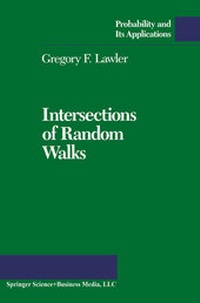
Intersections of Random Walks
Published on 15. September 1992
Book
Paperback/Softback
IV, 220 pages
978-1-4757-2139-3 (ISBN)
Description
A more accurate title for this book would be "Problems dealing with the non-intersection of paths of random walks. " These include: harmonic measure, which can be considered as a problem of nonintersection of a random walk with a fixed set; the probability that the paths of independent random walks do not intersect; and self-avoiding walks, i. e. , random walks which have no self-intersections. The prerequisite is a standard measure theoretic course in probability including martingales and Brownian motion. The first chapter develops the facts about simple random walk that will be needed. The discussion is self-contained although some previous expo sure to random walks would be helpful. Many of the results are standard, and I have made borrowed from a number of sources, especially the ex cellent book of Spitzer [65]. For the sake of simplicity I have restricted the discussion to simple random walk. Of course, many of the results hold equally well for more general walks. For example, the local central limit theorem can be proved for any random walk whose increments have mean zero and finite variance. Some of the later results, especially in Section 1. 7, have not been proved for very general classes of walks. The proofs here rely heavily on the fact that the increments of simple random walk are bounded and symmetric.
More details
Series
Edition
Softcover reprint of the original 1st ed. 1991
Language
English
Place of publication
MA
United States
Target group
Professional and scholarly
Illustrations
IV, 220 p.
Dimensions
Height: 23.5 cm
Width: 15.5 cm
ISBN-13
978-1-4757-2139-3 (9781475721393)
DOI
10.1007/978-1-4757-2137-9
Schweitzer Classification
Other editions
Additional editions
Gregory F. Lawler
Intersections of Random Walks
Book
09/1991
Birkhauser Boston Inc
€85.59
Article exhausted; check different version
Content
1 Simple Random Walk.- 2 Harmonic Measure.- 3 Intersection Probabilities.- 4 Four Dimensions.- 5 Two and Three Dimensions.- 6 Self-Avoiding Walks.- 7 Loop-Erased Walk.