

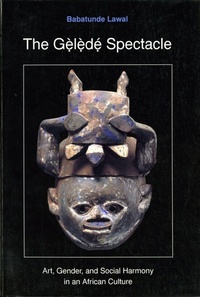
The Gelede Spectacle
Art, Gender, and Social Harmony in an African Culture
Published on 1. July 1997
Book
Paperback/Softback
368 pages
978-0-295-97599-3 (ISBN)
Description
This remarkable study explores the use of the visual and performing arts to promote nonviolence and social harmony in sub-Saharan Africa. It focuses on Gelede, a popular community festival of masquerade, dance, and song, held several times a year by the Yoruba of Southwestern Nigeria and the Republic of Benin. Babatunde Lawal, an art historian and African scholar who has taught in Nigeria, Brazil, and the United States, is himself a Yoruba and has taken an active part in Gelede. He writes from the perspective of an informed participant/observer of his own culture.
Lawal bases his book on extensive field research-observations and interviews-conducted over more than two decades as well as on numerous published and unpublished scholarly sources. He casts significant new light on many previously obscure aspects of Gelede, and he demonstrates a useful methodological approach to the study of non-Western art.
The book systematically covers the major aspects of the Gelede spectacle, presenting its cultural background and historical origins as preface to a vivid and detailed description of an actual performance. This is followed by a discussion of the iconography and aesthetics of costume, and an examination of the sculpted images on the masks. The book concludes with a discussion of the moral and aesthetic philosophy of Gelede and its responsiveness to technological and social change.
The Gelede Spectacle is illustrated in color and black-and-white with over 100 field and museum photographs, including a rare sequence on the dressing of a masquerader. It offers, in addition, more than 60 Gelede song texts, proverbs, and divination verses, each in the original Yoruba as well as in translation. Lawal's interpretations of these pieces indicate the rich complexities of metaphor and analogy inherent in the Yoruba language and art.
Lawal bases his book on extensive field research-observations and interviews-conducted over more than two decades as well as on numerous published and unpublished scholarly sources. He casts significant new light on many previously obscure aspects of Gelede, and he demonstrates a useful methodological approach to the study of non-Western art.
The book systematically covers the major aspects of the Gelede spectacle, presenting its cultural background and historical origins as preface to a vivid and detailed description of an actual performance. This is followed by a discussion of the iconography and aesthetics of costume, and an examination of the sculpted images on the masks. The book concludes with a discussion of the moral and aesthetic philosophy of Gelede and its responsiveness to technological and social change.
The Gelede Spectacle is illustrated in color and black-and-white with over 100 field and museum photographs, including a rare sequence on the dressing of a masquerader. It offers, in addition, more than 60 Gelede song texts, proverbs, and divination verses, each in the original Yoruba as well as in translation. Lawal's interpretations of these pieces indicate the rich complexities of metaphor and analogy inherent in the Yoruba language and art.
More details
Series
Language
English
Place of publication
Seattle
United States
Target group
Professional and scholarly
Product notice
Paperback (trade)
Illustrations
160 illus., 25 in color
Dimensions
Height: 253 mm
Width: 179 mm
Thickness: 28 mm
Weight
1043 gr
ISBN-13
978-0-295-97599-3 (9780295975993)
Copyright in bibliographic data and cover images is held by Nielsen Book Services Limited or by the publishers or by their respective licensors: all rights reserved.
Schweitzer Classification
Person
Babatunde Lawal