

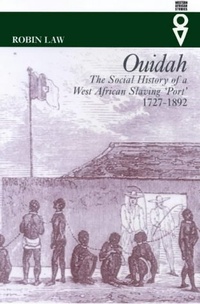
Ouidah
The Social History of a West African Slaving Port 1727-1892
Published on 9. November 2004
Book
Paperback/Softback
320 pages
978-0-85255-497-5 (ISBN)
Description
Ouidah, an African town in Dahomey, now Benin, was the principal pre-colonial commercial centre of its region and this is the first detailed study of the town's history and its role in the Atlantic slave trade.
Ouidah, an indigenous African town in the modern Republic of Benin, was the principal pre-colonial commercial centre of its region, and the second most important town of the Dahomey kingdom. It served as a major outlet for the export of slaves for the trans- Atlantic trade. Between the seventeenth and the nineteenth centuries Ouidah was the most important embarkation point for slaves in the region of West Africa known to outsiders as the 'Slave Coast'. Exporting over a million slaves, it was second only to Luanda in Angola for the embarkation of slaves in the whole of Africa.
The author's central concerns are the organization of the African end of the slave trade, and the impact participation in the trade had on the historical development of the African societies involved. It shifts the focus from the viewpoint of the Dahomian monarchy, represented in previous studies, to the coast. Here is a well documented case study of pre-colonial urbanism, of the evolution of a merchant community, and in particular the growth of a group of private traders whose relations with the Dahomian monarchy grew increasingly problematic over time.
North America: Ohio U Press
Ouidah, an indigenous African town in the modern Republic of Benin, was the principal pre-colonial commercial centre of its region, and the second most important town of the Dahomey kingdom. It served as a major outlet for the export of slaves for the trans- Atlantic trade. Between the seventeenth and the nineteenth centuries Ouidah was the most important embarkation point for slaves in the region of West Africa known to outsiders as the 'Slave Coast'. Exporting over a million slaves, it was second only to Luanda in Angola for the embarkation of slaves in the whole of Africa.
The author's central concerns are the organization of the African end of the slave trade, and the impact participation in the trade had on the historical development of the African societies involved. It shifts the focus from the viewpoint of the Dahomian monarchy, represented in previous studies, to the coast. Here is a well documented case study of pre-colonial urbanism, of the evolution of a merchant community, and in particular the growth of a group of private traders whose relations with the Dahomian monarchy grew increasingly problematic over time.
North America: Ohio U Press
Reviews / Votes
This work is a masterful chronological history of a community, especially the history of its merchant families. Although grounded in archival research, the book's collection of oral traditions from descendants of the Ouidah merchants makes this study of an urban community unique. Especially important is the history of the Brazilians among them, because many of these merchants were ex-slaves themselves and Portuguese was the lingua franca. -- R.T. Brown * CHOICE * This magisterial volume, an impressive contribution to the history of West Africa and of the slave trade, together with his numerous other published works, highlights Robin Law as one of the most distinguished historians in the field of African history. -- Christopher Fyfe * AFRICAN STUDIES * Ouidah offers a great deal more than just a case study of slave traffic. Professor Law examines the town from the inside out, and from its obscure Hueda origins to its occupation by the French in 1892 via its long incorporation into the kingdom of Dahomey. Slaving features as a staple of the local economy - the merchants and officials of Ouidah served as middlemen in the sale of slaves taken elsewhere - and is a recurring theme, but the character of the town and its inhabitants are also dealt with at length. Of course, they are inextricably linked. ... Professor Law excels in reconstructing the topography, society and administrative history of Ouidah under successive regimes and relating these structures to the conduct of external trade, both for slaves and, latterly, for palm oil. -- Richard Gorski * HISTORY * This book is an excellent case study on the formation, growth and decline of Ouidah's Atlantic merchant community and of the town itself. ... this is a very informative book. It provides a detailed analysis of the formation and growth of Ouidah's trade community and its relations with Dahomey in the era of Atlantic commerce. -- Ibrahima Thiaw * INTERNATIONAL REVIEW OF SOCIAL HISTORY *More details
Series
Language
English
Place of publication
Oxford
United Kingdom
Target group
College/higher education
Professional and scholarly
Product notice
Paperback (trade)
Illustrations
5 line illus.
Dimensions
Height: 234 mm
Width: 156 mm
Weight
480 gr
ISBN-13
978-0-85255-497-5 (9780852554975)
Copyright in bibliographic data and cover images is held by Nielsen Book Services Limited or by the publishers or by their respective licensors: all rights reserved.
Schweitzer Classification
Other editions
Additional editions
E-Book
10/2005
1st Edition
Ohio University Press
€30.49
Available for download
Book
12/2004
James Currey
€82.00
Article exhausted; check different version
E-Book
11/2004
1st Edition
De Gruyter
€48.99
Available for download
E-Book
11/2004
1st Edition
Boydell & Brewer
€48.99
Available for download
Person
Robin Law is Professor of African History at the University of Stirling.
Content
Introduction - Origins: Ouidah before the Dahomian conquest - The Dahomian conquest of Ouidah - Dahomian Ouidah - The operation of the Atlantic slave trade - De Souza's Ouidah: the era of the illegal slave trade, 1815-39 - The era of transition: from slaves to palm oil, 1840-57 - Dissension & decline: Ouidah under King Glele, 1858-77 - From Dahomian to French rule, 1878-92 - Sources & bibliography.