

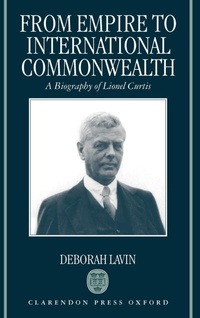
From Empire to International Commonwealth
A Biography of Lionel Curtis
Published on 12. October 1995
Book
Hardback
384 pages
978-0-19-812616-4 (ISBN)
Description
Lionel Curtis C.H. once counted among the great and the good, working behind the scenes of international politics and honoured as the `pioneer of a great idea' - international federation as the natural successor to empire. He advocated federation as the way to create a new South Africa after the Boer War; he called for self-government in India in 1912; in 1921 he was instrumental in attempting to pacify the Irish Troubles by treating Eire as if it were a self-governing Commonwealth Dominion. He went on to preach the conversion of the Empire-Commonwealth into a multinational federation, which, in association with the United States, would serve as a model for a united Europe, and even for world government.
He founded the Round Table think-tank, the Royal Institute of International Affairs at Chatham House, and the Oxford Society. He lobbied indefatigably for his vision of the Commonwealth as a new world order, to be more effective that the League of Nations in making wars obsolete. In the process, he exasperated nationalists and imperialists alike as a prophet of apparently lost causes.
He deserves to be remembered not only for what he achieved but for what he was: the bore who never lost a friend; the optimist who stuck to his belief when all was lost, the third-class scholar who became a Fellow of All Souls; the visionary riding his hobby-horse into the drawing rooms of high political society and yet invited affectionately to return.
The remarkable character of the man and the influence he exerted on the history of the Empire and Commonwealth are explored in this authoritative biography.
He founded the Round Table think-tank, the Royal Institute of International Affairs at Chatham House, and the Oxford Society. He lobbied indefatigably for his vision of the Commonwealth as a new world order, to be more effective that the League of Nations in making wars obsolete. In the process, he exasperated nationalists and imperialists alike as a prophet of apparently lost causes.
He deserves to be remembered not only for what he achieved but for what he was: the bore who never lost a friend; the optimist who stuck to his belief when all was lost, the third-class scholar who became a Fellow of All Souls; the visionary riding his hobby-horse into the drawing rooms of high political society and yet invited affectionately to return.
The remarkable character of the man and the influence he exerted on the history of the Empire and Commonwealth are explored in this authoritative biography.
Reviews / Votes
This is an excellent book. Deborah Lavin is conspicuously fair and weighs her subject's strengths and weaknesses with elegant dispassion...an important contribution to imperial history, yet contrives at the same time strikingly to illuminate the infinite and bizarre complexity of human nature. * Times Literary Supplement *More details
Language
English
Place of publication
Oxford
United Kingdom
Publishing group
Oxford University Press
Target group
Professional and scholarly
Illustrations
frontispiece
Dimensions
Height: 235 mm
Width: 157 mm
Thickness: 27 mm
Weight
779 gr
ISBN-13
978-0-19-812616-4 (9780198126164)
Copyright in bibliographic data and cover images is held by Nielsen Book Services Limited or by the publishers or by their respective licensors: all rights reserved.
Schweitzer Classification