

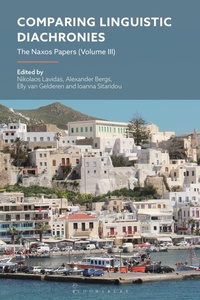
Comparing Linguistic Diachronies
The Naxos Papers (Volume III)
Will be published approx. on 11. December 2025
Book
Hardback
176 pages
978-1-350-51633-5 (ISBN)
Description
This volume presents eight case studies examining diachronic linguistics and language contact, as well as different aspects of language change.
The chapters cover a variety of topics and consider the relationship between historical data and linguistic theory. They also examine the diachronic development of linguistic characteristics in different levels of linguistic analysis including historical morpho-syntax, historical phonology, historical pragmatics and historical sociolinguistics. The authors propose modern methodologies of analyzing and explaining the diachronic development of various morpho-phonological and morpho-syntactic characteristics. Focusing on common directions of change in different languages, including English, Gothic, Ancient Greek, Eastern Indo-Aryan and Hebrew, they provide explanations that reveal the role of internal factors as well as of language contact.
The volume promotes a dialogue between traditional approaches to language change and modern approaches utilizing new, statistical methodologies. Through this type of dialogue, the volume enriches our knowledge of theoretical perspectives, tools and methods that can facilitate a contrastive analysis of the diachronic development of linguistic characteristics.
The chapters cover a variety of topics and consider the relationship between historical data and linguistic theory. They also examine the diachronic development of linguistic characteristics in different levels of linguistic analysis including historical morpho-syntax, historical phonology, historical pragmatics and historical sociolinguistics. The authors propose modern methodologies of analyzing and explaining the diachronic development of various morpho-phonological and morpho-syntactic characteristics. Focusing on common directions of change in different languages, including English, Gothic, Ancient Greek, Eastern Indo-Aryan and Hebrew, they provide explanations that reveal the role of internal factors as well as of language contact.
The volume promotes a dialogue between traditional approaches to language change and modern approaches utilizing new, statistical methodologies. Through this type of dialogue, the volume enriches our knowledge of theoretical perspectives, tools and methods that can facilitate a contrastive analysis of the diachronic development of linguistic characteristics.
Reviews / Votes
This book is a great testimony to the vibrant and inspirational Naxos summer school workshops. Using established methodologies but also testing new approaches to diachronic linguistics, the chapters showcase lesser-studied linguistic varieties and periods. From Goths to Greeks, the book will be of interest to advanced students and academics alike. * Joanna Kopaczyk-McPherson, Professor of Scots and English Philology, University of Glasgow, UK * This is a fascinating volume that touches on very important topics in historical linguistics. The reader will find studies on lexico-grammatical as well as on lexical change, and likewise several well-structured articles that highlight different aspects of language contact together with excellent analyses of their impact on language change. * Ljuba Veselinova, Professor of Linguistics, Stockholm University, Sweden * This book offers a valuable and thought-provoking contribution to the study of diachronic linguistics, with a particular focus on the role of language contact in explaining linguistic change over time. Using modern methodologies, both emerging and established researchers reflect on the various directions in which languages such as Ancient Greek, Hebrew, Gothic, and English have evolved. * Dr. Maria Isabel Jimenez, Universidad Autonoma de Madrid, Spain *More details
Language
English
Place of publication
London
United Kingdom
Publishing group
Bloomsbury Publishing PLC
Target group
College/higher education
Illustrations
7 bw illus
Dimensions
Height: 240 mm
Width: 161 mm
Thickness: 14 mm
Weight
440 gr
ISBN-13
978-1-350-51633-5 (9781350516335)
Copyright in bibliographic data and cover images is held by Nielsen Book Services Limited or by the publishers or by their respective licensors: all rights reserved.
Schweitzer Classification
Persons
Nikolaos Lavidas is Associate Professor of Diachronic Linguistics at the University of Athens, Greece.
Alexander Bergs is Full Professor and Chair of English Language and Linguistics at the University of Osnabrueck, Germany.
Elly van Gelderen is Regents' Professor Emeritus in English, Linguistics and Applied Linguistics at Arizona State University, USA.
Ioanna Sitaridou is Professor of Spanish and Historical Linguistics at the University of Cambridge, UK.
Alexander Bergs is Full Professor and Chair of English Language and Linguistics at the University of Osnabrueck, Germany.
Elly van Gelderen is Regents' Professor Emeritus in English, Linguistics and Applied Linguistics at Arizona State University, USA.
Ioanna Sitaridou is Professor of Spanish and Historical Linguistics at the University of Cambridge, UK.
Content
List of Figures
List of Tables
List of Contributors
Acknowledgements
1. Introduction, Nikolaos Lavidas (National and Kapodistrian University of Athens, Greece), Alexander Bergs (Osnabrueck University, Germany), Elly van Gelderen (Arizona State University, USA) and Ioanna Sitaridou (University of Cambridge, UK)
Part I: Comparing the Diachronies of Grammar
2. Negative 'Might' and 'Easy' Shifts in Hebrew, Bar Avineri (Ben Gurion University of the Negev, Israel)
3. The Verbs of Grief and Fear in the Ancient Greek Tragedy Plays and Oratory Speeches, Anastasia Tsiropina (National and Kapodistrian University of Athens, Greece)
Part II: Comparing Diachronies and Different Settings of Language Contact
4. Code Switching in English Merchants' Writings: The Johnson Correspondence, Carmela Perta (Universita degli Studi 'G. d'Annunzio' Chieti --- Pescara, Italy)
5. At the Morphological-Syntactic Crossroads: Unveiling the Forces Shaping Neuter Assignment in Heptanesian Borrowing from Italo-Romance, Vassiliki Makri (National and Kapodistrian University of Athens, Greece)
6. The Influence of Greek on the Gothic Verbal Morpho-Syntax: Comparing Cross-Linguistic Evidence on Written Contact in the Pauline Epistles to the Corinthians, Sofia Chionidi (National and Kapodistrian University of Athens, Greece)
Index
List of Tables
List of Contributors
Acknowledgements
1. Introduction, Nikolaos Lavidas (National and Kapodistrian University of Athens, Greece), Alexander Bergs (Osnabrueck University, Germany), Elly van Gelderen (Arizona State University, USA) and Ioanna Sitaridou (University of Cambridge, UK)
Part I: Comparing the Diachronies of Grammar
2. Negative 'Might' and 'Easy' Shifts in Hebrew, Bar Avineri (Ben Gurion University of the Negev, Israel)
3. The Verbs of Grief and Fear in the Ancient Greek Tragedy Plays and Oratory Speeches, Anastasia Tsiropina (National and Kapodistrian University of Athens, Greece)
Part II: Comparing Diachronies and Different Settings of Language Contact
4. Code Switching in English Merchants' Writings: The Johnson Correspondence, Carmela Perta (Universita degli Studi 'G. d'Annunzio' Chieti --- Pescara, Italy)
5. At the Morphological-Syntactic Crossroads: Unveiling the Forces Shaping Neuter Assignment in Heptanesian Borrowing from Italo-Romance, Vassiliki Makri (National and Kapodistrian University of Athens, Greece)
6. The Influence of Greek on the Gothic Verbal Morpho-Syntax: Comparing Cross-Linguistic Evidence on Written Contact in the Pauline Epistles to the Corinthians, Sofia Chionidi (National and Kapodistrian University of Athens, Greece)
Index